Richard Ford - The Sportswriter
Здесь есть возможность читать онлайн «Richard Ford - The Sportswriter» весь текст электронной книги совершенно бесплатно (целиком полную версию без сокращений). В некоторых случаях можно слушать аудио, скачать через торрент в формате fb2 и присутствует краткое содержание. Год выпуска: 1995, Издательство: Vintage Books, Жанр: Современная проза, на английском языке. Описание произведения, (предисловие) а так же отзывы посетителей доступны на портале библиотеки ЛибКат.
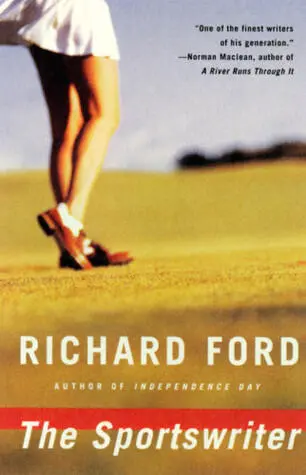
- Название:The Sportswriter
- Автор:
- Издательство:Vintage Books
- Жанр:
- Год:1995
- ISBN:нет данных
- Рейтинг книги:3 / 5. Голосов: 1
-
Избранное:Добавить в избранное
- Отзывы:
-
Ваша оценка:
The Sportswriter: краткое содержание, описание и аннотация
Предлагаем к чтению аннотацию, описание, краткое содержание или предисловие (зависит от того, что написал сам автор книги «The Sportswriter»). Если вы не нашли необходимую информацию о книге — напишите в комментариях, мы постараемся отыскать её.
The Sportswriter — читать онлайн бесплатно полную книгу (весь текст) целиком
Ниже представлен текст книги, разбитый по страницам. Система сохранения места последней прочитанной страницы, позволяет с удобством читать онлайн бесплатно книгу «The Sportswriter», без необходимости каждый раз заново искать на чём Вы остановились. Поставьте закладку, и сможете в любой момент перейти на страницу, на которой закончили чтение.
Интервал:
Закладка:
For some reason Herb seems to be having a hard time making his head be still. It’s wandering all around. “You couldn’t really like sports, Frank,” he says. “You don’t look like a guy who likes sports.”
“I like some better than others.” It is not that uncommon a question, really.
“But wouldn’t you rather talk about something else?” Herb shakes his big head, still wondrous. “What about Winslow Homer?”
“I’d talk to you about him, Herb. Any time. Writing about something is a lot different from doing the thing itself. Does that clear anything up?” For some reason my diaphragm, or its vicinity, feels like it is quaking again.
“Pretty interesting, Frank.” Herb nods at me with genuine admiration. “I’m not sure it explains a goddamn thing, but it’s interesting. I’ll give you that.”
“It’s pretty hard to explain your own life, Herb.” I’m sure my quaking is visible, though maybe not to Herb, for whom the whole world might quake all the time. He’s still having trouble keeping his head stationary. “I think I’ve said enough. I’m supposed to be asking you questions.”
“I’m a verb, Frank. Verbs don’t answer questions.”
“Don’t think that way, Herb.” My diaphragm is crackling. Herb and I have not been together an hour, but there is a strong sense around him that he would like to strangle someone , and not be choosy whose neck he got his hands on. When you have spent so much of your life whamming into people and hurting them, it must be hard just to call a halt to it and sit down. It must be hard to do anything else, it seems to me, but keep oil whamming. In any case, I’m always most at ease when I know the way out. There is something to be avoided here, and I intend to avoid it. “I’m going to try to write a good story, Herb,” I say, inching toward the back of Smallwood’s Checker.
Clarice Wallagher has stepped out onto the front stoop and stands watching us. She calls Herb’s name and smiles wearily. This must happen to everyone: meetings ending in stunned silences out front; a waiting cab; Herb proclaiming himself a verb. My greatest admiration is her’s. I’d hoped to have a word with her on the subject of Herb’s heroism-in-life, but that has gone past us. I simply hope there is a consolation for her late on dark nights.
“Herb,” Clarice says in a pretty voice that cracks on the cold Michigan wind.
“Okay!” Herb shouts heroically. “Gotta go, Frank, gotta go. You oughta write my life story. You’d make six figures.” We shake hands, and once again Herb tries to jerk me to my knees. There is an odd smell on Herb now, a metallic smell that is the odor of his chair. His cheek is bleeding from where he peeled off the paper. “I wanted you to see some old game films before you left. I could put the kebosh on ’em, Frank. Don’t let this chair fool ya.”
“We’ll do it next time, Herb, that’s a promise.”
Mr. Smallwood starts his cab with a loud whooshing and drops it into drive so that the body bucks half a foot forward.
“I don’t know what happens sometimes, Frank.” Herb’s sad blue eyes suddenly fill with hot tears, and he shakes his big head to dash them away. It is the sadness of elusive life glimpsed and unfairly lost, and the following, lifelong contest with bitter facts. Pity, in other words, for himself, and as justly earned as a game ball. Only I do not want to feel it and won’t. It is too close to regret to play fast and loose with. And the only thing worse than terrible regret is unearned terrible regret. And for that reason I will not bend to it, will, in fact, go on to the bottom with my own ship.
I take four quick steps back. “I’m glad I met you, Herb.”
Herb stares at me, his face distorted by unhappiness. “Yeah sure,” he says.
And I am into the boxy, musty backseat of Mr. Smallwood’s Checker, and we shush off down Glacier Way without even so much as a goodbye to Clarice, leaving Herb sitting in the empty street, in his chair, waving goodbye to our tail lights, his sad face astream with helpless and literal tears.
7
Mr. Smallwood is the best possible confederate for my circumstances.
“You look like you could use a pick-me-up,” he says, once we are going, and hands back a bottle half out of its flimsy paper bag. I drink down a good gulp that makes me flubber my lips — it is peppermint and sweet as cough syrup, but I’m happy to have it in me, and take a second big gulp. “You musta had you a time,” Mr. Smallwood says as we hiss past the remnants of a long, charred building on the landward side of the lakefront road. A dismembered line of cabins stands opposite. The big building was once a Quonset hut with a barn built on behind, though snow is piled on its blackened interior timbers, one of which is a long bar. Grass has grown up. No one, apparently, has thought to find a new use for the land. My past in decomposition and trivial disarray.
“These peoples out here’re crazy,” Mr. Smallwood announces widely, steering chauffer-style with one huge hand on the plastic steering knob, the other stretched over the seat back. “Sur-burban peoples, I’m tellin you. Houses full of guns, everybody mad all the time. Oughta cool out, if you ask me. I ain’t been out here in years, couldn’t even figure out which street was which. I used to come out here all the time.” We pull up onto the expressway back toward Big D, invisible now in mossy green clouds that tell of snow and possibly a marooning storm. “Look here now.” Mr. Smallwood catches my eye in the rearview and leans backwards in his driver’s seat for a speculative stretch. “How much money you got?”
“Why?”
“Well, for a hundred dollars I could make a phone call up here at a gas station and the first thing you know, somebody be done made you feel a whole lot better.” Mr. Smallwood grins a big happy grin at the back seat, and I think for a moment about a hundred dollar whore, the kindness she might bring, like the pharmacy sending over an expensive prescription to get you through a rough night. A trip to the hot springs. Something wordless to patch the tissue of innocent words that holds life in its most positive attitude. Too much serious talk and self-explanation and you’re a goner.
What Herb needs, of course, and can’t have, is to strap on a set of pads and beat the daylights out of somebody and quit worrying about theories of art. He is a man without a sport, when a sport is exactly what he needs. With better luck we might’ve summoned up a vi vider memory of his playing days, seen the game films. Herb could get back within himself, shake off alienation and dreary doubt, and play through pain — be the inspiration he was put on earth to be.
I tell Mr. Smallwood no thanks, and he chuckles in a mirthful-derisive way. Then for a while we wind back toward town without speaking, taking the Lodge this time since the snow is off and the traffic gone north, leaving the expressway gray and wintry.
Across from Tiger Stadium, Mr. Smallwood stops at a liquor store owned, he says, by his brother-in-law, a little Fort Knox of steel mesh and heavy bullet-proof glass. Across the avenue the big stadium hulks up white and lifeless. A message on its marquee says simply, “Sorry Folks. Have a Good One.”
Mr. Smallwood ambles across and buys another pint bottle of schnapps, which I insist on paying for, and he and I treat ourselves to a warm elevation of spirits on the short trip down to the Pontchartrain. He says he is a Tiger fan and that he believes it’s time for a dynasty. He also tells me that his parents moved up from Magnolia, Arkansas, in the Forties, and that for a while he attended Wayne State before he got married and went to work at Dodge Main. He quit that last year, he says, a jump ahead of the lay-offs, and bought his taxi. And he is happy to name his own hours now and to go home every day at noon for lunch with his wife and to rest an hour before getting back onto the street for the afternoon rush. Someday he hopes to retire to Arkansas. He doesn’t ask me about myself, either too courteous or too engaged in his own interesting life of work and discretionary time. His is a nice life, a life that would be easy to envy if you didn’t have one just as good. I calculate him to be not much older than I am.
Читать дальшеИнтервал:
Закладка:
Похожие книги на «The Sportswriter»
Представляем Вашему вниманию похожие книги на «The Sportswriter» списком для выбора. Мы отобрали схожую по названию и смыслу литературу в надежде предоставить читателям больше вариантов отыскать новые, интересные, ещё непрочитанные произведения.

Обсуждение, отзывы о книге «The Sportswriter» и просто собственные мнения читателей. Оставьте ваши комментарии, напишите, что Вы думаете о произведении, его смысле или главных героях. Укажите что конкретно понравилось, а что нет, и почему Вы так считаете.