Richard Ford - Independence Day
Здесь есть возможность читать онлайн «Richard Ford - Independence Day» весь текст электронной книги совершенно бесплатно (целиком полную версию без сокращений). В некоторых случаях можно слушать аудио, скачать через торрент в формате fb2 и присутствует краткое содержание. Год выпуска: 1996, Издательство: Vintage, Жанр: Современная проза, на английском языке. Описание произведения, (предисловие) а так же отзывы посетителей доступны на портале библиотеки ЛибКат.
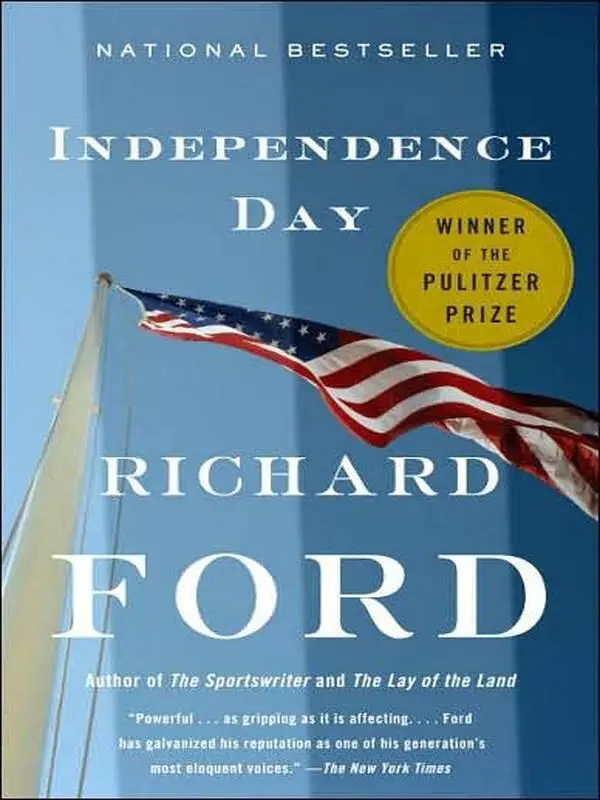
- Название:Independence Day
- Автор:
- Издательство:Vintage
- Жанр:
- Год:1996
- ISBN:нет данных
- Рейтинг книги:3 / 5. Голосов: 1
-
Избранное:Добавить в избранное
- Отзывы:
-
Ваша оценка:
Independence Day: краткое содержание, описание и аннотация
Предлагаем к чтению аннотацию, описание, краткое содержание или предисловие (зависит от того, что написал сам автор книги «Independence Day»). Если вы не нашли необходимую информацию о книге — напишите в комментариях, мы постараемся отыскать её.
, Richard Ford deepens his portrait of one of the most unforgettable characters in American fiction, and in so doing gives us an indelible portrait of America. Frank Bascombe, in the aftermath of his divorce and the ruin of his career, has entered an "Existence Period," selling real estate in Haddam, New Jersey, and mastering the high-wire act of normalcy. But over one Fourth of July weekend, Frank is called into sudden, bewildering engagement with life.
is a moving, peerlessly funny odyssey through America and through the layered consciousness of one of its most compelling literary incarnations, conducted by a novelist of astonishing empathy and perception.
Independence Day — читать онлайн бесплатно полную книгу (весь текст) целиком
Ниже представлен текст книги, разбитый по страницам. Система сохранения места последней прочитанной страницы, позволяет с удобством читать онлайн бесплатно книгу «Independence Day», без необходимости каждый раз заново искать на чём Вы остановились. Поставьте закладку, и сможете в любой момент перейти на страницу, на которой закончили чтение.
Интервал:
Закладка:
But neither am I in the same “place” emotion-wise as ten minutes ago, nor am I exactly used to women with their tits on such nautical display. And I’m now no longer looking forward to being hauled through the door of the Tunnicliff — a place I can all too perfectly picture — and filling the slot as one of “Char’s guys from the inn” while the locals grab off their nightly geeze at those hogans, while writing me off as the doofus I am.
“All right, Mr. Pleasure Unit, you ready to roll? Or are you still reading the instructions?” Char’s new eyelashes bat closed and open, her small hazel eyes roguishly fixing me. “What’s wrong with your eyes? You been in here crying? Is that what I’m getting into?”
“I looked at a book and got dust in my eyes,” I say ludicrously.
“I didn’t know anybody ever read those books. I thought they were just to make the room look cozy.” She surveys the shelves, unimpressed. “Jeremy buys ’em by the metric ton from some recycler up in Albany.” She sniffs, detecting some of the cinnamon redolence. “Pew. P-U,” she says. “Smells like an old folks’ home at Christmas in here. I’m in need of a Black Velvet.” She fires me off a challenging smile. A smile with a future.
“Great!” I say, thinking I’d feel better if I could just take a walk by myself down to the soggy lakeshore and hear the tinkly, liquid sounds of faceless, nameless others enjoying themselves gaily in long, red-walled rooms lit by crystal chandeliers. Not much to ask.
But I can’t back out on something as unfreighted as a simple walk and a drink, especially since it’s me did the asking. Canceling will make me out to be a weepy, cringing nutcase who can’t go a step without scuttling back three for fear and shame.
“Maybe I’ll just have to break down and cook you a fried-egg sandwich à la Charlane. Since you’re so starved.” She’s moving toward the front screen, her hard butt encased in denim like a rodeo wrangler’s, her thighs chunky and taut.
“I should try to find my son eventually, I guess,” I mutter not quite loud enough to be heard, following onto the porch, where little town lights twinkle in through the trees.
“Say what?” Char gives me a head-cocked look. We’re in the solid porch darkness here now.
“My son Paul’s here with me,” I say. “We’re going to the Hall of Fame in the morning.”
“Did you leave Mom at home this time?” She rolls her tongue around inside her cheek again. She has heard a warning signal.
“In a sense I did. I’m not married to her anymore.”
“So who are you married to?”
“Nobody.”
“And where’s your son gone?” She glances out around at the dark lawn, as if he’s there. She runs a finger under her tank top strap, attempting to seem noncommittal. I sniff apple perfume again. That would have to go.
“I don’t know where he is,” I say, trying to sound both at ease and concerned. “He sort of took off when we got here. I had a nap.”
“When was this?”
“I guess five-thirty or a quarter to six. I’m sure he’ll be coming back pretty soon.” I’ve lost all heart for everything now — a walk, the Tunnicliff, a drink, oeufs à la Charlane . Though my failure is a part of human mystery I understand, even have sympathy for. “I should maybe stick around here. So he can find me.” I smile cravenly at her in the darkness.
Out on the highway a dark car rumbles past, its windows open or its top down, loud rock music blaring and thumping through the silent trees. I can make out one scalding phrase only: “Get wet, go deep, take it all.” Paul could be there, in the act of disappearing forever, to be seen by me only on milk cartons or grocery store bulletin boards: “Paul Bascombe, 2–8-73, last seen near Baseball Hall of Fame, 7–2-88.” It is not a relaxing thought.
“Well, whatever stokes your flame the hottest, I guess,” Charlane says, already I hope thinking of something else. “I gotta take off, though.” She’s leaving down the steps right away, concluding I’m more trouble than I’m worth, though also probably embarrassed for me.
“Do you have any children?” I say just to say something.
“Oh yeah,” she says, and half turns back.
“Where’s he right now?” I say. “Or she. Or they?”
“He’s at wilderness survival.”
I hear a faint cry then, a woman’s high-pitched voice, brief and ululating, from somewhere above. Char looks up and around, a little smile crossing her lips. “Somebody’s enjoying her fireworks early.”
“What’s your son learning to survive?” I say, trying not to think about the Ohioans right above us. Char and I are descending back through the stages of familiarity and in a minute will once again be unknown to each other.
She sighs. “He’s with his dad, who lives out in Montana in a tent or a cave someplace. I don’t know. I guess they’re surviving each other.”
“I’m sure you’re a great mom,” I say, apropos of nothing.
“Eastern religion,” she says in a wise-cracky voice. “Motherhood’s as close as I come to it.” She raises her small nose toward the warm, spruce-scented air and sniffs. “I smelled a lilac just then, but it’s too late for lilacs. Musta been somebody’s perfume.” She squints down hard at me as though I’ve suddenly moved far, far away and am moving farther (which I am). It’s a friendly squint, full of sympathy, and makes me want to come down off the porch and give her a bustly hug, but which would only confuse matters. “I assume you’ll find your son,” she says. “Or he’ll find you. Whatever.”
“We will,” I say, holding my ground. “Thanks.”
“Yep,” Char says, and then, as though she’s embarrassed by something else, adds, “They don’t usually stay gone long. Not long enough, really.” Then she hikes off into the trees alone, gone out of sight well before I can manage an audible good-bye.
Très amusant,” a voice familiar to me speaks out of the summer’s wicking darkness. “Très, très amusant . Your most important sexual organ is between your ears. Eeeck, eeeck, eeeck. So use it.”
Down the porch, in the last rocking chair in line, Paul is slouched barely visible behind his drawn-up knees, his The Rock shirt giving out the only light hereabouts. He’s been overhearing my cumbersome parting, no doubt wondering if I’ll get around to finding our dinner.
“Howz ur health?” I say, walking down the line of rockers, laying a palm on the smooth spindled back of his and giving it a small, fatherly push.
“Fine ‘n’ yours?”
“Is that Dr. Rection’s anatomy advice?” I am, God knows, full of airy relief he’s not departed for Chicago or the Bay Area in the blaring-music car, or not off getting his ashes perilously hauled, or, worse, stretched out in the Cooperstown ER with a wound drip-drip-dripping on the tiles, waiting for some old turkey-neck GP, woozy from the Tunnicliff, to shake his head clear. (If I intend to have him home with me, I’ll need to be more vigilant.)
“Was that my new mom?”
“Almost. Did you eat anything?”
“I got a mocktail, some mock turtle soup and a piece of mock apple pie. Don’t mock me, please.” These are all holdovers from childhood. If I could see his face, it would be worked into a look of secret satisfaction. He seems, however, completely calm. I might be making progress with him and not realizing it (every parent’s dearest hope).
“Do you want to call your mother and say you got here safely?”
“Ix-nay.” He’s tossing a little Hacky Sack up and down in the dark, barely making movement but suggesting he’s less calm than seems. I have an aversion to Hacky Sacks. My view is that its skills are perfect only for the sort of brain-dead delinquents who whonked me in the head on my way home from work this spring and sent me sprawling. I understand from it, though, that Paul may have made a connection with the towny kids on the corner.
Читать дальшеИнтервал:
Закладка:
Похожие книги на «Independence Day»
Представляем Вашему вниманию похожие книги на «Independence Day» списком для выбора. Мы отобрали схожую по названию и смыслу литературу в надежде предоставить читателям больше вариантов отыскать новые, интересные, ещё непрочитанные произведения.

Обсуждение, отзывы о книге «Independence Day» и просто собственные мнения читателей. Оставьте ваши комментарии, напишите, что Вы думаете о произведении, его смысле или главных героях. Укажите что конкретно понравилось, а что нет, и почему Вы так считаете.