Richard Ford - Independence Day
Здесь есть возможность читать онлайн «Richard Ford - Independence Day» весь текст электронной книги совершенно бесплатно (целиком полную версию без сокращений). В некоторых случаях можно слушать аудио, скачать через торрент в формате fb2 и присутствует краткое содержание. Год выпуска: 1996, Издательство: Vintage, Жанр: Современная проза, на английском языке. Описание произведения, (предисловие) а так же отзывы посетителей доступны на портале библиотеки ЛибКат.
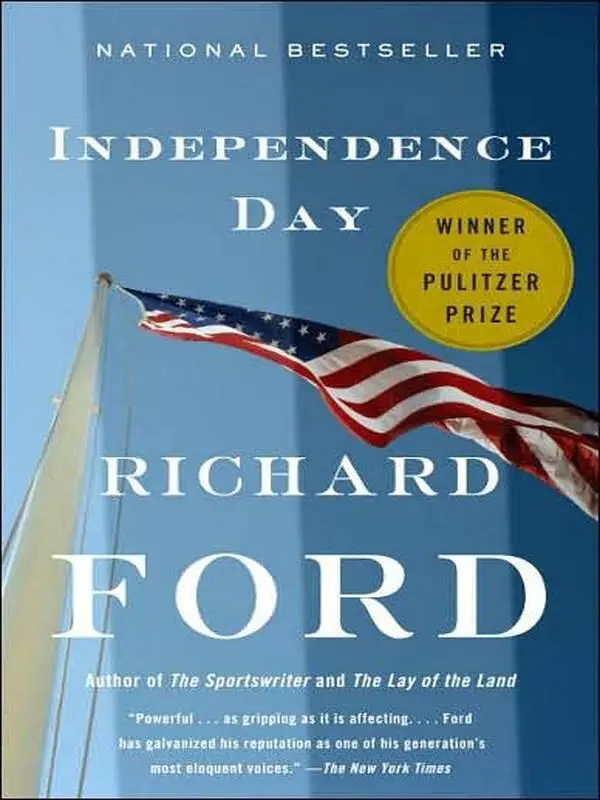
- Название:Independence Day
- Автор:
- Издательство:Vintage
- Жанр:
- Год:1996
- ISBN:нет данных
- Рейтинг книги:3 / 5. Голосов: 1
-
Избранное:Добавить в избранное
- Отзывы:
-
Ваша оценка:
Independence Day: краткое содержание, описание и аннотация
Предлагаем к чтению аннотацию, описание, краткое содержание или предисловие (зависит от того, что написал сам автор книги «Independence Day»). Если вы не нашли необходимую информацию о книге — напишите в комментариях, мы постараемся отыскать её.
, Richard Ford deepens his portrait of one of the most unforgettable characters in American fiction, and in so doing gives us an indelible portrait of America. Frank Bascombe, in the aftermath of his divorce and the ruin of his career, has entered an "Existence Period," selling real estate in Haddam, New Jersey, and mastering the high-wire act of normalcy. But over one Fourth of July weekend, Frank is called into sudden, bewildering engagement with life.
is a moving, peerlessly funny odyssey through America and through the layered consciousness of one of its most compelling literary incarnations, conducted by a novelist of astonishing empathy and perception.
Independence Day — читать онлайн бесплатно полную книгу (весь текст) целиком
Ниже представлен текст книги, разбитый по страницам. Система сохранения места последней прочитанной страницы, позволяет с удобством читать онлайн бесплатно книгу «Independence Day», без необходимости каждый раз заново искать на чём Вы остановились. Поставьте закладку, и сможете в любой момент перейти на страницу, на которой закончили чтение.
Интервал:
Закладка:
And yet I cart the book over to one of the red-shaded lamps, full of unexpected thrill. The boxful that I own, shipped to Haddam when the book was remaindered, was left in the attic on Hoving Road, untouched since its arrival and of no more interest to me than a box of clothes that no longer fit.
But this book, this specimen , sparks interest — since it is after all still “out there,” in circulation, still official if somewhat compromised, still striving to the purposes I meant it to: staging raids on the inarticulate, being an ax for the frozen sea within us, providing the satisfactions of belief in the general mess of imprecision. (Nothing’s wrong with high-flown purposes, then or now.)
A cake of fine house dust covers the top, so it’s clear none of tonight’s Clue players has had it down for pre-bedtime sampling. The old binding makes a dry-leaves crackle as I open it back. Pages at the front, I see, are yellow and water-stained, whereas those in the middle are milky, smooth and untouched. I take a look at the aforementioned author photo, a black-and-white taken by my then-girlfriend, Dale McIver: again a young man, though this time with a completely unwarranted confidence etched in his skinny mouth, ludicrously holding a beer and smoking a cigarette (!), an empty sun-lit (possibly Mexican) barroom and tables behind, staring fixedly at the camera as though he meant to say: “Yep, you just about have to live out here on the wild margins to get this puppy done the way God intended. And you probably couldn’t hack it, if you want to know the gospel.” And I, of course, couldn’t hack it; chose, in fact, a much easier puppy on a much less wild margin.
Though I’m not displeased to view myself thus — fore and aft, as it were, on my own book, two sides of the issue; not queasy in the hollow of my empty stomach where most of life-that-might’ve-been finally comes to rest. I carried that sandpaper regret around in me for a time back in 1970, then simply omitted it the way I’d have Paul omit the nightmares and dreads of his child’s life stolen away by bad luck and unconscionable adults. Forget, forget, forget.
Nor is this the first time I’ve happened onto my book blind: church book sales, sidewalk tables in Gotham, yard sales in unlikely midwestern cities, one rain-soaked night on top of a trash can behind the Haddam Public Library, where I was groping around in the dark to find the after-hours drop-off. And once, to my dismay, in a friend’s house shortly after he’d blown his brains out, though I never thought my book played a part. Once published, a book never strays so far from its author.
But without thinking a thought about its absolute worth, I intend to put my book in Char’s hands the moment she arrives and to speak the words I can’t now wait to speak: “Who do you think wrote this , that I found right here on the shelf below Natty Bumppo’s portrait and hard by the J. F. Coopers?” (My two likenesses will be my proof.) And not that it’ll have any important favorable effect on her. But for me , finding it still in “use” is high on the manifest of writerly thrills longed for — along with seeing someone you don’t know hungrily reading your book on an overland bus in Turkey; or noticing your book on the shelf behind the moderator on Meet the Press next to The Wealth of Nations and Giants in the Earth; or seeing your book on a list of overlooked American masterpieces compiled by former insiders in the Kennedy administration. (None of these has been my good luck yet.)
I blow the dust off and run my finger over the page ends to uncover the original red stain, then flip to the front and survey the contents page, twelve little titles, each as serious as a eulogy: “Words to Die By,” “The Camel’s Nose,” “Epitaph,” “Night Wing,” “Waiting Offshore,” all the way down to the title story — considered my “chance” at something to expand into a novel and thereby break me into the big time.
The book doesn’t in fact seem ever to have been opened (only rained on). I turn past the dedication—“To My Parents” (who else?) — back to the title page, ready to greet crisp “Frank Bascombe,” “Blue Autumn” and “1969,” set out in sturdy, easy-on-the-eyeball Ehrhardt, and to feel the old synchronicity extend to me in the here and now. Except what my eye finds, scrawled over the title page in blue, and in a hand I don’t know, is: “For Esther, remembering that really bleu autumn with you. Love ya, Dwayne. Spring, 1970,” every bit of which has been x-ed through with a smeary lipstick and below it written: “Dwayne. Rhymes with pain. Rhymes with fuck. Rhymes with the biggest mistake of my life. With contempt for you and your cheap tricks. Esther. Winter, 1972.” A big red smooch has been plastered on the page below Esther’s signature, and this connected by an arrow to the words “My Ass,” also in lipstick. This is a good deal different — by virtue of being a great deal less — than what I’d expected.
But what I feel, dizzily, is not wry, bittersweet, ain’t-life-strange amusement at poor Dwayne and Esther’s hot flame gone smoking under the waves, but a totally unexpected, sickening void opening right in my stomach — right where I said it wouldn’t two minutes ago.
Ann, and the end of Ann and me and everything associated with us, comes fuming up in my nostrils suddenly like a thick poison and in a way it never has even in my darkest seven-year despairings, or in the grim aftermath of my periodic revivals of hope. And instead of bellowing like a gored Cyclops, what I instinctively do is whap my book shut and sling it side-arm whirligig across the room, where it smacks the brown wall, knocks loose a crust of Florida-shaped plaster and hits the floor in the crumbles and dust. (Many fates befall books other than being read and treasured.)
The chasm (and what else is it?) between our long-ago time and this very moment suddenly makes yawningly clear that all is now done and done for; as though she was never that she, me never that me, as though the two of us had never embarked on a life that would lead to this queer librarial moment (though we did). And rather than being against all odds, it’s in precise accordance with the odds: that life would lead to here or someplace just as lonely and spiritless, no less likely than for Dwayne and fiery, heartbroke Esther, our doubles in love. Gone in a hiss and fizzle. (Though if it weren’t that tears had just sprung stinging to my eyes, I’d accept my loss with dignity. Since after all I’m the man who counsels abandonment of those precious things you remember but can no longer make hopeful use of.)
I drag my wrist across my cheeks and dab my eyes with my shirtfront. Someone, I sense, is coming from somewhere in the house, and I hustle over, snake up my book, refit its cover, flatten the pages I’ve busted and carry it back to its coffin slot, where it can sleep for twenty more years — this just as Char appears at the front door, looks out, then sees me standing here like a teary immigrant and saunters in smelling of cigarettes and appley sweetness applied just on the off chance I might be the guy to buy her that condo.
And Char is not the Char of ten minutes ago. She’s dressed now in some shrunk-tight jeans with red cowboy boots, a concha belt, a sleeveless black tank top that reveals strong, round, bare athletic shoulders and the breasts I’ve already envisioned (now in much plainer view). She has done “something” to her eyes, and also to her hair, which has made it frizzier. There’s rose color in her cheeks, and what seems like glistening lubricant on her lips, so that she’s recognizable from when she was a chef, but only just. Though to me she’s not nearly as comely as in her boxy whites, when less of her was in view.
Читать дальшеИнтервал:
Закладка:
Похожие книги на «Independence Day»
Представляем Вашему вниманию похожие книги на «Independence Day» списком для выбора. Мы отобрали схожую по названию и смыслу литературу в надежде предоставить читателям больше вариантов отыскать новые, интересные, ещё непрочитанные произведения.
Обсуждение, отзывы о книге «Independence Day» и просто собственные мнения читателей. Оставьте ваши комментарии, напишите, что Вы думаете о произведении, его смысле или главных героях. Укажите что конкретно понравилось, а что нет, и почему Вы так считаете.