Richard Ford - Independence Day
Здесь есть возможность читать онлайн «Richard Ford - Independence Day» весь текст электронной книги совершенно бесплатно (целиком полную версию без сокращений). В некоторых случаях можно слушать аудио, скачать через торрент в формате fb2 и присутствует краткое содержание. Год выпуска: 1996, Издательство: Vintage, Жанр: Современная проза, на английском языке. Описание произведения, (предисловие) а так же отзывы посетителей доступны на портале библиотеки ЛибКат.
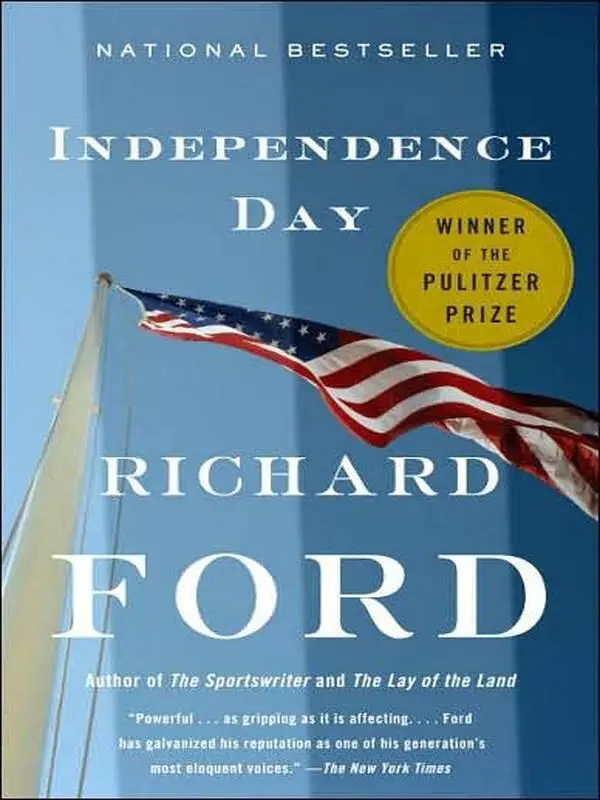
- Название:Independence Day
- Автор:
- Издательство:Vintage
- Жанр:
- Год:1996
- ISBN:нет данных
- Рейтинг книги:3 / 5. Голосов: 1
-
Избранное:Добавить в избранное
- Отзывы:
-
Ваша оценка:
Independence Day: краткое содержание, описание и аннотация
Предлагаем к чтению аннотацию, описание, краткое содержание или предисловие (зависит от того, что написал сам автор книги «Independence Day»). Если вы не нашли необходимую информацию о книге — напишите в комментариях, мы постараемся отыскать её.
, Richard Ford deepens his portrait of one of the most unforgettable characters in American fiction, and in so doing gives us an indelible portrait of America. Frank Bascombe, in the aftermath of his divorce and the ruin of his career, has entered an "Existence Period," selling real estate in Haddam, New Jersey, and mastering the high-wire act of normalcy. But over one Fourth of July weekend, Frank is called into sudden, bewildering engagement with life.
is a moving, peerlessly funny odyssey through America and through the layered consciousness of one of its most compelling literary incarnations, conducted by a novelist of astonishing empathy and perception.
Independence Day — читать онлайн бесплатно полную книгу (весь текст) целиком
Ниже представлен текст книги, разбитый по страницам. Система сохранения места последней прочитанной страницы, позволяет с удобством читать онлайн бесплатно книгу «Independence Day», без необходимости каждый раз заново искать на чём Вы остановились. Поставьте закладку, и сможете в любой момент перейти на страницу, на которой закончили чтение.
Интервал:
Закладка:
“If we didn’t get more interesting,” I said, happy to belabor a moot point, “all the other crap we put up with in life might drive us right out of it.”
“Us Baptists don’t believe that, now,” she said, flinging her arm across my chest and jamming her hard chin into my bare ribs. “What’s his name — Aristotle — Aristotle canceled his class today. He got sick of hearing his own voice and couldn’t make it.”
“I don’t have anything to teach you,” I said, thrilled as usual.
“That’s not wrong,” Clair said. “I’m not going to keep you that long anyway. You’ll start to get boring on me, start repeating yourself. I’ll be right out of here.”
Which was not very different from what happened.
One March morning I showed up at the office early (my usual) to type an offer sheet for a presentation later that day. Clair had nearly finished her classes to get her realtor’s certification and was at her desk, studying. She was never at ease addressing private-life matters in the office setting, yet as soon as I sat down she got up, wearing a little peach-colored skirt-and-sweater combo and red high heels, came right over to my desk by the front window, took a seat and said very matter-of-factly that she had met a man that week, bond lawyer McSweeny, whom she’d decided to start “dating,” and therefore had decided to stop “dating” me.
I remember being perfectly dazed: first, by her altogether firing-squad certainty; and then by how damned unhappy the whole prospect made me. I smiled, though, and nodded as if I’d been thinking along those lines myself (I definitely hadn’t) and told her that in my view she was probably doing the right thing, then went on smiling more disingenuously, until my cheeks ached.
She said she’d finally talked to her mother about me, and her mother had immediately told her, in what Clair said were actually “crude” terms, to get as far away from me as possible (I’m sure it wasn’t my age), even if it meant spending her nights home alone or moving away from Haddam or finding another job in another city — which I said was too strong a medicine. I would just obligingly step aside, hope she was happy and feel lucky to have had the time with her I’d had, though I told her I didn’t think we’d done anything but what men and women had done to and for each other through the ages. My saying this clearly made her aggravated. (She was not well practiced at being argued with, either.) So that I just finally shut up about it and grinned at her again like a half-wit, as a way of saying (I guessed) good-bye.
Why I didn’t protest, I’m not exactly sure, since I was stung, and surprisingly near to the heart, and spent days afterward tinkering with convoluted futuristic scenarios in which life would’ve been goddamned tough but that sheer off-the-map novelty and unlikelihood might’ve proved the final missing ingredients to true and abiding love — in which case she’d sacrificed to convention a type of mountaintop victory reserved for only the brave and enlightened few. It’s, however, undoubtedly true that my idyll with permanence was entirely founded on Clair’s being a total impossibility, which means she was finally never more than a featured player in some Existence Period melodrama of my own devising (nothing to be proud of, but not radically different from my cameo in her short life).
After our abrupt sayonara she returned to her desk, resumed studying her realty books — and with this new state of affairs in effect, we stayed on at our desks for another whole hour and a half, doing work! Our colleagues arrived and departed. We both entered into amused, even jocular, conversations with several different individuals. I once asked her about the disposition of a bank foreclosure, and she answered me as equably and cheerfully as you would expect in any well-run office bent on profit. Neither one of us said anything else of moment, and I eventually finished my offer sheet, made a couple of cold client calls, did part of a crossword, wrote a letter, put on my coat and wandered around in it for a few minutes, wisecracking with Shax Murphy, and finally just wandered out and down to the Coffee Spot, after which I did not come back — all the while (I suppose) Clair stayed at her desk, concentrating like a cleric. And basically that was that.
In short order she and lawyer McSweeny became a nice, viable, single-race item in town. (Though she began treating me, in my view, with unneeded correctness in the office, which became, of course, the only place I ever saw her.) Everybody agreed the two of them were lucky to find each other when attractive members of their race were scarce as diamonds. Predictable difficulties came up to prevent their speedy marriage: Ed’s grasping grown kids caused a ruckus about Clair’s age and financial situation (Ed, naturally, is my age, and loaded). Clair’s ex-husband, Vernell, declared Chapter 11 in Canoga Park and tried to reopen their divorce decree. Clair’s grandmother died in Mobile, her mother broke her hip, her younger brother got put in jail — the usual wearisome inventory of life’s encroachments. In the long run it all would’ve worked out, with Clair and Ed married to the tune of a clearly worded prenuptial agreement. Clair would’ve moved into Ed’s big late Victorian out on Cromwell Lane, would’ve had a flower garden and a nicer car than a Honda Civic. Her two kids would’ve grown to like going to school with white children and in time forgotten there was a difference. She would’ve gone on selling condos and gotten better at it. Ed’s grown children would’ve finally accepted her for the true-hearted, straight-talking, slightly overcertain girl she was, and not as just some hick gold-panner they needed to sic their own lawyers on. She and Ed, in time, would have enjoyed a somewhat isolated suburban existence, with a few but not many people regularly over for dinner, and even fewer close friends — a life spent with each other in a way most people would pay money to know how to pull off but can’t because their days are too full of rich opportunity they just can’t say no to.
Except that one spring afternoon Clair happened out to Pheasant Meadow and in an entirely professional way got trapped in a bad situation and ended up as dead as the Mormon traveler in the body bag down in room 15.
And as I lie in bed here, still alive myself, the Fedders blowing brisk, chemically cooled breezes across my sheets, I try to find solace against the way this memory and the night’s events make me feel, which is: bracketed, limbo’d, unable to budge, as illustrated amply by Mr. Tanks and me standing side by side in the murderous night, unable to strike a spark, utter a convincingly encouraging word to the other, be of assistance, shout halloo, dip a wing; unable at the sad passage of another human to the barren beyond to share a hope for the future. Whereas, had we but been able, our spirits might’ve lightened.
Death, veteran of death that I am, seems so near now, so plentiful, so oh-so-drastic and significant, that it scares me witless. Though in a few hours I’ll embark with my son upon the other tack, the hopeful, life-affirming, anti-nullity one, armed only with words and myself to build a case, and nothing half as dramatic and persuasive as a black body bag, or lost memories of lost love.
Suddenly my heart again goes bangety-bang, bangety-bangety-bang, as if I myself were about to exit life in a hurry. And if I could, I would spring up, switch on the light, dial someone and shout right down into the hard little receiver, “It’s okay. I got away. It was goddamned close, I’ll tell ya. It didn’t get me, though. I smelled its breath, saw its red eyes in the dark, shining. A clammy hand touched mine. But I made it. I survived. Wait for me. Wait for me. Not that much is left to do.” Only there’s no one. No one here or anywhere near to say any of this to. And I’m sorry, sorry, sorry, sorry, sorry.
Читать дальшеИнтервал:
Закладка:
Похожие книги на «Independence Day»
Представляем Вашему вниманию похожие книги на «Independence Day» списком для выбора. Мы отобрали схожую по названию и смыслу литературу в надежде предоставить читателям больше вариантов отыскать новые, интересные, ещё непрочитанные произведения.






Обсуждение, отзывы о книге «Independence Day» и просто собственные мнения читателей. Оставьте ваши комментарии, напишите, что Вы думаете о произведении, его смысле или главных героях. Укажите что конкретно понравилось, а что нет, и почему Вы так считаете.