Richard Ford - Independence Day
Здесь есть возможность читать онлайн «Richard Ford - Independence Day» весь текст электронной книги совершенно бесплатно (целиком полную версию без сокращений). В некоторых случаях можно слушать аудио, скачать через торрент в формате fb2 и присутствует краткое содержание. Год выпуска: 1996, Издательство: Vintage, Жанр: Современная проза, на английском языке. Описание произведения, (предисловие) а так же отзывы посетителей доступны на портале библиотеки ЛибКат.
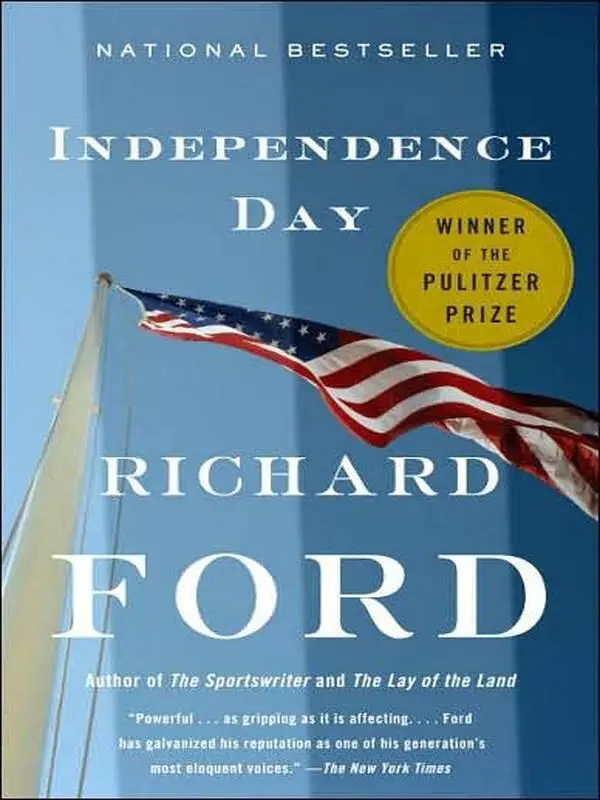
- Название:Independence Day
- Автор:
- Издательство:Vintage
- Жанр:
- Год:1996
- ISBN:нет данных
- Рейтинг книги:3 / 5. Голосов: 1
-
Избранное:Добавить в избранное
- Отзывы:
-
Ваша оценка:
Independence Day: краткое содержание, описание и аннотация
Предлагаем к чтению аннотацию, описание, краткое содержание или предисловие (зависит от того, что написал сам автор книги «Independence Day»). Если вы не нашли необходимую информацию о книге — напишите в комментариях, мы постараемся отыскать её.
, Richard Ford deepens his portrait of one of the most unforgettable characters in American fiction, and in so doing gives us an indelible portrait of America. Frank Bascombe, in the aftermath of his divorce and the ruin of his career, has entered an "Existence Period," selling real estate in Haddam, New Jersey, and mastering the high-wire act of normalcy. But over one Fourth of July weekend, Frank is called into sudden, bewildering engagement with life.
is a moving, peerlessly funny odyssey through America and through the layered consciousness of one of its most compelling literary incarnations, conducted by a novelist of astonishing empathy and perception.
Independence Day — читать онлайн бесплатно полную книгу (весь текст) целиком
Ниже представлен текст книги, разбитый по страницам. Система сохранения места последней прочитанной страницы, позволяет с удобством читать онлайн бесплатно книгу «Independence Day», без необходимости каждый раз заново искать на чём Вы остановились. Поставьте закладку, и сможете в любой момент перейти на страницу, на которой закончили чтение.
Интервал:
Закладка:
“I guess so. Or not.”
“I figured you guys was all crooks,” Mr. Tanks says as though talking about something else to someone else. “Like a used-car guy, only ‘cept with houses. Or burial insurance. Something like that.”
“Some people feel that way, I guess.” I’m thinking that we’re at this moment two feet away from my trunkful of realty signs, blank offer sheets, earnest money receipts, listing forms, prospect memos, PRICE REDUCED and SORRY, YOU MISSED IT stickers. Burglar’s tools, to Mr. Tanks. “Really, a main concern is avoiding misrepresentation. I wouldn’t want to do anything to you that I wouldn’t want done to me — at least as far as realty goes.” This did not come out sounding right (due to exhaustion).
“Hunh,” is all Mr. Tanks offers. Our time for bearing witness to life’s strangeness is nearly over.
Suddenly, at the end of the row of motel units, out the door of the lighted room we’ve been waiting a vigil over, come two uniformed local police, followed by the tough-nut detective, followed by a uniformed policewoman, holding the arm of the young blue-dressed wife who’s in turn holding the small hand of a tiny blond girl, who looks apprehensively all around in the dark and back behind her into the room she’s left, though suddenly, by dint of memory, she turns and looks up at ole Bugs, stuck to the window of the Suburban, leering his nutty brains out. She’s wearing neat little yellow shorts and tennies with white socks, and a hot-pink pullover that has a red heart on the front like a target. She is slightly knock-kneed. When she gazes around again and sees no one she recognizes, she fastens her eyes on Mr. Tanks as she’s led across the lot to an unmarked vehicle that will take her and her mother elsewhere, to some other Connecticut town, where a terrible-awful thing hasn’t happened. There, to sleep.
They have left their room standing open, the Whaler jammed with stealable gear somebody should see about locking up or storing. (This I would’ve waked up and worried about in the middle of the night back in 1984, even if it were my loved one who was killed.)
Though just as the young woman ducks into the dark car, she looks back at her room and at the Suburban and the Sea Breeze and then to the left at Mr. Tanks and me, her companions of a sort, watching her with distant compassion as she encounters grief and confusion and loss all alone and all at once. Her face comes up, light catches it so that I see the look of startlement on her fresh young features. It is her first scent, the first light-glimmer, that she’s no longer connected in the old manner of two hours ago but into some new network now, where caution is both substance and connector. (It is not so different from the look on the boy’s face who killed her husband.) I, of course, could connect with her — give a word or a look. But it would be only momentary, whereas caution is what she needs now, and what’s dawning. To learn a lesson of caution at a young age is not the worst thing.
Her face disappears into the squad car. The door closes hard, and in half of one minute they are all gone — the local boys in their Fairfield Sheriff’s cruiser, murmuring ahead, gumball flashing; the unmarked car with the policewoman driving — off in the direction opposite, where the ambulance has gone. Again, when they are all out of sight into the scrub-timber distance, a siren rises. They will not be back tonight.
“I bet they got their insurance paid up,” Mr. Tanks says. “Mormons. You know they’re paid up. Them people don’t let nothin’ slide.” He consults his wristwatch, sunk into his great arm. Time of day means nothing to him. I don’t know how he knows they were Mormons. “You know how to keep a Mormon from stealin’ your sandwich when you go fishin’, don’t you?”
“How?” It is an odd moment for a quip.
“Take another Mormon witchyou.” Mr. Tanks makes his deep-chested hunh noise again. This is his way of resolving the unresolvable.
I, though, have had it in mind — since his position on realtors is that we’re first cousins to odometer-spinning car dealers and burial plot scammers — to ask about his views on moving-van drivers. We hear plenty of adverse opinions of them in my business, where they’re generally considered the loose cannons of the removal industry. But I’m certain he wouldn’t have an opinion. I’d be surprised if Mr. Tanks practiced many analytical views of himself. He is no doubt happiest concentrating on whatever’s beyond his windshield. In this way he’s like a Vermonter.
In the thick trees behind the Sea Breeze I hear a dog barking, perhaps at the skunk, and somewhere else, faintly, a phone ringing. Mr. Tanks and I have not shared much, in spite of my wishing we could. We are, I’m afraid, not naturals for each other.
“I guess I’ll hit the hay,” I say as if the idea has just come to me. I offer Mr. Tanks a hopeful smile, which awards no closure, only its surface appeal.
“Talk about misinterpreted and not being misinterpreted.” Mr. Tanks still has in mind our conversation from before (a surprise).
“Right,” I say, not knowing what’s right.
“Maybe I’m gon’ come down there to New Jersey and buy a big house from you,” he announces imperially. I’m beginning to inch away toward my room.
“I wish you’d do that. That’d be great.”
“You got some expensive neighborhoods where they’ll let me park my truck?”
“That might take some time to find,” I say. “But we could work up something.” A ministorage up in Kendall Park, for instance.
“We could work on that, huh?” Mr. Tanks yawns a cavernous yawn and closes his eyes as he rolls his big furry head back in the moonlight.
“Absolutely. Where do you park in Alhambra?”
He turns, to notice I’m farther away now. “You got any niggers down there in your part of New Jersey?”
“Plenty of ’em,” I say.
Mr. Tanks looks at me steadily, and of course, even as sleepy as I am, I’m awfully sorry to have said that, yet have no way to yank the words back. I just stop, one foot up on the Sea Breeze walkway, and look helpless to the world and fate.
“’Cause I wouldn’t care to be the only pea in the pod down there, you understand?” Mr. Tanks seems earnestly if briefly to be considering a move, committing to a life in New Jersey, miles and miles from lonely Alhambra and lightless, glacial Michigan.
“I bet you’d be happy there,” I say meekly.
“Maybe I’ll have to call you up,” Mr. Tanks says. He, too, is walking away, striding off almost jauntily, his short beer-keg legs prized apart in his green spectator shorts but close together at the knees as if a rolling gait did not come easy for him, his big arms in motion despite his attaché case being mashed under one of them.
“That’d be great.” I need to give him my card so he can call me if he rumbles in late, finds no place to park and no one to be helpful. But he is already keying his way in. His room is three away from the murder scene. A light burns inside. And before I can call out and mention my card or say “Good night,” or say anything more, he has stepped inside his door and quickly closed it.
I n my Sea Breeze double, I run the a/c up to medium, get the lights off and myself into bed as fast as possible, praying for quick sleep, which seemed so overpowering ten minutes or an hour ago. The thought nags me that I should call Sally (who cares if it’s three-thirty? I have an important offer to make). But the phone here circuits through the Pakistani switchboard, and everyone there’s long asleep.
And then — and not for the first time today but for the first time since my talk with Ann on the turnpike — I think a worrisome, urgent-feeling thought for Paul, under siege at this minute by phantom and real-life woes, and a court date as his official rite of passage into life beyond parent and child. I could want for better. Though I could also want him to stop braining people with oarlocks and blithely stealing condoms and struggling with security guards, to stop grieving for dogs a decade dead, and barking the case for their return. Dr. Stopler says (arrogantly) he could be grieving the loss of whoever we hoped he would be. But I don’t know who that boy is or was (unless of course it’s his dead brother — which it isn’t). My wish has consistently been to strengthen the constitution of whoever he is whenever I meet him — though that is not always the same boy, and because I’m only a part-timer, possibly I have been insufficient at my job too. So that clearly I must do better, must adopt the view that my son needs what only I can supply (even if it’s not true) and then try for all I’m worth to imagine just what that something might be.
Читать дальшеИнтервал:
Закладка:
Похожие книги на «Independence Day»
Представляем Вашему вниманию похожие книги на «Independence Day» списком для выбора. Мы отобрали схожую по названию и смыслу литературу в надежде предоставить читателям больше вариантов отыскать новые, интересные, ещё непрочитанные произведения.











Обсуждение, отзывы о книге «Independence Day» и просто собственные мнения читателей. Оставьте ваши комментарии, напишите, что Вы думаете о произведении, его смысле или главных героях. Укажите что конкретно понравилось, а что нет, и почему Вы так считаете.