Adam Levin - The Instructions
Здесь есть возможность читать онлайн «Adam Levin - The Instructions» весь текст электронной книги совершенно бесплатно (целиком полную версию без сокращений). В некоторых случаях можно слушать аудио, скачать через торрент в формате fb2 и присутствует краткое содержание. Год выпуска: 2011, Издательство: Perseus Books Group, Жанр: Современная проза, на английском языке. Описание произведения, (предисловие) а так же отзывы посетителей доступны на портале библиотеки ЛибКат.
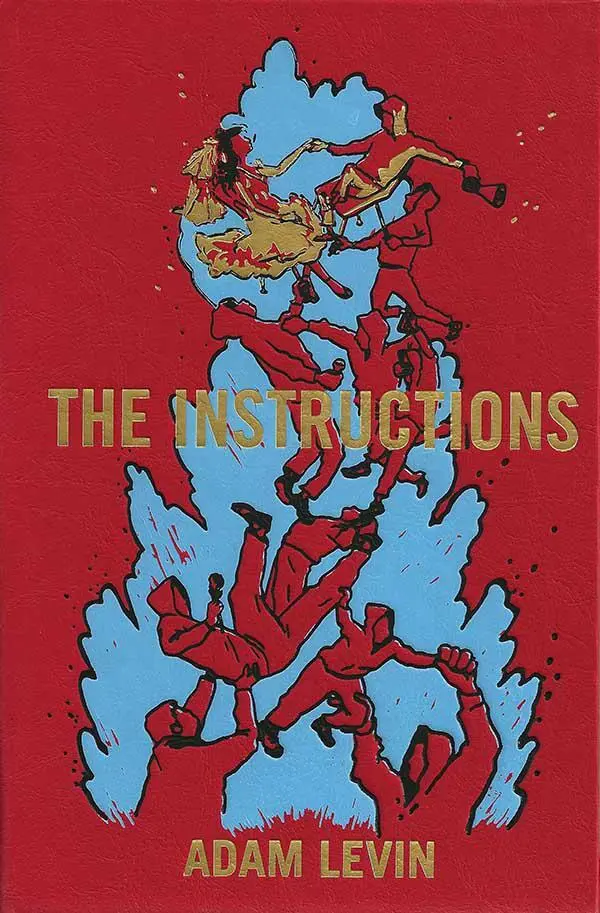
- Название:The Instructions
- Автор:
- Издательство:Perseus Books Group
- Жанр:
- Год:2011
- ISBN:нет данных
- Рейтинг книги:3 / 5. Голосов: 1
-
Избранное:Добавить в избранное
- Отзывы:
-
Ваша оценка:
The Instructions: краткое содержание, описание и аннотация
Предлагаем к чтению аннотацию, описание, краткое содержание или предисловие (зависит от того, что написал сам автор книги «The Instructions»). Если вы не нашли необходимую информацию о книге — напишите в комментариях, мы постараемся отыскать её.
The Instructions
The Instructions — читать онлайн бесплатно полную книгу (весь текст) целиком
Ниже представлен текст книги, разбитый по страницам. Система сохранения места последней прочитанной страницы, позволяет с удобством читать онлайн бесплатно книгу «The Instructions», без необходимости каждый раз заново искать на чём Вы остановились. Поставьте закладку, и сможете в любой момент перейти на страницу, на которой закончили чтение.
Интервал:
Закладка:
PRESENTATIONAL
During individual sessions, Gurion’s conversational style is highly animated — filled with much movement of the hands and face (I’m tempted to describe this animation, particularly that of the face, as being “caricatured,” but “caricatured” seems to imply a level of theatricality or falsity, when, in fact, I don’t believe that’s the case at all — rather, by using “caricatured,” if, that is, I were to settle on using “caricatured,” I would only mean to get across the “intensity” or “poignancy” of the facial expressions) that appears to seem almost caricaturey — and typically contains a number of humorous gambits, many of which I must admit I do not follow, although, I must also admit, I tend to laugh along with, as Gurion’s emotional state, whatever it may be at a given moment, is highly infectuous/contagious.
The infectuousness/contagiousness of Gurion’s emotional states is not only evidenced by my reaction to him, but by the reactions of his peers.
The parallel in Group Session to Gurion’s animation in Indiv. Session is an extremely labile affect. I have twice seen him, in a single instant, affectively leap from an almost-trance-looking state that could indicate anything from sleepiness to hostile disinterest, into a state of total emotional intensity, and then back again. These affective leaps have, both times, included postural, facial, vocal, and manual activity. On the first occasion, owing to what must have been a visual cue on the part of M.B., the boy Gurion would momentarily address (I was engaging another group member in eye-contact at the time, which prevented me from being able to see what the rest of the group was doing, and, added to that, I did not hear anything out of the ordinary, so I must assume it was a visual cue), Gurion stood up with such suddenness that his chair was forced into a backwards double-tumble, and, in a boxer’s crouch, one fist on guard, the other overhead with an extended index finger, he shouted, “Do not!” at M.B., who wept openly in response.
The second affective leap occurred during a session which had, I must admit, reached a chaotic peak that I could not for the life of me control, wherein all of the group members, except for Gurion and a mentally retarded boy (Williams Syndrome) who I’ll call S.M., traded swear-peppered insults and cross-talked without cease. S.M. appeared sad throughout the chaotic period, and often looked to Gurion, who, when he wasn’t engaging eye-contact back at S.M. in what appeared to be a gesture of comforting solidarity, stared fixedly at the ground. After about twenty minutes of the aforementioned group chaos, S.M. began to pray aloud, though too quietly for anyone to make out the words he was pronouncing, and it was at this point that Gurion ceased staring fixedly at the ground and leaned forward. I don’t believe I can describe the intensity of this leaning forward — I don’t believe I can describe what aspect of it communicated what it communicated, but what it communicated was a capacity, and even a willingness, to paste the walls of my office with the bones and organs of anyone other than S.M. who dared continue making noise. (And I should note, here, that I am not attempting to sensationalize or to startle you, Professor Lakey, with that kind of imagery, but to produce a reproduction of actual events: at that moment [whatever it may say about me as a person or a therapist], I actually thought to myself, “Sandy! Pay attention to S.M., or Gurion will make a paste of your bones and your organs with which he will cover the walls of your office.”) Within moments, the other group members had ceased riotously acting out in their various ways and given their total attention to S.M. At the conclusion of his prayer (which, once it had been rendered audible by our silence, proved itself to be melodically familiar, however in another, completely unfamiliar language), S.M. sang “She Said, She Said” by the Beatles (S.M.’s singing voice is angelic), and at the conclusion of the song, Gurion applauded S.M., as did the other, formerly chaos-making group members, and then fell back into staring fixedly at the ground, as did the other, formerly chaos-making group members. They would not speak, not any of them, for the session’s remaining ten minutes.
PEERS, FRIENDS
Though he is not, at the time of this assessment’s writing, generally well-liked by other students in the Cage program, Gurion is offered a wide social berth by his peers (I have never seen him sanctioned for any of his behavior), and, more often than not, it is the case that, as the saying goes, “all eyes are on this kid.”
Other than all of them being Cage students at least two years his senior, the few friends at Aptakisic who Gurion has acquired do not share any notable similarities; their personality traits vary greatly, as do the forms taken by their acting-out behaviors. Nonetheless, the few who Gurion considers to be his friends share a group identity. It is unclear whether they are aware of this group identity, but other students respond to it, as do teachers. In fact, the Cage Monitor, Victor Botha, even has a name for the group, a name, albeit, that he only uses in the teachers lounge, but a name nonetheless, and one that has caught on among some of the other teachers (though they, as well, only use it in the teachers lounge). Victor Botha calls the group Spooky and The Spastics. For obvious reasons, I find this name offensive, and prefer to the think of the group as the Maccabeean Collective. The Collective’s roster is outlined below:
The aforementioned S.M.
L.R., a selectively mute African-American boy (I only mention his racio-ethnicity because, apart from Gurion — who, as we’ve seen, denies the affiliation — L.R. is the sole African-American student at Aptakisic).
V.P., a short-tempered and often violent boy who has been, unlike Gurion (see below, under Diagnoses) correctly diagnosed with Conduct Disorder.
J.R., a girl who, apart from a tendency to become overexcited when she is interested in the subject matter at hand, along with a kind of verbal ferocity when placed in competitive situations or situations wherein an authority figure seems vulnerable, as well as a tendency to bite people who stand “too close” to her, is a quiet, attentive, and, if I may be permitted to say so in an academic essay such as this one, very sweet girl.
J.M., a girl who has been diagnosed with Pica, OCD, and ADHD (again, accurately), who often engages in physical confrontations with other students — mostly boys — and who, curiously enough, all but refuses to participate in one-on-one conversations, but becomes quite loud and communicative when faced with a peer-group of 2+. (J.M., like Gurion and all the others listed, with the exception of B.N. [description forthcoming], is in the open therapy group I lead, and I have noticed that she only enters conversations that are in progress.)
Sixthly, finally, B.N., a very — for lack of better terms— troubled and angry boy; the son of an alcoholic single mother who neglects and (we suspect [he refuses to speak against her]) physically abuses him, and who has already been (B.N, I mean) through the juvenile justice system for having committed arson on a local residence at the age of ten; fights incessantly (is recognized by many of his peers as the “toughest” boy at Aptakisic); has been diagnosed with ADHD (once more, accurately, I believe); who would, were it not for the efforts of Bonnie Wilkes, PsyD (who meets in Indiv. session with him [B.N.] regularly), have long since been permanently expelled from Aptakisic; and who Gurion sees as his only intellectual and masculine equal, and even (in certain senses that Gurion will go to great lengths to qualify) as his superior — Gurion looks up to B.N.
Читать дальшеИнтервал:
Закладка:
Похожие книги на «The Instructions»
Представляем Вашему вниманию похожие книги на «The Instructions» списком для выбора. Мы отобрали схожую по названию и смыслу литературу в надежде предоставить читателям больше вариантов отыскать новые, интересные, ещё непрочитанные произведения.











Обсуждение, отзывы о книге «The Instructions» и просто собственные мнения читателей. Оставьте ваши комментарии, напишите, что Вы думаете о произведении, его смысле или главных героях. Укажите что конкретно понравилось, а что нет, и почему Вы так считаете.