Adam Levin - The Instructions
Здесь есть возможность читать онлайн «Adam Levin - The Instructions» весь текст электронной книги совершенно бесплатно (целиком полную версию без сокращений). В некоторых случаях можно слушать аудио, скачать через торрент в формате fb2 и присутствует краткое содержание. Год выпуска: 2011, Издательство: Perseus Books Group, Жанр: Современная проза, на английском языке. Описание произведения, (предисловие) а так же отзывы посетителей доступны на портале библиотеки ЛибКат.
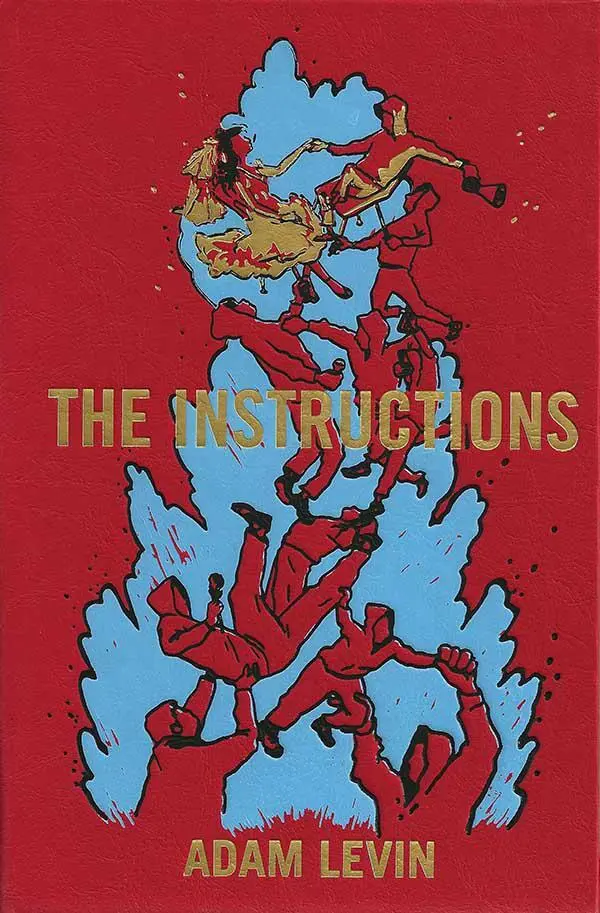
- Название:The Instructions
- Автор:
- Издательство:Perseus Books Group
- Жанр:
- Год:2011
- ISBN:нет данных
- Рейтинг книги:3 / 5. Голосов: 1
-
Избранное:Добавить в избранное
- Отзывы:
-
Ваша оценка:
The Instructions: краткое содержание, описание и аннотация
Предлагаем к чтению аннотацию, описание, краткое содержание или предисловие (зависит от того, что написал сам автор книги «The Instructions»). Если вы не нашли необходимую информацию о книге — напишите в комментариях, мы постараемся отыскать её.
The Instructions
The Instructions — читать онлайн бесплатно полную книгу (весь текст) целиком
Ниже представлен текст книги, разбитый по страницам. Система сохранения места последней прочитанной страницы, позволяет с удобством читать онлайн бесплатно книгу «The Instructions», без необходимости каждый раз заново искать на чём Вы остановились. Поставьте закладку, и сможете в любой момент перейти на страницу, на которой закончили чтение.
Интервал:
Закладка:
Samuel wanted to know when they’d receive the new scripture.
Solly wondered whether June had friends, or maybe sisters.
Shai asked what they should tell the other scholars about visiting me after Havdallah, and then Samuel asked Shai how he could fail to notice I’d risen from my chair and shown them my back.
Samuel had me wrong, though. Their reaction to the story had been perfect, the reaction I’d’ve wanted most from anyone, and it made me feel artful — in describing the moments leading up to the conversion, I’d skipped all mention of mine and June’s birthmarks. So the reason I’d risen was to go to the sink, to scrub the makeup from my thumbs and reveal the yuds, not doubting for a second that my mom would understand. These were the last four brothers in the world who’d trample me.
Yet as they rose from their own chairs, apologizing for outstaying their welcome, expressing their gratitude for my “patience and hospitality in the midst of upsetting events” (Emmanuel), assuring me and each other that I’d answered enough of their questions for one day, “the longest day I’ve ever heard of outside Irish literature” (Samuel), I saw they were right — not right that I felt stretched or put out by their visit, but right that I’d already said enough.
One time, at the Frontier, Flowers and I watched this show about pets where a dog did the moonwalk when its owner held its elbows. It was so weird and funny it got all over the web. Within a couple days, someone CGI’d the owner out and gave the dog a hat it doffed with a diamond-studded paw. We agreed the doctored video wasn’t as funny as the original — it wasn’t really funny at all — except I didn’t get why til Flowers explained it. He said, “Gild the lily, the stem collapse.”
It was the right explanation. And if faith and trust worked anything like comedy, which I suspected they did — I suspected most good things did — then the reason I wanted to show the scholars the yuds could just as easily be a reason not to show them the yuds. That is: They already believed June was an Israelite, and they believed it because I told them she was. So while the revelation of my birthmarks, which aspired to hard evidence, might strengthen that belief, it might also insult their intelligence, damage their faith, and thereby endanger (structurally and otherwise) the integrity of the stem from which their trust blossomed.
I followed them out of the kitchen without a word or a gesture. It is true they were mistaken about outstaying their welcome — their visit made me feel much better, kept me from staring into my head at my falling father’s image, or at least from ceaselessly doing so — but it was, nonetheless, still time for them to go, time now to stare at that image excessively, to work myself up to interrogate my dad. I was angry at him, but not angry enough, and it was already 8:00, he’d have to come home soon. Plus, the later the scholars stayed, the more likely it got that they’d be interrogated. I knew they’d never fink on me or each other, but silence could get them grounded too, yet if I told them that, they’d only say grounding was a small price to pay, then attempt to stick around to prove that they meant it. Better if they thought they’d overstayed their welcome.
I have to make some decisions, I told them, but I’ll send word before Shabbos on what’s to come. Tell everyone we know to lay low til then.
All of them but Emmanuel were bundled. He’d gotten everything on except for his boots, then sat on the floor to attempt doomed contortions. Unable to reach past his knees, he rose and shed his entire wooly bulk — overcoat, pullover, hat, scarf, and gloves — then sat back down and pulled on the boots, the laces of which kept slipping from his fingers. The others, in the meantime, overheated. Shifting their weight from foot to foot, they tucked their toplips and extended their bottom ones to aim huffy air at their darkening foreheads.
“Go ahead,” Emmanuel told them.
“We’re fine,” said Samuel. “Just hurry.”
“No, really,” said Emmanuel, “I have to stop at the pharmacy anyway.”
“For what?” Shai said.
“You don’t ask for what when it’s the pharmacy,” said Samuel.
“Why not?” said Shai.
“Because maybe he’s got a fungus or the runs,” offered Solly.
“Do you have a fungus or the runs?” said Shai to Emmanuel.
“You don’t ask that, Shai,” said Samuel.
“I bet Solly’s right, though. Look how silent Emmanuel’s being suddenly. He’s almost as silent as Solly,” said Shai. “We’ve come to expect that from Solly, silence, but silence we don’t readily associate with Emmanuel. It might be he’s been suffering all along. Suffering in silence. An uncharacteristic silence indicative of a medical unpleasantness. We’re all among friends, though, and what’s a fungus among friends? Who hasn’t had the runs? I’ve had the runs, we’ve all had the runs. You know what it is that my dad calls the runs? It’s the trots, what he calls them. My dad calls the runs the trots.”
“My dad calls you ‘that shvontz with the gums,’ so let’s go already,” said Samuel.
“What’s wrong with my gums?”
“Nothing, you shvontz.”
“Then why’s your dad specify the gums if it’s nothing?”
“ Specify . He doesn’t even know who you are.”
“But I see him all the time.”
“You’re not memorable, Shai.”
“What’s wrong with my gums?”
“I’m telling you I made it up.”
“Why, though? Why’d you say ‘with the gums’?”
“It was the first thing that came to mind.”
“But why was it the first thing that came to mind?”
“Probably I was looking at your gums.”
“What’s wrong with my gums, you look at them?”
“You’re crazy.”
“Maybe you’re crazy, Samuel. Did you ever think of that? Maybe you can’t stop looking at my gums.”
“Now that you mention it, my eyes are drawn to them,” said Samuel. “What is it about them, I wonder, that draws my eyes?”
“Stop messing with me.”
“No,” said Samuel. “Before, I was messing with you. Now I’m thinking: you got a lot of gums. They’re…”
“What? No. You’re messing with me. No. What? They’re what?”
“Meaty.”
“Meaty?”
“You got a lot of gums, Shai.”
Shai looked to Solly. Solly looked away.
“What?” Shai said. “They’re meaty?”
I missed you guys, I said.
“We missed you, too,” said Shai.
“You know, you’re thick sometimes,” said Samuel. “The Rabbi already knows you missed him. That was his polite way of saying, ‘Go home.’”
“Well, I did miss him, though,” said Shai.
Emmanuel had yet to tie his second boot, and I saw that he was trying to linger. Samuel now saw too and, saying goodbye, he shouldered the others outside.
I pressed my spine against the doorframe, bracing to hear June’s conversion get questioned. Emmanuel put his hat on, took it off, stared at it. Maybe I’d overestimated my effect — my lily a sunflower, or even just a dandelion. He put the hat on again. Then he took it off again.
Nu? I said to him.
“This hiding,” he said. “That we’re supposed to ‘lay low.’ How you told us to tell the other scholars to ‘lay low’—it troubles me.”
I dropped to the floor beside him, pretended to give him a deadarm.
“What?” he said.
I thought you were gonna say something else, I said.
“Something having to do with June and your being in love with her and her so-called conversion, you thought.”
Yeah, I said.
“I might have. I might have unpacked the logics of love and Israelite conversion and then discussed your theory of potential messiahs as it relates to those logics. I might have said something like, ‘Gurion, if love is forever, and therefore what it means to be in love is that you stay in love forever, then one can never truly know if he is in love until the moment he dies. And yet you say you are in love with June.’ That might have been premise one. If I wanted to introduce premise two, I might have gone on to say, ‘Since all it means to be an Israelite is you have the soul of an Israelite, and the soul is eternal, and the soul from its creation is immutably Israelite or non-, then no one can truly convert; they have or haven’t been an Israelite all along, and therefore conversion ceremonies are only ceremonious. At best such ceremonies acknowledge a truth that requires no acknowledgment to be true— This Israelite is an Israelite —and at worst these ceremonies are but lying declarations— This non-Israelite is an Israelite . So if June is an Israelite, she has always been an Israelite, whether you or I or she believed it to be so, whether you or I or she currently believe it. And no matter what we say about it, either. Yet about it, you say, “June is an Israelite.” And in response, we say, “Amen.” And all of it is heartfelt.’
Читать дальшеИнтервал:
Закладка:
Похожие книги на «The Instructions»
Представляем Вашему вниманию похожие книги на «The Instructions» списком для выбора. Мы отобрали схожую по названию и смыслу литературу в надежде предоставить читателям больше вариантов отыскать новые, интересные, ещё непрочитанные произведения.






Обсуждение, отзывы о книге «The Instructions» и просто собственные мнения читателей. Оставьте ваши комментарии, напишите, что Вы думаете о произведении, его смысле или главных героях. Укажите что конкретно понравилось, а что нет, и почему Вы так считаете.