Adam Levin - The Instructions
Здесь есть возможность читать онлайн «Adam Levin - The Instructions» весь текст электронной книги совершенно бесплатно (целиком полную версию без сокращений). В некоторых случаях можно слушать аудио, скачать через торрент в формате fb2 и присутствует краткое содержание. Год выпуска: 2011, Издательство: Perseus Books Group, Жанр: Современная проза, на английском языке. Описание произведения, (предисловие) а так же отзывы посетителей доступны на портале библиотеки ЛибКат.
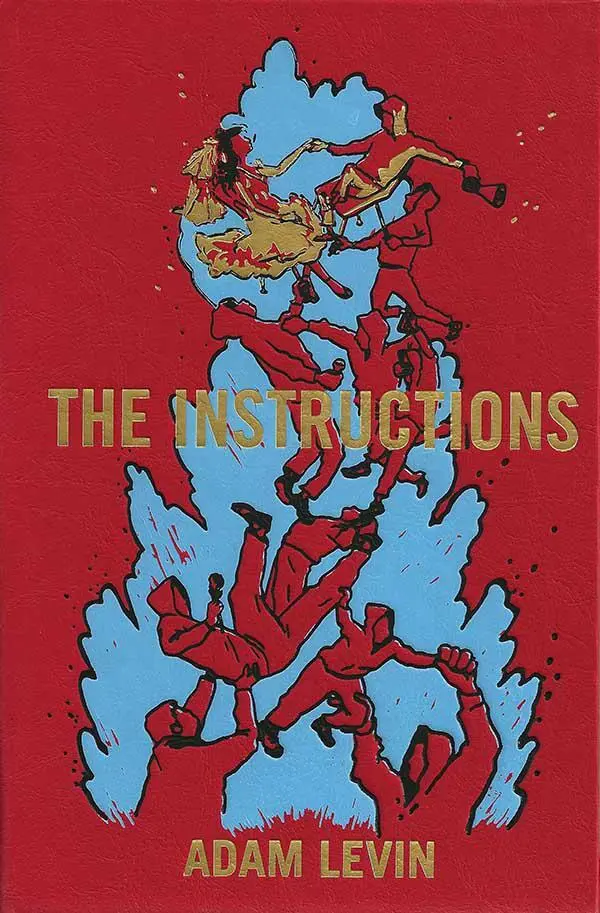
- Название:The Instructions
- Автор:
- Издательство:Perseus Books Group
- Жанр:
- Год:2011
- ISBN:нет данных
- Рейтинг книги:3 / 5. Голосов: 1
-
Избранное:Добавить в избранное
- Отзывы:
-
Ваша оценка:
The Instructions: краткое содержание, описание и аннотация
Предлагаем к чтению аннотацию, описание, краткое содержание или предисловие (зависит от того, что написал сам автор книги «The Instructions»). Если вы не нашли необходимую информацию о книге — напишите в комментариях, мы постараемся отыскать её.
The Instructions
The Instructions — читать онлайн бесплатно полную книгу (весь текст) целиком
Ниже представлен текст книги, разбитый по страницам. Система сохранения места последней прочитанной страницы, позволяет с удобством читать онлайн бесплатно книгу «The Instructions», без необходимости каждый раз заново искать на чём Вы остановились. Поставьте закладку, и сможете в любой момент перейти на страницу, на которой закончили чтение.
Интервал:
Закладка:
Even though, if not because, these three aspects of the conversation are so significant, others of no less significance tend to get overlooked. One is how Avraham says what he says, another when he says it. He enters the conversation like an accuser — raging, scornful, indignant above all — and he does so at a moment when a scholar would expect indignation to be the last thing he would feel. It was only three days earlier that Hashem told Avraham he would have the thing he wanted most in the world — a son with Sarah — and, for that reason, a scholar might expect Avraham to feel joyous; or, if not joyous, then maybe weak, for immediately after learning that Isaac would be born, Avraham circumsized himself, and the third post-operative day is known to be the most painful, more painful even than the bris itself. That Avraham would feel exhausted is another possibility. If neither weak with pain nor joyous with news of a son-to-be, then maybe, a scholar might think, Avraham would be exhausted by the tasks of dutiful hosting: only seconds before Hashem told him of His plans for Sodom, Avraham bade farewell to the angels Hashem sent to his tent to test his hospitality, a test he passed without complaint, despite the pain of the third day.
Then again, it is within the very same utterance of His plans for Sodom that Hashem reiterates His pledge to give Avraham a son with Sarah — more than a son, in fact. “Shall I conceal from Avraham what I do,” Hashem begins, “now that Avraham is surely to become a great and mighty nation, and all the nations of the earth shall bless themselves by him?” At which a scholar would expect Avraham to feel — if not in addition to joyous or weak or exhausted, then in place of those feelings — safe, protected; certainly not indignant.
Yet Avraham, once Hashem is through speaking, once the plans for Sodom have been laid out before him (“Because the outcry of Sodom and Gomorrah has become great, and because their sin has been very grave,” Hashem has just finished saying, “I will descend and see: If they act in accordance with its outcry which has come to Me — then destruction! And if not, I will know.”), Avraham does the most dangerous thing imaginable. He lashes out at the guarantor of his safety, raises his voice to challenge his protector. He yells at God.
“What if there should be fifty righteous people in the midst of Sodom?” says Avraham. “Would You still stamp it out rather than spare the place for the sake of the fifty righteous people within it? It would be sacrilege to You to do such a thing, to bring death upon the righteous along with the wicked. It would be sacrilege to You! Shall the judge of all the earth not do justice?”
And Hashem not only listens to Avraham — this brown old man shouting accusations in the desert, this defiant creation waving his fist — but attempts to appease him. And this makes a scholar wonder — or at least it should make a scholar wonder — if coming to Hashem full of rage is not sometimes (on those occasions when the scholar faces injustice, for example) a better idea than coming to Him full of praise. “If I find fifty righteous people in Sodom,” says Hashem, “I will spare the city on their account.”
And Avraham, though no longer as indignant, is nonetheless unappeased. “What if there are five fewer?” he says. “What if there are forty-five righteous people in Sodom?”
And Hashem says that for forty-five, he’ll spare the city. And Avraham continues to bargain. From forty-five to forty, forty to thirty, thirty to twenty, and then, says Avraham, “Let not my Lord be annoyed and I will speak but this once: What if ten should be found there?”
And Hashem says, “I will not destroy on account of the ten.”
The next line closes the chapter: “Hashem departed when He had finished speaking to Avraham, and Avraham returned to his place.”
When He had finished speaking: not when Avraham had finished speaking to Him; not when they had finished speaking to one another. “When He had finished speaking to Avraham” = “Avraham was not finished speaking.”
So what would Avraham have said, had Hashem not departed just then? It should be as obvious to scholars as it was to Hashem.
He would have said, “Five righteous men?” And if Hashem tried to appease him, he would have said, “Three righteous men?” And if Hashem agreed to three, he would have said, “And one?”
There are some scholars who will disagree with these assertions. Some scholars will argue that there is no way of knowing if I am right or wrong, no way to know if Avraham was as settled on the number ten as was Hashem. Some may even argue that the phrase prefacing Avraham’s last spoken sally of the argument, a phrase which, to me, reads as nothing more than an act of formal self-effacement that one who has just finished yelling indignantly at the Creator of the Universe would, on calming down a little bit, think wise to employ — some scholars might argue that “Let my Lord not be annoyed and I will speak but this once ” indicates that Avraham had no intention of continuing to bargain. And those scholars would have a point, just not a very significant one.
Whether or not Avraham was finished speaking, whether or not he ultimately did come to terms with Hashem, the last line of Genesis 18 contains the most significant aspect of the conversation that gets overlooked by scholars: the revelation of Hashem’s (if not also Avraham’s) final stance on collateral damage. Namely: that some collateral damage is acceptable.
And how much is some? How much collateral damage? At first, it seems easy to calculate: 9 parts per the population of Sodom. And scholars do have a rough idea of that population — between 600 and 1200. But then, on second thought, neither Avraham nor Hashem would speak of children as being righteous or wicked (until one comes of age, one’s behavior is attributed to one’s parents), so scholars must subtract the number of Sodomite males under the age of thirteen and Sodomite females under the age of twelve from the denominator. Scholars don’t know this number, but can assume, conservatively (in terms of allowable collateral damage), that the percentage of children in Sodom was equivalent to the percentage of children in Jordan today ≈ 40 %, which is relatively low for that region.
So the denominator (the estimated population of Sodom minus 40 % of itself) is somewhere between 360 and 720. The acceptable proportion of collateral damage, then, is somewhere between 9 parts per 360 and 9 parts per 720. Reduced to their greatest common denominators, these proportions become, respectively, 1 part per 40 and 1 part per 80.
In other words: If a scholar were to approach the issue of collateral damage as conservatively as possible, that scholar would conclude that to kill 1 righteous person in the course of killing 79 or more wicked ones is acceptable to Hashem. If, on the other hand, a scholar were to approach the issue of collateral damage as liberally as possible, that scholar would conclude that to kill 1 righteous person in the course of killing 39 or more wicked ones is acceptable to Hashem.
In either case, to say “Hashem treats the righteous with mercy” is omissive.
Hashem treats the righteous with mercy when it is cost-efficient.
His standards of cost-efficiency are the ones by which Israelites must strive to live. Therefore even those who play the numbers as loosely as possible cannot justify bringing a proportion of collateral damage that is greater than 2.5 % of the total damage brought. When death is the unit by which damage is measured (as seen above), these calculations are simple enough. When injury is the unit of measurement, however, it is a bit more complicated. How many righteous noses, for example, may be collaterally broken in the course of smashing 39 wicked femurs? Certainly more than one — a broken nose is little more than a flesh wound compared to a broken leg — but how many? And what is the acceptable ratio of crushed and righteous strong-side wrists to crushed and wicked weak-side ones? It is true that without the use of his left hand, David could not have sawn past the neckbone of Goliath of Gath, and so could not have hoisted high the massive head, but without the use of his right, he would never have even felled the giant.
Читать дальшеИнтервал:
Закладка:
Похожие книги на «The Instructions»
Представляем Вашему вниманию похожие книги на «The Instructions» списком для выбора. Мы отобрали схожую по названию и смыслу литературу в надежде предоставить читателям больше вариантов отыскать новые, интересные, ещё непрочитанные произведения.









Обсуждение, отзывы о книге «The Instructions» и просто собственные мнения читателей. Оставьте ваши комментарии, напишите, что Вы думаете о произведении, его смысле или главных героях. Укажите что конкретно понравилось, а что нет, и почему Вы так считаете.