Adam Levin - The Instructions
Здесь есть возможность читать онлайн «Adam Levin - The Instructions» весь текст электронной книги совершенно бесплатно (целиком полную версию без сокращений). В некоторых случаях можно слушать аудио, скачать через торрент в формате fb2 и присутствует краткое содержание. Год выпуска: 2011, Издательство: Perseus Books Group, Жанр: Современная проза, на английском языке. Описание произведения, (предисловие) а так же отзывы посетителей доступны на портале библиотеки ЛибКат.
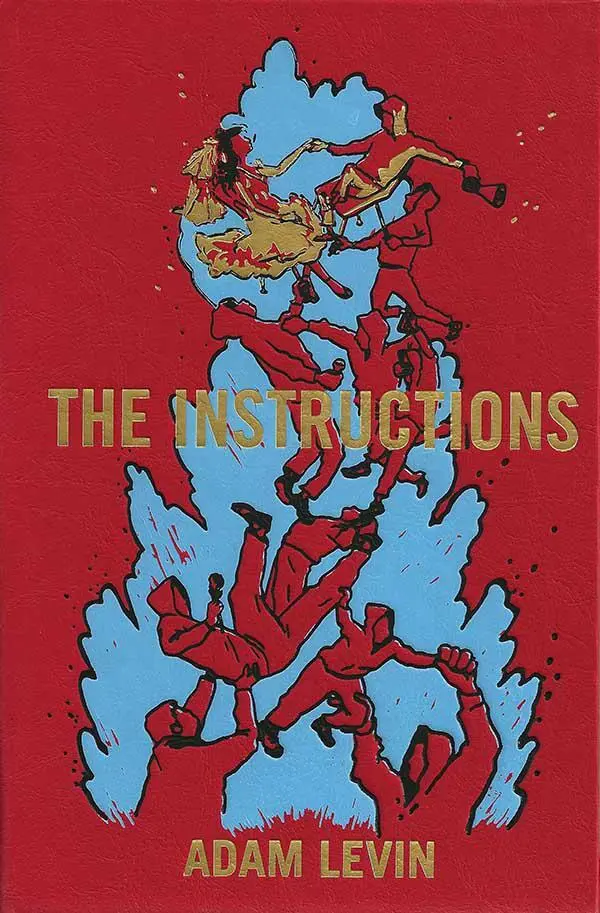
- Название:The Instructions
- Автор:
- Издательство:Perseus Books Group
- Жанр:
- Год:2011
- ISBN:нет данных
- Рейтинг книги:3 / 5. Голосов: 1
-
Избранное:Добавить в избранное
- Отзывы:
-
Ваша оценка:
The Instructions: краткое содержание, описание и аннотация
Предлагаем к чтению аннотацию, описание, краткое содержание или предисловие (зависит от того, что написал сам автор книги «The Instructions»). Если вы не нашли необходимую информацию о книге — напишите в комментариях, мы постараемся отыскать её.
The Instructions
The Instructions — читать онлайн бесплатно полную книгу (весь текст) целиком
Ниже представлен текст книги, разбитый по страницам. Система сохранения места последней прочитанной страницы, позволяет с удобством читать онлайн бесплатно книгу «The Instructions», без необходимости каждый раз заново искать на чём Вы остановились. Поставьте закладку, и сможете в любой момент перейти на страницу, на которой закончили чтение.
Интервал:
Закладка:
Fucker! I yelled at the clouds of yud.
And the clouds said nothing. They were only clouds, mute symbols at best.
I was a snatless wonder.
I didn’t want to fight Bam. I liked him. Even as I’d regained my feet and jumped to attack him, I’d liked him. Even as I hated to like him. Why did I have to like him? And why did he just hold me in the air like that? Was it mercy? Some scholars would argue it was mercy. They would argue that because he could’ve done any number of other things — any number of things that would have seriously damaged Gurion’s body — it was merciful of Bam Slokum to do nothing more than hold Gurion in the air, and that Gurion should therefore be grateful.
Other scholars would see it differently. Maybe Bam held Gurion in the air, they would suggest, because he thought that was the only way to keep his advantage. Maybe he thought that if he fell forward and broke Gurion’s back or damaged Gurion’s kidneys or lifted Gurion higher and dropped him on his head — maybe Slokum thought actions of that kind would incite Gurion’s friends to step in. Maybe he thought Nakamook, or Vincie, or the Side of Damage, though presently kept at bay by their fear of him, would be incited to rally against him if he actually damaged Gurion.
Or, would argue a third group of scholars, maybe Slokum just thought he’d get in trouble if he damaged Gurion. It could be Slokum knew that what he seemed to be doing, to the eyes of Brodsky and the teachers — if they were even watching — was stopping a fight = restraining Gurion = restoring order = separating the undesired prefix from the disArrangement. It is true that Gurion had been stopping that same fight himself, but Bam might not have known that; and even if he had known it, he could plausibly deny the knowledge as long as all he did was restrain Gurion, who few at Aptakisic would ever suspect of attempting to break up a fight.
But then again, maybe Bam knew that being held back helpless while otherwise able to function at full capacity was, ultimately, more humiliating than having that capacity beaten out of you with blows that broke bones and bruised organs. Maybe Bam, like the Cage, was just another fractal of the Arrangement, operating perfectly, in concentrated miniature, according to the central principles on which all its rules were based: The less violent the measures of restraint, the more humiliation those measures inflict on the restrained; the more humiliated the restrained, the less violent need be the measures to restrain them.
What would seem an act of mercy to some scholars would, to others, surely seem a quiet, snakey assertion of dominance, a prelude to enslavement.
But even if those latter scholars would be wrong and it was an act of mercy, who was Bam Slokum to show me mercy? And why should I consider the possibility that it was mercy? Wasn’t that a kind of weakness in itself? Giving him the benefit of the doubt? Why did I have to like him? Ever? But especially now? Why did I have to still like him? Why was I compelled to posit scholars who would come to his defense? Why did I have to play his apologist? Why couldn’t the story be that I used to like him, and then, after he’d humiliated me, I gave up on him and didn’t like him anymore? Why couldn’t I just feel disappointed and then betrayed and then get on with the vengeance or whatever it is you’re supposed to get on with when you’ve been disappointed and betrayed? I could never get disappointed at the appropriate time. I was always so late. It took me nine weeks to see Esther Salt’s shadiness, and it would have surely taken longer if I hadn’t fallen in love with June. And those scholars who had ditched me third period — why not call them enemies? Why resist? What was wrong with me? I wanted to damage someone, but I was the only one in the two-hill field’s valley and I wasn’t getting up.
I thought: You’ve been laid low. Pray.
But I didn’t think: You’ve been laid low by an enemy. Fight.
I thought: Stop thinking. Thinking only makes it worse.
But I didn’t think: Stop praying. Self-pity only makes it worse.
I should have been thinking those things I didn’t think, but instead I just laid there, tight-chested and pitiful, trying to make hearty the hollow Hebrew praise I found myself whispering in the direction of the same yud-shaped clouds I had cursed only moments earlier.
And then I heard jingling, and grass-blades getting crushed. And then there were knees, next to my face. Girl’s knees. June’s knees. Under the denim they were naked, freckled. I’d never seen them.
“Who are you talking to?” she said. “Get up. They’re about to take attendance.”
June, I said, don’t look at me. I just got defeated.
She said, “I know.”
You saw? I said.
“No,” she said. “I saw Benji Nakamook crying and I — nyee-yah!” She got a chill from the cold that rolled her shoulders. “Eee!” she said. “I saw Benji crying and I asked him why.”
Why didn’t he help me? I said.
“I think that’s why he was crying,” she said. “But get up, okay? If you don’t show for attendance, you’ll be in trouble.”
I said, I don’t care if I get in trouble.
“That’s fine for you,” she said, “but I care. If you get an OSS or expelled, then it’ll be hard for me to see you.”
I said, You’re gonna stop seeing me if I get in trouble?
“With my eyes,” she said. “If you’re not in school, it’ll be hard for me to see you with my eyes . What’s wrong with you? I told you I’d marry you. We’re engaged. Why would I break our engagement because you got in trouble? And why would you care, anyway? If I was the kind of person who would stop being engaged to you because you got in trouble, then I’d be a suck kind of person and you’d be better off without me, and we both know you wouldn’t be better off without me, so that means I’m not that kind of person. What I want is to make out with you a lot and crack jokes. I want to make out with you a lot after school today and crack jokes. If you get kicked out, how will we be able to do that?”
I followed her halfway up the high hill, where she spun around to face me, like she had something new and sudden to say.
The Side of Damage was just over the crest. Botha told them to quiet the nonsense and line up. I didn’t hear any nonsense that needed quieting. I heard Nakamook clicking his Zippo open and snapping it shut inside of his pocket, an action he’d sometimes perform to calm himself. A brittle elm bough was creaking behind us, adjusting in the wind. Someone played spastic percussion with a zipper. A fought yawn forced crackling from someone else’s jaw-joints. The sound forced me to yawn, then June to yawn, and me one more time, but otherwise I didn’t care about any of it. June was staring at me and she was letting me stare at her. She didn’t turn her head away when she yawned. She hid her mouth behind her wrist and her eyes got even wetter-looking.
She said, “You always look really alive. I want to draw you. Line up now, okay? Get counted.” She touched my hand, dashed over the hill.
As soon as she was out of sight, I remembered my defeat; limpness washed through my muscles. I got on my stomach and army-crawled to the crest.
Chin on the ground, my field of vision sliced into portions by hard, dead blades of grass, I looked down on the field full of lining-up students. Eliyahu and the Five were nowhere. Probably the same nowhere as Brodsky and Floyd. I couldn’t spot Maholtz, Co-Captain Baxter, or Shlomo either. Blonde Lonnie and Slokum stood in parallel attendance lines, low-voicing jokes. Boystar, ten yards away from them, kept shouting their names. When they’d revolve to see what he wanted, he’d turn his thumbs up.
Читать дальшеИнтервал:
Закладка:
Похожие книги на «The Instructions»
Представляем Вашему вниманию похожие книги на «The Instructions» списком для выбора. Мы отобрали схожую по названию и смыслу литературу в надежде предоставить читателям больше вариантов отыскать новые, интересные, ещё непрочитанные произведения.











Обсуждение, отзывы о книге «The Instructions» и просто собственные мнения читателей. Оставьте ваши комментарии, напишите, что Вы думаете о произведении, его смысле или главных героях. Укажите что конкретно понравилось, а что нет, и почему Вы так считаете.