Adam Levin - The Instructions
Здесь есть возможность читать онлайн «Adam Levin - The Instructions» весь текст электронной книги совершенно бесплатно (целиком полную версию без сокращений). В некоторых случаях можно слушать аудио, скачать через торрент в формате fb2 и присутствует краткое содержание. Год выпуска: 2011, Издательство: Perseus Books Group, Жанр: Современная проза, на английском языке. Описание произведения, (предисловие) а так же отзывы посетителей доступны на портале библиотеки ЛибКат.
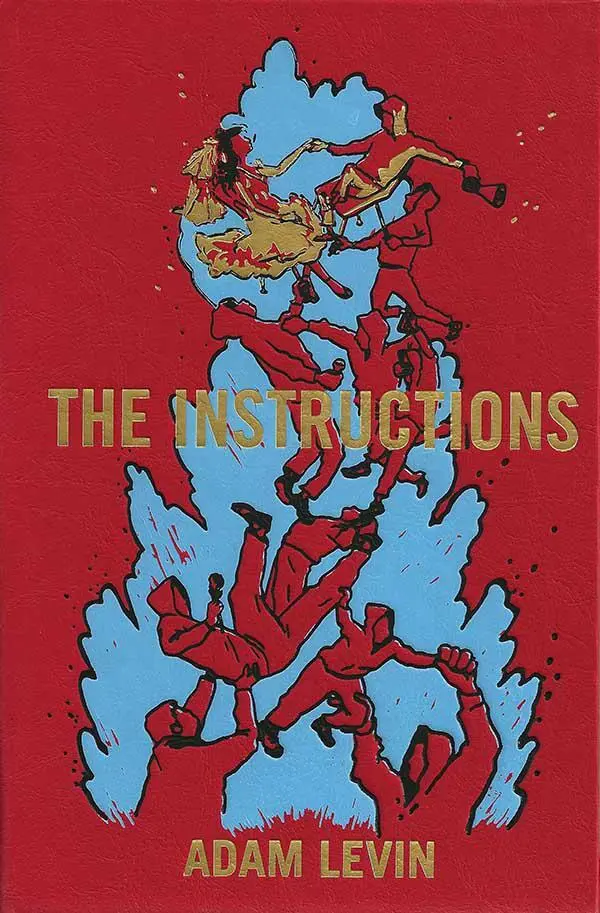
- Название:The Instructions
- Автор:
- Издательство:Perseus Books Group
- Жанр:
- Год:2011
- ISBN:нет данных
- Рейтинг книги:3 / 5. Голосов: 1
-
Избранное:Добавить в избранное
- Отзывы:
-
Ваша оценка:
The Instructions: краткое содержание, описание и аннотация
Предлагаем к чтению аннотацию, описание, краткое содержание или предисловие (зависит от того, что написал сам автор книги «The Instructions»). Если вы не нашли необходимую информацию о книге — напишите в комментариях, мы постараемся отыскать её.
The Instructions
The Instructions — читать онлайн бесплатно полную книгу (весь текст) целиком
Ниже представлен текст книги, разбитый по страницам. Система сохранения места последней прочитанной страницы, позволяет с удобством читать онлайн бесплатно книгу «The Instructions», без необходимости каждый раз заново искать на чём Вы остановились. Поставьте закладку, и сможете в любой момент перейти на страницу, на которой закончили чтение.
Интервал:
Закладка:
Suddenly Ben-Wa stood, and just as suddenly the shouting stopped.
The teachers uncovered their ears.
“Sit down,” said Botha to Ben-Wa Wolf.
The Side of Damage stood, awaited his next mis-step.
“Detantion for all of you for that first nawnsinz,” said Botha. “And lunch in the Cage for all of you for this nawnsinz.”
The end-of-class tone harmonized with our acute tinnitus.
Botha returned to the monitor’s desk.
“We are a defiance,” Ben-Wa said to us.
“But we’ve all got detention.” “And lunch in the Cage.” “And no one answered your questions.” “And Botha didn’t let your chair go til the tone sounded.”
“That’s right!” snapped Botha from the monitor’s desk. “You’ve done nathin’ but catch a banch of trouble for yourselves. Kape it up and I’ll kape giving you all the trouble I ken.”
“Botha says,” Benji said, “that he’ll keep giving us all of the trouble he can.”
“All of it?” said Vincie.
“He’s been giving us all the trouble he can?” said Eliyahu.
What the monitor’s given us, I said to my army, is all the trouble he can.
The Gurionic War
Emmanuel Liebman: Diaspora Judaism is what? I missed the last part.
Terry Gross: “Diaspora Judaism is masturbation.”
Emmanuel Liebman: And who’d you say you were quoting?
Terry Gross: A.B. Yehoshua.
Emmanuel Liebman: Who’s that?
Terry Gross: A novelist.
Emmanuel Liebman: He sounds Israeli.
Terry Gross: He is Israeli.
Emmanuel Liebman: An Israeli novelist ?
— Fresh Air with Terry Gross, 11/17/12
TRANSLATOR’S NOTE
Except for where otherwise noted, Rabbi Gurion ben-Judah Maccabee wrote all of what you have read so far, the first twelve books of The Instructions —our most important work of scripture but for Torah itself — in English between the ages of ten and twelve years (between late 2006 and early 2009), and the latter ten books in Hebrew between the ages of thirteen and sixteen years (between mid-2009 and mid-2013). Upon completing the first twelve books (which the Rabbi had yet to title “The Side of Damage”), Rabbi Gurion asked Emmanuel Liebman — who has, of late, gone completely underground and thus could not, regrettably, help me write this introduction — to translate them into Hebrew. The rabbi gave Emmanuel eight weeks to do so. Considering that Books One through Twelve comprise approximately 230,000 words, this was no small task. Nonetheless, Emmanuel met his deadline, the rabbi approved the translation, and a couple days later (on March 14, 2009), asked me to translate Emmanuel’s translation back into English by June 18, 2009, which was three days before the Rabbi would become bar-mitzvah, at which point he would cease to speak English, write English, and — inasmuch as it would be possible — hear or (with the exception of studying the canons of Philip Roth and Don DeLillo, whose End Zone he has lately, for hobby purposes, been translating into Hebrew) read English.
Of course I protested: Why so Borgesian an assignment? Weren’t there more important things for me to do than translate a translation back into its original language?
“No,” said the Rabbi. Nor would he let me see the original. Just Emmanuel’s translation.
Long made short, my task was surprisingly easy. I brought the re-translation to Gurion on June 18, 2009, and I told him so. He informed me that Emmanuel had reported similarly. He took out his original English version and compared paragraphs for a few minutes, a quarter-hour tops, then told me, “It’s good. Thank you, Eliyahu.”
To have three months of work, however easy, merely browsed by the friend for whom you did that work, and even if he tells you it’s good — not to mention that it seemed insincere, he wasn’t smiling, scholars, I’ll tell you that — it was infuriating.
I said so.
The Rabbi pushed the two versions across the table. “See for yourself,” he said.
And so I saw: My re-translation was, word for word and jot for jot, identical to the original.
“I thought it might be this way,” the rabbi said. “I guess I probably knew it would. I guess this means I have to finish.”
My re-translation’s having turned out identical to the rabbi’s original meant — to him — that his scripture was translingual, and therefore definitive. That is what he told me. Had it turned out otherwise, i.e., not definitive, he would have, he explained, ceased to write scripture and stayed silent forever, never allowing what he’d written to be read by anyone other than myself and Emmanuel, never completing what he’d spent nearly three years starting. As scholars can imagine, the thought of that shook me, still shakes me today (had I somehow managed to screw up the re-translation, “The Gurionic War” would not have been written; The Instructions would not exist ), though not half as much as did the look on Gurion’s face when he uttered the words, “I guess this means I have to finish.” That look, scholars, the grimness of which I’d not seen in evidence since the so-called “11/17 Miracle” itself… That look would have wilted young David ben-Jesse astride Gath’s giant in the Valley of Elah; the head would have dropped from his capable hands.
Even so, while I do agree without hesitation that the scripture you hold in your hands is definitive, I cannot share — try as I might — in Gurion’s certainty that it is “translingual” (though for reasons I trust by now to be obvious, I did not argue when he first claimed it was). However remarkable, the identicality of my re-translation and Gurion’s original — along with the identicality of the original and re-translation of the latter ten books, which you’re about to read, and to which Emmanuel and I applied the same methodology as we had to the first ten (Hebrew-to-English-to-Hebrew this time) — might be otherwise explained by what’s lately known in social-science communities as “The Gurion Effect,” and “Gurionic Solomony” among non-pseudoscientists. Both Sandra Billings, in her “Assessment of a Client” (p. 291), and Rabbi Avel Salt, in his letter to Leonard Brodsky (p. 217), glancingly refer to certain outcomes of Gurionic Solomony, but neither really describes it, not even briefly. And so, to describe it, however briefly:
Anyone who reads or listens to Gurion ben-Judah without enmity becomes more like him; demonstrably more like him. E.g., before I, at the age of twelve, met Gurion, I was no doubt booksmart, even exceptionally so, but I was not on a path toward finishing college at the age of nineteen. Now, at the age of nineteen, I’m in law school. I will not detail it here for security reasons, but Emmanuel Liebman’s experience has been highly similar to mine. Suffice it to say that among those who have encountered the Rabbi and/or his work, instances of grade-skipping and a generally increased talent for verbal articulation are not only manifold, but well documented. You can even witness these changes happening (to Vincie Portite, for example) over the course of the four days on which the vast majority of The Instructions focuses. And lest I be accused of coyness, let it not go without saying: If you are with us, you will certainly witness such changes in yourself as you proceed through the scripture. I would not be too surprised were I to learn that you have already.
But the point I’m trying to make is this: Given the effect of Gurionic Solomony, Emmanuel and I, two of the five people with whom Gurion has maintained the closest contact over the last few years, might be two of the only five people with the ability to translate/re-translate The Instructions in the way that Gurion himself would have. And so the fact that we have done so does not — not necessarily, at least — indicate that The Instructions is translingual, at least not in the general sense. It only indicates the potential of The Instructions to be translingual. It might, of course, further indicate that if you’re a scholar without enmity toward Gurion, and you were to come to know him as well as we do — it is his hope, and ours, that reading The Instructions will itself engender such knowing, or at least a sufficient approximation thereof— The Instructions would in turn become translingual. For you. The scholar. It might. We hope. And so maybe I’m merely splitting hairs.
Читать дальшеИнтервал:
Закладка:
Похожие книги на «The Instructions»
Представляем Вашему вниманию похожие книги на «The Instructions» списком для выбора. Мы отобрали схожую по названию и смыслу литературу в надежде предоставить читателям больше вариантов отыскать новые, интересные, ещё непрочитанные произведения.










Обсуждение, отзывы о книге «The Instructions» и просто собственные мнения читателей. Оставьте ваши комментарии, напишите, что Вы думаете о произведении, его смысле или главных героях. Укажите что конкретно понравилось, а что нет, и почему Вы так считаете.