H. Adler - The Journey
Здесь есть возможность читать онлайн «H. Adler - The Journey» весь текст электронной книги совершенно бесплатно (целиком полную версию без сокращений). В некоторых случаях можно слушать аудио, скачать через торрент в формате fb2 и присутствует краткое содержание. Год выпуска: 2008, Издательство: Random House, Жанр: Современная проза, на английском языке. Описание произведения, (предисловие) а так же отзывы посетителей доступны на портале библиотеки ЛибКат.
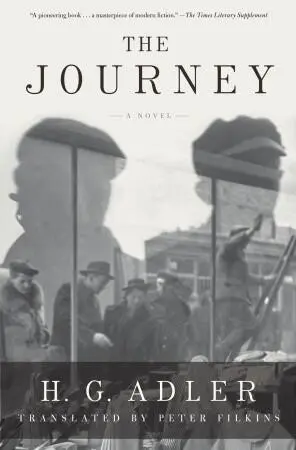
- Название:The Journey
- Автор:
- Издательство:Random House
- Жанр:
- Год:2008
- ISBN:нет данных
- Рейтинг книги:3 / 5. Голосов: 1
-
Избранное:Добавить в избранное
- Отзывы:
-
Ваша оценка:
The Journey: краткое содержание, описание и аннотация
Предлагаем к чтению аннотацию, описание, краткое содержание или предисловие (зависит от того, что написал сам автор книги «The Journey»). Если вы не нашли необходимую информацию о книге — напишите в комментариях, мы постараемся отыскать её.
The story behind the story of
is remarkable in itself: Award-winning translator Peter Filkins discovered an obscure German novel in a Harvard Square bookstore and, reading it, realized that it was a treasure unavailable to English speakers. It was the most powerful book by the late H. G. Adler, a survivor of Theresienstadt and Auschwitz, a writer whose work had been praised by authors from Elias Canetti to Heinrich Böll and yet remained unknown to international audiences.
Written in 1950 after Adler’s emigration to England,
was not released in Germany until 1962. After the war, larger publishing houses stayed away from novels about the Holocaust, feeling that the tragedy could not be fictionalized and that any metaphorical interpretation was obscene. Only a small publisher was in those days willing to take on
.
Yet Filkins found that Adler had depicted the event in a unique, truly modern, and deeply moving way. Avoiding specific mention of country or camps — even of Nazis and Jews—
is a lyrical nightmare of a family’s ordeal and one member’s survival. Led by the doctor patriarch Leopold, the Lustig family finds itself “forbidden” to live, uprooted into a surreal and incomprehensible circumstance of deprivation and death. This cataclysm destroys father, daughter, sister, and wife and leaves only Paul, the son, to live again among those who saved or sacrificed him.
reveals a world beset by an “epidemic of mental illness. . As a result of the epidemic, everyone was crazy, and once they finally recognized what was happening it was too late.”
Linked by its innovative style to the work of James Joyce and Virginia Woolf,
is as much a revelation as other recent discoveries on the subject as the works of W. G. Sebald and Irène Némirovsky’s
. It is a book proving that art can portray the unimaginable and expand people’s perceptions of it, a work anyone interested in recent history and modern literature must read.
The Journey — читать онлайн бесплатно полную книгу (весь текст) целиком
Ниже представлен текст книги, разбитый по страницам. Система сохранения места последней прочитанной страницы, позволяет с удобством читать онлайн бесплатно книгу «The Journey», без необходимости каждый раз заново искать на чём Вы остановились. Поставьте закладку, и сможете в любой момент перейти на страницу, на которой закончили чтение.
Интервал:
Закладка:
Next he wandered — exhausted and sick — to Halberstadt, from where he began the adventurous return to Prague. He hardly had the strength to climb the stairs to the first floor when he got there, and for years he suffered from sudden spells of weakness. Nonetheless he managed to start a new life. He dedicated himself to the memory of the “precious dead” and found his vocation as a “witness to truth.” This gave him a new, in fact the sole, purpose for his life. In 1947 he fled the arrival of the Communist regime, leaving his native Prague for London. There he remained an exile, describing himself as a freelance writer “at home in exile,” though he was able to establish himself neither as a poet nor as a teacher. Eventually he found a footing as a writer in Germany, Austria, and Switzerland, as well as in Israel and the United States. As his first biographer, Jürgen Serke, remarked, when he died in London on August 21, 1988, H. G. Adler left behind an unparalleled “Gesamtkunstwerk” made up of poems, stories, novels, scholarly studies, and essays. Among these The Journey holds a special place. It is his most tender, most moving book.
After he finished the first draft of his groundbreaking monograph Theresienstadt 1941–1945: The Face of a Slave Society , which he wrote between 1945 and 1948, with an unbelievable outburst of the energy that had been chained up in the camps, my father quickly produced five novels, including the novel of his formative years, Panorama (written in 1948 and published in 1968), and The Invisible Wall (written from 1954 to 1956 and published in 1989). The Journey , written in 1950–51, is the centerpiece of this unique confrontation with l’univers concentrationnaire , to use David Rousset’s term. Like many of the works from the early part of his career, the novel remained unpublished for a long while. For one thing, his reputation as a scholar after the publication of his Theresienstadt book in 1955 overshadowed his literary efforts. For another, the time was not yet ripe for a former prisoner to present his years in the camps in literary rather than documentary fashion. Moreover, the members of the Prague School that had shaped Adler’s writing had either been expelled or exterminated, and with them his works’ ideal readers.
Only gradually and through the repeated assays that have been made over the years are we able to comprehend the scale of the terror between 1933 and 1945. Memory fails in the face of facts. One needs only to think of how long it took for Primo Levi’s moving portrait of his life in Auschwitz to become widely known in order to recognize how difficult it has been to make the Shoah known in the world. Simply reporting events was in no way enough to develop awareness or to shape memory, and thereby enable readers to enter into the world of the camps. For the public at large, the decisive turning points were the Nuremberg trials, the Auschwitz trial in Frankfurt, and the Eichmann trial in Jerusalem. Outrage at the perpetrators who were still alive rekindled the memory of their victims. After that there was no looking away. Understanding still depends, however, on the perspective from which one views the events, with what degree of sincerity, and whether one accepts the truth. Whoever wants to look away has to ask himself in what direction he will turn his gaze. In The Journey this means: “The truth is merciless, and it is always victorious, always to people’s surprise, for nothing is as deeply mocked as the final victory of truth, even when its story involves countless insults, though never a final defeat. The truth is most terrible for those who never risk it.… Truth allows no escape … but it is never cruel.” People, so it seems, were simply not ready to listen to this kind of “truth” in a novel in the 1950s.
Although there were a number of voices at the time that spoke in support of The Journey , the book faced stiff opposition from several influential people. In England a well-known publisher advised H. G. Adler to take Norman Mailer’s The Naked and the Dead as a model of how to tackle a novel about Auschwitz. In Germany, Peter Suhrkamp reacted with outrage: “As long as I live, this book will not be printed in Germany.” That is just what happened. Only after Suhrkamp’s death did the book find an independent spirit, Knut Erichson, who decided to publish The Journey in his Bonn publishing house, bibliotheca christiana, in 1962. “I’m not the publisher for you,” he explained to the author, “but I’ll publish the book because no one else will.” The notable typographer Hermann Zapf did the design, and so the book first appeared in a suitably elegant form. However, the publisher did not have the means to gain widespread attention for the work. Despite important reviews that should have helped the book to break through, it didn’t happen. The Journey remained a well-kept secret.
The original title was Die Reise: Eine Ballade , yet for reasons of copyright Erichson chose Eine Reise , and he advised the author to drop the unusual subtitle, Eine Ballade . But since in Adler’s eyes the book was not a “novel,” which in his opinion is a genre that captures “an entire world,” he chose the more modest subtitle Eine Erzählung , or A Tale . This confusing, somewhat lightweight subtitle is another reason the book was rarely noticed. In his review, Heimito von Doderer acknowledged the problem with the genre: “The author calls this book ‘A Tale.’ Yet it’s a novel. Not because of its length, but rather because of its universal reach.” Then came the concession: “Yet the work is really a ballad.” Doderer went on to explain his view: “A ballad does not accuse, it does not excuse. It is a crystalline form.” The ballad of The Journey is “liberating,” “it makes the subject, be it as it may (and here the case borders on the unbelievable), weightless and floating, without relinquishing any of its weight. A whole mountain of horror is turned into song.” Though Doderer was right to draw the analogy between the lyrical nature of The Journey and the ballad form, the term also makes sense on other levels, for in a ballad, according to Goethe’s definition, lyrical, dramatic, and narrative moments join together. These three forms of expression are bound together elaborately in The Journey . The polyphonic stream of consciousness leads us continually from one point of view to another. The reader often no longer knows who is speaking before the next voice enters. In this manner, the narrative stream runs from Paul’s thoughts to his mother’s feelings without our noticing a break, or the narrator’s reflections into the sister’s fears. As with a ballad, the book contains the refrainlike repetition of numerous central motifs. Thus the form of the ballad does not harken here to a traditional genre, but rather creates a new narrative form, one that can be placed somewhere among Joyce, Woolf, and Faulkner. The Journey appeared almost at the same time as Faulkner’s great memoir of World War I, A Fable , and there are also parallels with Ulysses and Between the Acts , Ilse Aichinger’s Herod’s Children being another important point of reference. In the end, however, like Doderer, I am at a loss when it comes to finding suitable literary comparisons for The Journey . Roland H. Wiegenstein came to the most radical conclusion on this point in his review in Merkur: “The book belongs to no literary category whatsoever.”
The book is dedicated to Adler’s friends Elias and Veza Canetti. Soon after it was completed, Canetti formed a clear judgment: The Journey was “a masterpiece, written in an especially beautiful and clear prose, beyond rancour or bitterness.” Canetti went on to elaborate his view, using his own characteristic idiom: “I believe that your experience … has here met with a complete poetic transformation, one that has never before been achieved.” Since Canetti considered a writer to be the “guardian of transformation,” we can assume that he was choosing his words most precisely, and that The Journey matched his own illuminating criteria for successful imaginative literature. The magic word transformation recalls the continual movement of The Journey , its overwhelming linguistic richness, that “boundlessness that tolerates no limit,” which the narrative voice invokes right from the start: “You travel many roads, and in many towns you appear with your relatives and friends; you stand, you walk, you fall and die.” That which Canetti called the mythic is found in the images that are continually transformed and used as leitmotifs, as well as in the various fairy-tale figures. Finally, Canetti was the first to arrive at what the novel meant for modernity. In the quality of the novel, which Canetti particularly stressed, we recognize its lasting relevance: “The most terrible things that could possibly happen to human beings are presented here as if they were weightless, delicate, and easily withstood, as if they could not harm the human core.” When the book appeared, Veza Canetti wrote to thank the author with a postcard from the British Museum that depicts the torso of Pallas Athene together with its head, from which the face has been broken off. “The book is too beautiful for words and too sad. We are proud of the dedication.”
Читать дальшеИнтервал:
Закладка:
Похожие книги на «The Journey»
Представляем Вашему вниманию похожие книги на «The Journey» списком для выбора. Мы отобрали схожую по названию и смыслу литературу в надежде предоставить читателям больше вариантов отыскать новые, интересные, ещё непрочитанные произведения.





Обсуждение, отзывы о книге «The Journey» и просто собственные мнения читателей. Оставьте ваши комментарии, напишите, что Вы думаете о произведении, его смысле или главных героях. Укажите что конкретно понравилось, а что нет, и почему Вы так считаете.