H. Adler - The Journey
Здесь есть возможность читать онлайн «H. Adler - The Journey» весь текст электронной книги совершенно бесплатно (целиком полную версию без сокращений). В некоторых случаях можно слушать аудио, скачать через торрент в формате fb2 и присутствует краткое содержание. Год выпуска: 2008, Издательство: Random House, Жанр: Современная проза, на английском языке. Описание произведения, (предисловие) а так же отзывы посетителей доступны на портале библиотеки ЛибКат.
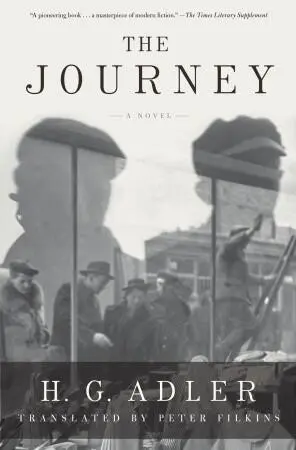
- Название:The Journey
- Автор:
- Издательство:Random House
- Жанр:
- Год:2008
- ISBN:нет данных
- Рейтинг книги:3 / 5. Голосов: 1
-
Избранное:Добавить в избранное
- Отзывы:
-
Ваша оценка:
The Journey: краткое содержание, описание и аннотация
Предлагаем к чтению аннотацию, описание, краткое содержание или предисловие (зависит от того, что написал сам автор книги «The Journey»). Если вы не нашли необходимую информацию о книге — напишите в комментариях, мы постараемся отыскать её.
The story behind the story of
is remarkable in itself: Award-winning translator Peter Filkins discovered an obscure German novel in a Harvard Square bookstore and, reading it, realized that it was a treasure unavailable to English speakers. It was the most powerful book by the late H. G. Adler, a survivor of Theresienstadt and Auschwitz, a writer whose work had been praised by authors from Elias Canetti to Heinrich Böll and yet remained unknown to international audiences.
Written in 1950 after Adler’s emigration to England,
was not released in Germany until 1962. After the war, larger publishing houses stayed away from novels about the Holocaust, feeling that the tragedy could not be fictionalized and that any metaphorical interpretation was obscene. Only a small publisher was in those days willing to take on
.
Yet Filkins found that Adler had depicted the event in a unique, truly modern, and deeply moving way. Avoiding specific mention of country or camps — even of Nazis and Jews—
is a lyrical nightmare of a family’s ordeal and one member’s survival. Led by the doctor patriarch Leopold, the Lustig family finds itself “forbidden” to live, uprooted into a surreal and incomprehensible circumstance of deprivation and death. This cataclysm destroys father, daughter, sister, and wife and leaves only Paul, the son, to live again among those who saved or sacrificed him.
reveals a world beset by an “epidemic of mental illness. . As a result of the epidemic, everyone was crazy, and once they finally recognized what was happening it was too late.”
Linked by its innovative style to the work of James Joyce and Virginia Woolf,
is as much a revelation as other recent discoveries on the subject as the works of W. G. Sebald and Irène Némirovsky’s
. It is a book proving that art can portray the unimaginable and expand people’s perceptions of it, a work anyone interested in recent history and modern literature must read.
The Journey — читать онлайн бесплатно полную книгу (весь текст) целиком
Ниже представлен текст книги, разбитый по страницам. Система сохранения места последней прочитанной страницы, позволяет с удобством читать онлайн бесплатно книгу «The Journey», без необходимости каждый раз заново искать на чём Вы остановились. Поставьте закладку, и сможете в любой момент перейти на страницу, на которой закончили чтение.
Интервал:
Закладка:
This is the Earth. Once it was on fire, but it has long since cooled and settled into a general state of coldness, the clumps having turned to pieces of ice between your fingers. The sharp north wind blows and leaves you shuddering on your scaffold. The sky is clouded over but contains no snow because it is dry, because your hands have no other work to do but demolish what was once built. The wall once laid down the border between what is yours and mine, but now everything belongs to you, and thus the former border dissolves right in front of your eyes. It could be that the glow of all of the extinguished fires of the world has not chilled. Therefore there must be hot bricks, for otherwise you could not stand here for hours, and your companions would neither be on your scaffold nor the neighboring scaffold. No one would be here, the town would stand empty, and death would cover over anything that dared to live. Yet death does not arrive in order to inhabit us, but instead strolls by. He has chosen the entire land as his empire. His path travels the length of the streets that run past the walls. Not all walls are demolished, not every border disappears; between death and life there is still a separation.
The town is a timeless island of walls. A hundred thousand bricks are baked, bread that is piled into mountains of inhabitable loaves. The town floats on the ocean of time and knows nothing of itself. This is why the town can feel lonesome even when many things are going on within it. If you just take apart the bricks you’ll find what has been stored away and hidden. You’re interested in such exposure, nothing can hold back your urge to explore. Yet time has slowed, it’s become a sticky paste. The fired bricks are crushed, resulting in a coarse dark flour, the bread of the past that no one can chew. Whoever vainly pursues the past will be gobbled up by it. Yet it’s easy to chop it up into pieces when one uses a bit of trickery. The hands lift one stone after another and let them fall onto the heap below where the ashlar breaks them up with a dull cracking sound. No one says anything, the old bread is already too crumbly.
A wall is demolished, yet in some empty spots other walls are erected for which no new bricks are available, which is why this wall has to disappear. Thus it means displacement, not salvation, and therefore it’s better if many bricks are broken up. One should not erect new walls with new bricks when it can only be accomplished by destroying others.
Sometimes the builder comes by and warns: “Be careful! Don’t break any bricks! We don’t have any new ones! Wedge the pick between the bricks in order to loosen them. That also makes the job easier. And don’t toss any bricks!”
It’s easy for the builder to say this, because he doesn’t have to take part in the work. Whoever looks on and gives commands stands above matters and walks back and forth in order to oversee everything, though this is impossible, and so bricks get broken. They should clear everything away and remove all the rubble so that there’s nothing left for memory to worm its way into. Then maybe a pleasing bit of grass would grow if only the continual steps of the guards didn’t trample it. No proper thoughts arise among standing buildings, but rather only misleading ones, though memory alone suits the timeless city. Whatever stands in its way can be cleared away. Then the grass can thrive. When the bricks crumble, no one’s will is destroyed. You shouldn’t think that the work of dissolution is the same as the work of destruction. Some bricks remain unharmed, especially when handled absentmindedly, which is all the more reason why the builder cannot stand any breakage. But he only gets a few bricks, and there are fewer and fewer as new supplies dwindle and building stones can only be had by destroying old walls. Everything is made of rubble, something stolen from earlier times and not allowed to stand. Rubble is gathered, but that’s not good. Whoever wants to begin something anew also needs to provide what’s needed to make it happen. As soon as a building is condemned, no concessions can be made and it must be quietly demolished, rather than just stripped of all its components, because that would only fulfill half of the order, thus bringing its validity into question.
The women stand below with half-frozen fingers, cleaning the last of the mortar off of the bricks with iron scrapers. Partial bricks can also be used, said the builder. Anything that’s only half done is also thought to be finished; for completion is no longer the goal as long as such shortages remain. The desire to achieve something has been destroyed by the orders handed out. They shoot out like the blows of a whip and no longer move the hearts of men. The will is broken, mere obedience remains, reluctant obedience. Its achievements are fleeting and result in only rubble. The new walls lean and are fragile, they will soon topple. Yet other walls are built, consisting of nothing more than wishes. They tower above and require no scaffolds in order to be erected, nor do they belong to any building. They pop up so fast and collapse so quickly that there is no joy in their accumulation, these false edifices, these moldy loaves of the soul. The living go hungry because the bricks can’t feed them.
Sometimes the bricks are lined up and counted. Then rifles are brought out and a voice yells: “Move!” The bricks begin to walk because they have grown legs, followed by swinging arms and finally heads. The bricks walk between the walls that are still standing and the walls that are already demolished. These walls want to be taken along with them, no one prevents it, so more and more bricks join the march. At last all walls are left behind, then a muddy path appears into which the bricks almost sink, though no one grants them any rest, an order transforms them into wheels that must turn. Yet the wheels cannot make their way through the mud. It doesn’t help that the children push them forward with canes, for the wheels are not toys. Someone should have strewn sand on the path so that the wheels can go forward, but now it’s too late. No cinders are to be found because there’s nothing more to burn, only bricks, and the ovens have not had any fire in them for ages and are now lying in pieces. Only blackened chimneys indicate that these buildings were once heated, themselves now nothing more than memorials to apartments that once were, lodgings ready to serve one’s bidding.
Then a voice struck by a cane screamed: “Nothing is real anymore!”
“What isn’t real?”
This question found no answer, yet another voice rose up, its tone much harsher than all of the other voices: “It’s all over for you.”
Perhaps it was a thought that was stronger than the ruins that were stuck in the mud, since that’s the way things seemed as soon as the wheels could not move anymore, life having come to a standstill. Then it was up to the spirit alone whether or not one rotted there and died without finding someone who would even remember what had happened. Everyday life is over, and no new arrangement replaces what was lost.
Suddenly the path begins to climb up out of the mire again, the clumps of mud drop off to the left and right as the wheels get hold of themselves and begin to move again with a feeble rattling. They feel like singing or whistling, but that is not allowed; they are only supposed to gasp for breath and not enjoy themselves. As a result of the stress from the way they are handled, they gradually come to their senses and remember they have eyes. They look around and they are no longer wheels, but rather pairs of crutches with heads stuck on the top. They are heavy heads that wag back and forth, human heads that look like those of horses, though the crutches are neither made of wood nor metal, but rather of stone dust that has turned into cement.
Читать дальшеИнтервал:
Закладка:
Похожие книги на «The Journey»
Представляем Вашему вниманию похожие книги на «The Journey» списком для выбора. Мы отобрали схожую по названию и смыслу литературу в надежде предоставить читателям больше вариантов отыскать новые, интересные, ещё непрочитанные произведения.




Обсуждение, отзывы о книге «The Journey» и просто собственные мнения читателей. Оставьте ваши комментарии, напишите, что Вы думаете о произведении, его смысле или главных героях. Укажите что конкретно понравилось, а что нет, и почему Вы так считаете.