H. Adler - The Wall
Здесь есть возможность читать онлайн «H. Adler - The Wall» весь текст электронной книги совершенно бесплатно (целиком полную версию без сокращений). В некоторых случаях можно слушать аудио, скачать через торрент в формате fb2 и присутствует краткое содержание. Год выпуска: 2014, Издательство: Random House, Жанр: Современная проза, на английском языке. Описание произведения, (предисловие) а так же отзывы посетителей доступны на портале библиотеки ЛибКат.
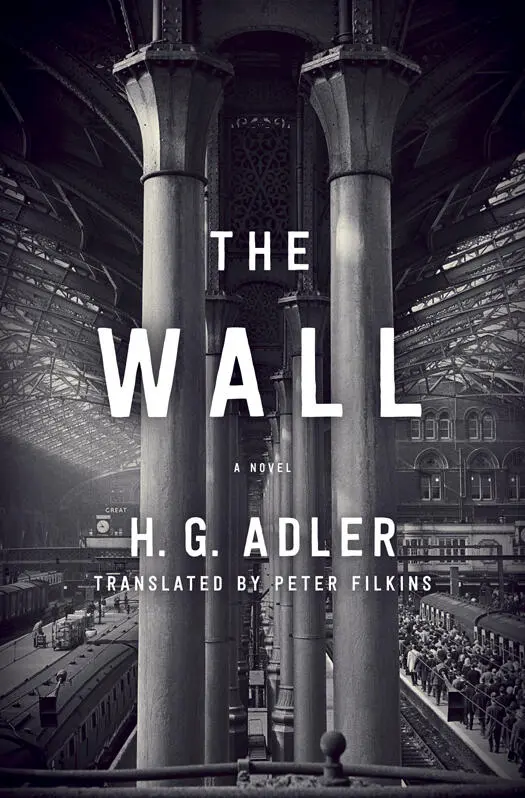
- Название:The Wall
- Автор:
- Издательство:Random House
- Жанр:
- Год:2014
- ISBN:нет данных
- Рейтинг книги:4 / 5. Голосов: 1
-
Избранное:Добавить в избранное
- Отзывы:
-
Ваша оценка:
The Wall: краткое содержание, описание и аннотация
Предлагаем к чтению аннотацию, описание, краткое содержание или предисловие (зависит от того, что написал сам автор книги «The Wall»). Если вы не нашли необходимую информацию о книге — напишите в комментариях, мы постараемся отыскать её.
Compared by critics to Kafka, Joyce, and Musil, H. G. Adler is becoming recognized as one of the towering figures of twentieth-century fiction. Nobel Prize winner Elias Canetti wrote that “Adler has restored hope to modern literature,” and the first two novels rediscovered after his death,
and
were acclaimed as “modernist masterpieces” by
. Now his magnum opus,
the final installment of Adler’s Shoah trilogy and his crowning achievement as a novelist, is available for the first time in English.
Drawing upon Adler’s own experiences in the Holocaust and his postwar life,
, like the other works in the trilogy, nonetheless avoids detailed historical specifics. The novel tells the story of Arthur Landau, survivor of a wartime atrocity, a man struggling with his nightmares and his memories of the past as he strives to forge a new life for himself. Haunted by the death of his wife, Franziska, he returns to the city of his youth and receives confirmation of his parents’ fates, then crosses the border and leaves his homeland for good.
Embarking on a life of exile, he continues searching for his place within the world. He attempts to publish his study of the victims of the war, yet he is treated with curiosity, competitiveness, and contempt by fellow intellectuals who escaped the conflict unscathed. Afflicted with survivor’s guilt, Arthur tries to leave behind the horrors of the past and find a foothold in the present. Ultimately, it is the love of his second wife, Johanna, and his two children that allows him to reaffirm his humanity while remembering all he’s left behind.
The Wall
The Wall — читать онлайн бесплатно полную книгу (весь текст) целиком
Ниже представлен текст книги, разбитый по страницам. Система сохранения места последней прочитанной страницы, позволяет с удобством читать онлайн бесплатно книгу «The Wall», без необходимости каждый раз заново искать на чём Вы остановились. Поставьте закладку, и сможете в любой момент перейти на страницу, на которой закончили чтение.
Интервал:
Закладка:
If you share your addresses on the telephone, a stream of fervent thank-yous follows. You are assured that you have done someone a great service, while it’s also strenuously emphasized what pleasure is accorded the one who gives out such information, since now you will have helped get more news to your friends. This is according to the custom of announcing the intermediary when writing to a new address in order to praise the one who helped and thereby enhance his reputation with the recipient. Whoever is always eager to accumulate new addresses — and that goes for the majority of letter writers — is called a street writer by those who are against this practice. With this insult, the unappeasable address hunters are branded, and are thought of as fickle people, lacking in conviction and reliability.
Different are the noble writers, who claim that only a few people, and at best only one, should write to his personal friends, in order not to confuse them and not to seem insistent. Some of them argue that one should write only rarely, for only then is the recipient overjoyed to receive a letter, and that, indeed, one should share meager though solid news, if only to awaken someone’s curiosity, and yet not bother those who are very busy. The adherents of this conviction attempt to make themselves into beloved ones who, as a result, hope to receive a response.
The belief in a best friend, or what many consider to be the same, a best address, is shared by a group that proudly calls itself single-letter writers. They excitedly advocate that there is only one address of any real worth, while the rest are, if not in fact unused, only meaningless. Unfortunately, among the single-letter writers there is no agreement as to what the right address is. Each individual adherent thinks he knows, yet not one can substantiate the truth of his claim. That turns this group, valued as it nonetheless may be, into agitators and cranks who rarely agree on anything and most often fall prey to suspicion. Only a certain shyness holds back the single-letter writers from breaking out into open battle, but with other letter writers they share the tendency to talk about the virtues of this or that address over the phone. One invokes the beauty of a name or different unusual aspects, such as the sound, the number of letters, wanting to constantly discern or discover from its sequence or shape a rhythmic charm. Endlessly the question is posed, “So, then, do I have the best address?” until someone complains about how much valuable time, which would be better used for writing, is idly being wasted through such talk. At which the other most often agrees, happy not to have to defend his hard-to-support rationale. Others avoid completely such pointless exchanges, though their own thoughts are occupied a great deal by this question.
Rarely will someone admit that he does not give out his best address, for this risks the possibility that he would not get any help from others. It can also happen, though rarely, that he turns down all inquiries. If he will respond only when someone visits in person, he is then called, with good-natured kidding, a whisperer, though it quickly gets around that there is nothing at all to learn from him, he being considered with a mixture of astonished shyness and indignation and called a lone writer.
Infrequent are those old fogies who spring up here and there like a weed and quickly explain in short order that they don’t care about addresses, they are not at all interested in this scribbling, and want only not to be bothered with any of this. In this case there is no point in trying, for these heretics say nothing. What remains unknown is whether they still write letters secretly and, out of shame, arrogance, or eccentricity, don’t say anything about it. Some questions are posed to the heretics: Do you not take part because you don’t want any friends? Do you think writing is pointless because you don’t get any response and can never expect to get one? Do you think there’s a better way to keep in touch with your friends? But the answer remains unknown.
Some heretics are quiet and go their own way without bothering about the letter writers. Among them are nice people who don’t want any enemies. Others are those — it’s not easy to discover them, but nonetheless one senses their presence — who laugh at the letter writers, declaring with mockery that it is superstition and saying that foolish people should make themselves useful, and at least concern themselves with more everyday things than such a pack of received notions that only advance the ridiculous from generation to generation, all of it a barrier to any reasonable explanation. They maintain that a courageous government would ban such nonsense and penalize it. The letter writers feud with and hate these troublemakers, knowing that they enjoy the complete and full protection of the state, though they also fear the evildoers, for the hooligans among them threaten that one day they will raid a mailbox in order to search for the letters and expose this outrageous scam and shameful madness in a pamphlet in order to shine the hard light of day upon it. Yet none had risked doing so, for they were afraid of the law, which threatens the violation of the privacy of letters with harsh penalties. They also want to guard for certain against any such future action, and so all such mockery remains nothing more than a lot of hot wind that reveals its own powerlessness and only scares itself.
One would be pleased to know what happens with the countless letters through which the state pulls in millions each day owing to the high postal rates. What is not known is where the letters end up; only the postal administration could solve this puzzle, but not even the boldest of heretics is willing to question that, and the trust in the honest work of the post office is boundless. The fact is that the number of mailbox pickups has continually increased in recent years; writing is increasing at all social levels, and the colder it gets. Only in the summers, which grow shorter each year, does this passion decrease a bit, but hardly does autumn arrive than it increases with multiplied fervor. Statistics about the number of letters mailed are not published. Conservative estimates indicate astronomical figures, and reliable experts on the economy assure us that a significant part of people’s means is dedicated to writing supplies and stamps, which for the welfare of the lower classes is critical. Even letter writers on the highest of levels who understand such things fear bad consequences as a result.
Through polls conducted to find out the general opinion of society, it recently and surprisingly came to light that today there are many letter writers who never use the telephone to help search for addresses, and that their number is increasing. Some people don’t have a telephone and yet still want to write letters. It indeed has not escaped anyone’s attention that there could be many reasons that people decline being connected to such a network, but it is assumed that these people are satisfied with their own addresses or they use a stranger’s telephone. But not everyone wishes to disturb his neighbor or to hurry across the street to an unpleasant phone booth. Others don’t like the phone itself, and find it to be soulless, or worry that the operator can overhear them, or avoid the loss of irretrievable time through long phone conversations. Others more mature with years decide, even when they have their own telephone, that they have now collected enough addresses, enough is enough, and thereby they write one letter after another with deeper devotion to those friends they already have. Often, they admonish the young, “Why do you keep writing letters to new recipients and thereby continually increase your troubles? Fewer is wiser. Too much writing results in a flighty and superficial nature. I’m telling you that to be frugal in the number of letters you write is a virtue. Only then can you really succeed in best serving the work itself and compose letters that contain in-depth accounts.”
Читать дальшеИнтервал:
Закладка:
Похожие книги на «The Wall»
Представляем Вашему вниманию похожие книги на «The Wall» списком для выбора. Мы отобрали схожую по названию и смыслу литературу в надежде предоставить читателям больше вариантов отыскать новые, интересные, ещё непрочитанные произведения.







Обсуждение, отзывы о книге «The Wall» и просто собственные мнения читателей. Оставьте ваши комментарии, напишите, что Вы думаете о произведении, его смысле или главных героях. Укажите что конкретно понравилось, а что нет, и почему Вы так считаете.