Ma Jian - The Noodle Maker
Здесь есть возможность читать онлайн «Ma Jian - The Noodle Maker» весь текст электронной книги совершенно бесплатно (целиком полную версию без сокращений). В некоторых случаях можно слушать аудио, скачать через торрент в формате fb2 и присутствует краткое содержание. Год выпуска: 2006, Издательство: Farrar, Straus and Giroux, Жанр: Современная проза, на английском языке. Описание произведения, (предисловие) а так же отзывы посетителей доступны на портале библиотеки ЛибКат.
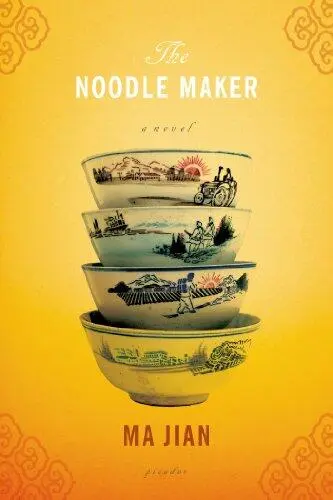
- Название:The Noodle Maker
- Автор:
- Издательство:Farrar, Straus and Giroux
- Жанр:
- Год:2006
- ISBN:нет данных
- Рейтинг книги:3 / 5. Голосов: 1
-
Избранное:Добавить в избранное
- Отзывы:
-
Ваша оценка:
The Noodle Maker: краткое содержание, описание и аннотация
Предлагаем к чтению аннотацию, описание, краткое содержание или предисловие (зависит от того, что написал сам автор книги «The Noodle Maker»). Если вы не нашли необходимую информацию о книге — напишите в комментариях, мы постараемся отыскать её.
From the highly acclaimed Ma Jian comes a satirical and powerfully written novel-excerpted in The New Yorker-about the absurdities and cruelties of life in post-Tianamen China.
Two men, a writer of political propaganda and a professional blood donor, meet for dinner every week. During the course of one drunken evening, the writer recounts the stories he would write, had he the courage: a young man buys an old kiln from an art school and opens a private crematorium, delighting in his ability to harass the corpses of police officers and Party secretaries while swooning to banned Western music; a heartbroken actress performs a public suicide by stepping into the jaws of a wild tiger, watched nonchalantly by her ex-lover. He is inspired by extraordinary characters, their lives pulled and pummeled by fate and politics, as if they were balls of dough in the hands of an all-powerful noodle maker.
Ma Jian's masterpiece allows us a humorous yet profound glimpse of those struggling to survive under a system that dictates their every move.
The Noodle Maker — читать онлайн бесплатно полную книгу (весь текст) целиком
Ниже представлен текст книги, разбитый по страницам. Система сохранения места последней прочитанной страницы, позволяет с удобством читать онлайн бесплатно книгу «The Noodle Maker», без необходимости каждый раз заново искать на чём Вы остановились. Поставьте закладку, и сможете в любой момент перейти на страницу, на которой закончили чтение.
Интервал:
Закладка:
She had no imagination, he says to himself She relied on her string of affairs to provide her with material for her tearful love stories. The critics claimed she was a great writer, they said her books were inspired. To achieve success as an author these days, you have to have led a troubled life. The more you have suffered, the better your books will sell. Today’s women understand the importance of time, but ignore the need for direction. They focus on the colour of a lampshade, they worry about which parts of their bodies to cover or expose. As soon as they find a man to act as their safe shore, they start floating through life like a boat drifting aimlessly out to sea. She was a boat stranded in mid-ocean, and the editor (it sickens me even to think about the old man) was a dirty sock she had discarded years before but was still floating by her side.
Today, the editor is an old pensioner who walks through the park every morning, listening to his portable radio. His wife divorced him last year and opened a hardware store in an empty room in the Writers’ Association. This innocent-looking shop is in fact a front for a variety of black market activities. Through her father’s military connections she is able to secure many sought-after licences and buy products that she can sell on for double the price. She has made a small fortune, and has lost interest in writing. Her business career is much more compatible with this crippled society, and it has given her the ultimate signs of success: a Western Dream mattress, wallpaper, electric kettle, a 28-inch television, a set of porcelain crockery, ajar of Nescafe, a bottle of French wine, aluminium window frames, and the centrally heated apartment that contains all these things.
‘Is this what we all work for?’ the professional writer asks out loud. ‘What we go to university for, make friends for? Tell me, is it worth all the pain?’
‘What pain?’ The blood donor stubs his cigarette out. He has become almost as fond of asking questions as the writer.
‘What I mean is — all literature has its cost. Writers must suffer for their art.’ The professional writer doesn’t want to pursue his previous train of thought.
‘Everything has its cost. If you work hard enough, you can buy anything you want. Except time, of course,’ the blood donor says, triumphantly.
‘Yes, except time.’ The writer knows that his fling with the female novelist was meaningless, there were no feelings involved. He admits that when she was a young woman, her writing had shown great promise, but it never lived up to expectations. All she produced in the end was a stream of inconsequential words. The professional writer smiles complacently, convincing himself that the reason he is unable to finish his novel is because he is practising self-control. However, in his heart he knows that he is even more worthless than the female novelist. He lacks the courage to commit himself to one thing entirely, or to jump into the thick of things. He wants to be a bystander, an objective witness, but in order to keep himself fed, he is forced to rely on others and submit himself to their needs. He is lazy by nature, and self-obsessed, and is destined to eke out the rest of his life on the poverty-stricken margins of society. He will never settle down to any serious work. There is always some obscure detail to research or mundane duty to perform, and while these provide a welcome distraction, they also give him excuses to delay what he needs to do. However, these diversions pull him back to the real world. Without them, he would spend his entire life suspended in mid-air.
The lights have gone out once more, and the room is pitch black. For a moment, the professional writer feels like a plastic bag caught in the high wind. It occurs to him that although the plastic bag is worthless, it is able to rise above the mundane world and change directions. When the wind blows against it, it fills with air and glides through space — things the earth-bound can never do.
The Street Writer or The Plastic Bag in the Air
In his mind, the professional writer sees the street writer squatting on a pavement in the new part of town, which a few years ago was open fields. It is a brand new district by the sea, built of concrete and cement. The local peasants who were evicted from their land and rehoused in the new three-storey concrete blocks are not yet accustomed to their new way of life. They still keep their timber and mouldy raincoats outside their front doors, even though they will never again have to burn wood or labour in the fields. The women continue to tie black scarves around their heads, although they no longer need to shield themselves from the sun. The men wear Western suits now, but still smoke their water pipes every afternoon. They always stand at an angle, as though they were leaning on their hoes in the fields. The children continue to shit in the streets rather than use the new toilets in their bathrooms. The flat roofs are pierced by a clutter of television aerials. Farmers from the hinterland who have found work in town but have failed to secure a residency permit, flock to this new district to rent private rooms. The local peasants have become wealthy landlords overnight, and the residents of the old town have been forced to take notice of the ‘cabbage-faced bumpkins’ they have previously preferred to ignore.
The street writer fixed his eyes on a plastic bag that was floating through the sky, and allowed all thoughts to empty from his mind. Passers-by assumed he was looking at the newly restored church, or the acacia tree beside it. No one could have guessed that he was staring at the plastic bag, or indeed that he was in fact squatting down tor that sole purpose. In this dusty, drab corner of the street, he and the plastic bag became one.
He had come to this town on the spur of the moment, without even having applied for a residency transfer. The gloom and smog of his hometown depressed him, and besides, he couldn’t afford to pay the compulsory three-hundred-yuan annual insurance fee that his metalwork factory now demanded from all employees. So he left his job and moved to this fast-developing town by the sea, which he then stuck to like a blob of chewing gum. After a while, the police got tired of arresting him for illegal residency and left him alone. He picked up a string of menial jobs. He washed dishes in a restaurant, worked as a security guard in a bar (although he wasn’t even strong enough to fend off a cripple), he delivered canisters of butane gas, collected plastic bottles, and transported leftover restaurant slops to private pig farmers in the suburbs. After two years of hard toil, he set up business as a self-employed street writer. People paid him to write letters of complaint, business letters and shop signs. His only tools were a pen, some paper and a stack of envelopes.
He became familiar with the latest documents issued by the local Party committee and the major departments of central government. He learned about marriage procedures, finance and publication laws, business taxes, private enterprise regulations, landlords’ rights, traffic laws, the latest developments in the policy of ‘Redressing Past Injustices’, and compensation for injuries at work. The complaints he wrote for his clients were coherent and well-argued, and conformed to the usual practice. He helped families condemned as rightists to gain rehabilitation, and victims of industrial injuries to secure financial compensation. Amorous young men paid him to write love letters to their girlfriends; wives of unfaithful artists paid him to write denunciations of their husbands that were to be read in the divorce courts; tenants and landlords paid him to fill out their tenancy contracts; illiterate peasants paid him to read out any letters they received. He carried out his tasks with great care, and his fees were reasonable. His speciality lay in the writing of love letters. If a client sent one of his letters to a woman, it was guaranteed that the next day she’d agree to sit next to him on a park bench.
Читать дальшеИнтервал:
Закладка:
Похожие книги на «The Noodle Maker»
Представляем Вашему вниманию похожие книги на «The Noodle Maker» списком для выбора. Мы отобрали схожую по названию и смыслу литературу в надежде предоставить читателям больше вариантов отыскать новые, интересные, ещё непрочитанные произведения.



Обсуждение, отзывы о книге «The Noodle Maker» и просто собственные мнения читателей. Оставьте ваши комментарии, напишите, что Вы думаете о произведении, его смысле или главных героях. Укажите что конкретно понравилось, а что нет, и почему Вы так считаете.