Richard House - The Kills
Здесь есть возможность читать онлайн «Richard House - The Kills» весь текст электронной книги совершенно бесплатно (целиком полную версию без сокращений). В некоторых случаях можно слушать аудио, скачать через торрент в формате fb2 и присутствует краткое содержание. Год выпуска: 2013, Издательство: Picador, Жанр: Современная проза, на английском языке. Описание произведения, (предисловие) а так же отзывы посетителей доступны на портале библиотеки ЛибКат.
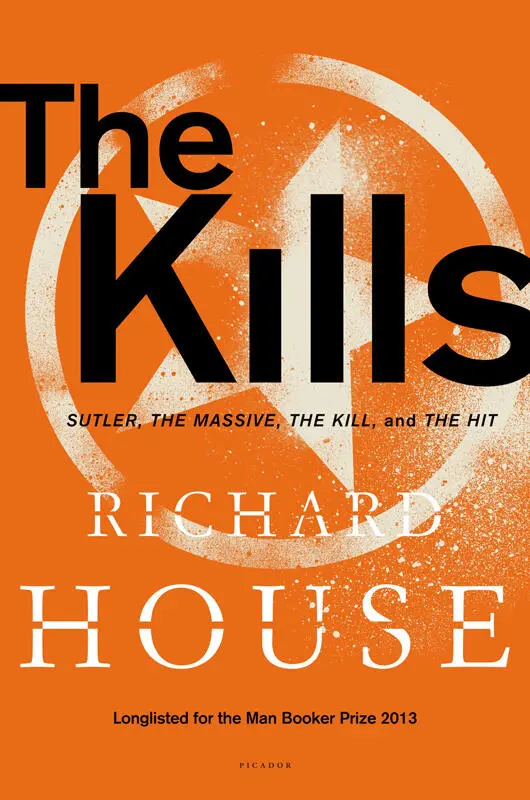
- Название:The Kills
- Автор:
- Издательство:Picador
- Жанр:
- Год:2013
- ISBN:нет данных
- Рейтинг книги:3 / 5. Голосов: 1
-
Избранное:Добавить в избранное
- Отзывы:
-
Ваша оценка:
The Kills: краткое содержание, описание и аннотация
Предлагаем к чтению аннотацию, описание, краткое содержание или предисловие (зависит от того, что написал сам автор книги «The Kills»). Если вы не нашли необходимую информацию о книге — напишите в комментариях, мы постараемся отыскать её.
The Kills — читать онлайн бесплатно полную книгу (весь текст) целиком
Ниже представлен текст книги, разбитый по страницам. Система сохранения места последней прочитанной страницы, позволяет с удобством читать онлайн бесплатно книгу «The Kills», без необходимости каждый раз заново искать на чём Вы остановились. Поставьте закладку, и сможете в любой момент перейти на страницу, на которой закончили чтение.
Интервал:
Закладка:
Rem struggled to stay calm. ‘It’s a training camp. It’s where everyone goes before they’re shipped out.’
‘You’ll die.’
‘He wants to know how it works.’
‘And who is this man?’ Cathy summoned anger from the air.
‘He’s the head of the parent company.’ Rem knew this not to be true, but the fact that Geezler could be undertaking this kind of enquiry meant that he was placed high in the company.
‘You don’t know what you’re doing. You don’t know what they’re asking. This isn’t a solution.’
‘Yes, it is. You just don’t want it.’ Rem’s answer came with a nasty calm.
‘Call him,’ she answered. ‘Go. See if I care.’
Rem picked up the phone, walked to the bedroom to find Geezler’s business card in his jeans. When he returned to the kitchen Cathy half-stood, half-leaned against the kitchen table. Eyes small and black.
‘Do it.’
‘It’s six weeks.’ Rem drew a chair back from the table, sat down, made his actions certain, definitive. ‘In six weeks we can have everything paid for. I don’t see much of a choice. I don’t see a lot of options.’
Cathy narrowed her eyes and hung her head. Call him. She said. Call him. Get it over with.
* * *
Santo wouldn’t answer Rem’s questions about Fatboy’s book. He didn’t outright refuse, just became weary, rolled his eyes, his patience with this almost out. If it was running, Rem reasoned, up until he was shot, then what had happened with the money?
Santo had no idea. ‘How should I know? You knew him. He wasn’t normal. He didn’t do things like everyone else.’
‘You said people paid in hundreds of dollars each a week. So there had to be money?’
‘It wasn’t all cash. Not hard cash. There aren’t exactly many banks round here. He kept a tab. That’s — the — reason — for — the — book.’ Santo dropped his head, exhausted. ‘That book.’ Santo tried to explain. ‘It’s like everything else here. It doesn’t work how you think. Let’s say I won, all right. Let’s say I bet two hundred on a top kill, and I won. Then I might get some money upfront from Fatboy, a little money, but the rest would be owed to me from the other people who’d laid bets. So other people who had unsuccessful bets would have to pay. Understand? Far as I know no one ever paid out. It was like a rolling debt. If I won, then anyone who’d placed a bet owed me, and it was carried on like that, week after week. Likewise.’
‘But there was still money. Five dollars. Ten dollars. A million dollars. I’m telling you there wasn’t a cent in his room. He left with nothing. I packed everything up for him.’
Santo finally appeared to understand. ‘Well, there had to be some.’
* * *
Rem found Samuels in the commissary. Since Fatboy’s accident Samuels had refused to go over the line and was in forfeit of his Strategic Placement Bonus. Samuels haunted the commissary, sat at tables with coffee nested between his hands, his skin growing whiter under the stark overheads, the lack of natural light.
Rem bought them both coffees and slid into the booth. Samuels, as insubstantial as Fatboy himself, cringed at the memory, and never spoke of the incident.
‘Did he have anything with him?’
Samuels pinched his mouth and shook his head. Rem thought his eyes looked glassy, not like a drinker, but fearful, rabbit-like.
‘He didn’t have a bag, a hold-all? He wasn’t carrying anything?’
‘He had the gun. That’s about all I remember.’
Rem looked up the hall. They could be in a school. The linoleum floor, the tiled ceiling, the sameshit double-glass fire doors. Cream-coloured walls. This could be Idaho, Iowa, Illinois, not Iraq.
‘He had nothing. He had a gun. He didn’t know how to hold it. I’m lucky it didn’t go off in my face. He shouldn’t have had that gun. He had no business being there.’
Rem thanked Samuels, and when Samuels asked him why he was asking, Rem shrugged. He didn’t rightly know, not really. Just had this notion that Fatboy had a bag of some kind, something he might have carried with him.
Samuels shut his eyes and softly shook his head. ‘Everyone wants to know where the money is.’
‘The money?’
Samuels gave Rem a long come on, be serious look. ‘Everyone wants to know about the money from the club.’
Just as Rem walked off, Samuels called him back. ‘On the seat. You’re right. A sportsbag. Singapore Airlines. That logo. Singapore. That’s what he had. I don’t think there was ever any money. I’m sure there never was any cash.’ Samuels talked and moved as a man disturbed from slumber. ‘It was all promises. Credit notes. IOUs. That’s all it was about. Winning. You promised money, and kept going, hoping for a perfect run.’
Rem couldn’t see what Fatboy would get out of it.
‘When people left they owed him. Fatboy was building a future. People who owed him favours. People who could help him out one day. It wasn’t about money, never was.’
Rem thanked Samuels again, and Samuels asked if Rem knew Fatboy’s name. ‘William. At home he went by Billy.’
Rem returned to Fatboy’s room, settled on the mat, and found himself sweating before he’d opened the notebook. Knowing someone’s name took away their mystery. He wondered who Billy was, back home with his family and his mother. Another timid boy. One among others, undistinguished. Plain William, borrowed from uncles and grandfathers.
He slept through much of the afternoon and woke to find email from Cathy on his cell: Call me. It’s about Matt.
* * *
For all but his last night Cathy slept separately and avoided talking with him, until, in a final capitulation she slipped, silently, under the covers beside him.
* * *
He’d taken a flight from the Netherlands via Austin the year before they married, spent time at immigration being questioned about his visa, about how many trips he’d made by officials for the Department of Homeland Security who didn’t quite understand that Schiphol Airport served the whole of the Netherlands. Rem insisted that his family came from a small village swallowed by Bergen op Zoom where people strived to live undistinguished lives, hold moderate values, the kind of people who knew their neighbours, rarely visited the city, and feared God with a powerful superstition, and he wondered, while he insisted on this distinction, why he had to attach himself to a place he hadn’t lived in for over twenty years, to people he’d worked hard to leave. He didn’t understand Halsteren when he was a child, and he held no attachment to it as an adult. His family simply lived there, and year by year, there were less of them. Nevertheless, Halsteren remained in his passport as his place of birth. For immigration these distinctions meant nothing. As a big man with a casual lope, they took him as a type. They detained Rem for four hours in an eight-by-nine space defined by six rolling screens he could have pushed aside. They left him alone, in this temporary space, not even a room, and he expected the man to return, passport in hand, to escort him to departure. He wasn’t sure how it would work, but he couldn’t see himself reaching Chicago. He missed his connecting flight and had to sleep in the terminal with the threat that these men could return, pick him out and pack him off, just as they pleased. The whole experience was so unpleasant it resolved him to marriage, although neither of them wanted to marry. The visas gave limited security. He understood that he might have chosen Chicago as his home, but Chicago had not chosen him.
On his return to Austin the same dread set upon him. He couldn’t imagine the next step and half-hoped for a call from Cathy telling him to come home, this was ridiculous, just come right back.
Читать дальшеИнтервал:
Закладка:
Похожие книги на «The Kills»
Представляем Вашему вниманию похожие книги на «The Kills» списком для выбора. Мы отобрали схожую по названию и смыслу литературу в надежде предоставить читателям больше вариантов отыскать новые, интересные, ещё непрочитанные произведения.



Обсуждение, отзывы о книге «The Kills» и просто собственные мнения читателей. Оставьте ваши комментарии, напишите, что Вы думаете о произведении, его смысле или главных героях. Укажите что конкретно понравилось, а что нет, и почему Вы так считаете.