Richard House - The Kills
Здесь есть возможность читать онлайн «Richard House - The Kills» весь текст электронной книги совершенно бесплатно (целиком полную версию без сокращений). В некоторых случаях можно слушать аудио, скачать через торрент в формате fb2 и присутствует краткое содержание. Год выпуска: 2013, Издательство: Picador, Жанр: Современная проза, на английском языке. Описание произведения, (предисловие) а так же отзывы посетителей доступны на портале библиотеки ЛибКат.
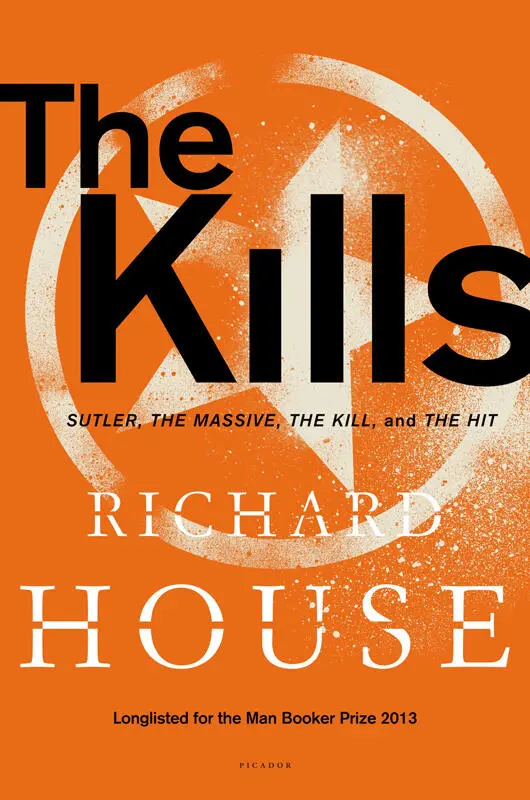
- Название:The Kills
- Автор:
- Издательство:Picador
- Жанр:
- Год:2013
- ISBN:нет данных
- Рейтинг книги:3 / 5. Голосов: 1
-
Избранное:Добавить в избранное
- Отзывы:
-
Ваша оценка:
The Kills: краткое содержание, описание и аннотация
Предлагаем к чтению аннотацию, описание, краткое содержание или предисловие (зависит от того, что написал сам автор книги «The Kills»). Если вы не нашли необходимую информацию о книге — напишите в комментариях, мы постараемся отыскать её.
The Kills — читать онлайн бесплатно полную книгу (весь текст) целиком
Ниже представлен текст книги, разбитый по страницам. Система сохранения места последней прочитанной страницы, позволяет с удобством читать онлайн бесплатно книгу «The Kills», без необходимости каждый раз заново искать на чём Вы остановились. Поставьте закладку, и сможете в любой момент перейти на страницу, на которой закончили чтение.
Интервал:
Закладка:
After the introduction they formed four queues in the foyer, A — F, G — L, M — S, T — Z, where they showed their papers and documents to a couple at a desk, after which, with everything satisfied, they returned to the seminar room. Rem noticed fewer people returning, and was joined by the man he’d spoken with in the parking lot. A sticker, hello, my name is — Rob, on his shirt pocket. They shook hands.
‘Did you show references?’
‘Do we need to?’
‘You’d think? This is an employment agency, right, and they don’t ask for references? You think they don’t have enough people to build their own roads out there?’ Rob kept his eye on the door. ‘Have you spoken with any of these guys?’
Rem said no.
‘Security is usually ex-military. Who knows who these people are?’ His voice low, he asked Rem questions while men were called out for their medical evaluations.
Rem wondered if the man was part of the recruitment process, a spy to vet the candidates they were unsure about, and with this doubt he became less confident about answering his questions. Was he working for the company, or for a rival? You have to consider these possibilities.
When the assistants called the candidates for interview, Rem noticed that Rob became quiet.
* * *
Rem took off his shirt, wondered how far he should go with this, gave blood anyway, breathed in and out when he was asked, answered questions about his general health which made him laugh, and then, behind a screen, produced a urine sample and made sure he filled the container to the top although he had been asked not to. He signed a form certifying that he’d never been convicted of a felony and faced no ongoing charges. When he returned to the seminar room he noticed that Rob was gone, along with half of the applicants. Eight men remaining. After a small wait he was asked back to another seminar room where a formal offer was made. On the wall hung a row of prints, scenes of windmills, fields, and waterways.
Rem allowed the man to talk. If he signed the contract he’d be working with HOSCO: the Hospitality and Operational Support Company of Hampton Roads, Virginia — just as Rob had said. Steve explained that HOSCO managed civil contracts in Europe, Africa, and across the Middle East, but they were hiring now for southern Iraq in a last bid to complete contracts within Amrah City. Rem also needed to understand that while these projects were nominally classified as civil, they were, in fact outsourced military projects: meaning that they were open to private business, and that those private businesses enjoyed military protection.
Rem fought against the urge to explain himself, the pure fun of stating that he was already working for HOSCO.
In Amrah City, Steve promised, you won’t see one local. Not one. It couldn’t be safer. Plus (not that you’ll need it), you have the entire US Marine Corps looking out for you. Posters behind Steve showed men beside diggers, smiling, shaking hands with men in desert MARPAT, a ziggurat in the background, a long low-lying adobe village; or men seated during a work-break at some stumpy oasis surrounded by skinny dogs, handsome strays with dark almond-shaped eyes; or (Rem’s favourite), an employee in a flak jacket playing soccer on wasteland with a scattered group of boys. ‘HOSCO: Building Communities One Project at a Time,’ the sky a clear wondrous blue, suggesting worthy effort and reward. Naive? Sure, but so what, at least they appeared sincere.
And how did the money sound to him? The first figure presented didn’t look impressive, but the advisor added up overtime, what he called ‘strategic placement bonus’ and a ‘completion of work bonus’, then explained the allowance for meals and reimbursement for any work-related accommodation. ‘This is covered while you’re at Amrah. We have a complex close by the government compound, with housing, stores, a PX, a commissary, a fully-equipped gym. And remember, there’s no tax. They can’t take a dime.’
As an idea Rem could see its appeal. The man continued. There were two kinds of insurance, one for life, one for catastrophic trauma.
‘You won’t need it, but it’s there. And supposing, and I mean supposing, something were to go wrong, we’d ship you to Germany and bring you back home. No questions. No trouble. You get the same cutting-edge medical attention as the military. It covers your family back here if you or they have to be provided for. Tell me,’ he asked, ‘where you could make this kind of money, every month. No tax. Not one cent.’
The man asked how good it sounded now, and Rem, understanding that the figure represented his potential monthly earning, not his yearly gross, admitted that it was starting to sound very, very good. Kuwait had paid well, except the agency had subtracted a sizeable monthly fee. This guaranteed considerably more.
When Rem said he’d like to think about it, the man sucked in his breath and placed his hand flat on the papers.
‘Sure,’ he cleared his throat, ‘of course you do. You can’t take a decision like this lightly. You need to consider it, think it through. I understand. I can hold this offer for a week. Think about it, talk it over, do whatever you need to do. If it takes more than a week I won’t be able to offer the same package. We have quotas, and once those are full we won’t be hiring any more. This is our final drive, there aren’t so many places. I’m offering the last of what we have. It’s a favourable package. If you need a week, take a week. I’ll hold it for you. I can’t promise any longer.’
Rem took up the pen, but said that he could not sign without speaking first with his wife.
The man pushed the papers forward.
‘It’s four months,’ he said, ‘you’ll be back before anyone knows you’re gone.’
* * *
Rem folded the contract into his back pocket as he came out of the building, the shift in temperature, from crisp air-conditioning to the humid outdoors, made him hold his breath. As he unlocked his car door he noticed Rob sat on the barrier across the parking lot, an attitude about him, a deliberate wait. A man smoking with intent, thin legs stretched out, looking like the slightest gust would push him over.
‘You didn’t sign anything, did you?’
Rem again wanted to explain what he was doing — just the once.
‘I didn’t sign.’
‘No? Not yet, but you will. You’ll go home and think it over. You’ll think about the money until it sounds so good you can’t see the harm in it. Be careful, though. Take a good look at these people before you agree to anything.’
Rem didn’t have the heart to explain how he’d done this before, as good as. What could be the difference? A complex in Amrah City? A hotel in Kuwait City? Two contained environments.
Three security guards came out of the building and waited under the awning, arms folded. ‘This is public property,’ Rob shouted across the road. ‘I have every right to be here.’
The men watched but kept their place.
‘They think they know me. I’m not a journalist,’ he said, ‘I’m an interested citizen.’
* * *
The two men sat outside the Intercontinental bar on a balcony overlooking the highway. Rem watched the cars and cabs turn off for the terminals, the hive-like hum of the highway, the hotels, the concrete spill of the parking lot and the approach to the airport, he felt part of a larger vista — the wind carried breadth and distance, a scope of land running right the way to Nebraska, Wyoming, the idea of a prairie holding a sense of potential, of unknowing. He let his eye hop over the billboards running alongside the airport approach — hotels, airlines, credit bureaus — as Rob paid for the drinks.
Читать дальшеИнтервал:
Закладка:
Похожие книги на «The Kills»
Представляем Вашему вниманию похожие книги на «The Kills» списком для выбора. Мы отобрали схожую по названию и смыслу литературу в надежде предоставить читателям больше вариантов отыскать новые, интересные, ещё непрочитанные произведения.





Обсуждение, отзывы о книге «The Kills» и просто собственные мнения читателей. Оставьте ваши комментарии, напишите, что Вы думаете о произведении, его смысле или главных героях. Укажите что конкретно понравилось, а что нет, и почему Вы так считаете.