Richard House - The Kills
Здесь есть возможность читать онлайн «Richard House - The Kills» весь текст электронной книги совершенно бесплатно (целиком полную версию без сокращений). В некоторых случаях можно слушать аудио, скачать через торрент в формате fb2 и присутствует краткое содержание. Год выпуска: 2013, Издательство: Picador, Жанр: Современная проза, на английском языке. Описание произведения, (предисловие) а так же отзывы посетителей доступны на портале библиотеки ЛибКат.
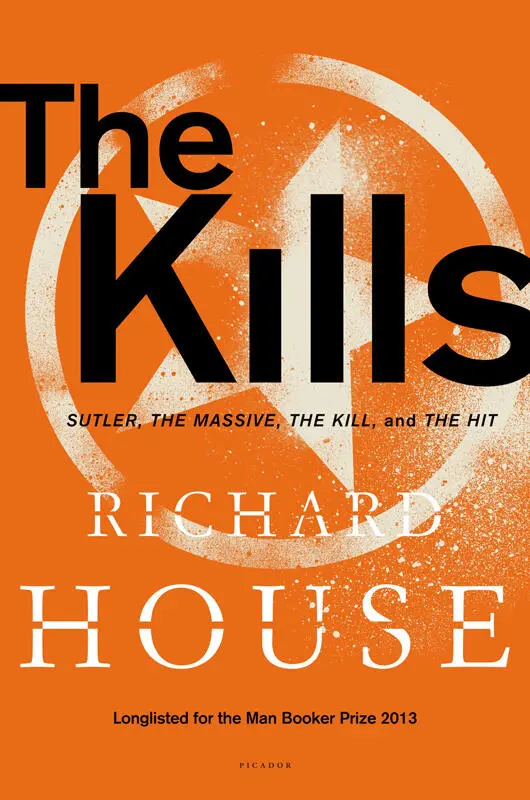
- Название:The Kills
- Автор:
- Издательство:Picador
- Жанр:
- Год:2013
- ISBN:нет данных
- Рейтинг книги:3 / 5. Голосов: 1
-
Избранное:Добавить в избранное
- Отзывы:
-
Ваша оценка:
The Kills: краткое содержание, описание и аннотация
Предлагаем к чтению аннотацию, описание, краткое содержание или предисловие (зависит от того, что написал сам автор книги «The Kills»). Если вы не нашли необходимую информацию о книге — напишите в комментариях, мы постараемся отыскать её.
The Kills — читать онлайн бесплатно полную книгу (весь текст) целиком
Ниже представлен текст книги, разбитый по страницам. Система сохранения места последней прочитанной страницы, позволяет с удобством читать онлайн бесплатно книгу «The Kills», без необходимости каждый раз заново искать на чём Вы остановились. Поставьте закладку, и сможете в любой момент перейти на страницу, на которой закончили чтение.
Интервал:
Закладка:
The businessman explained that he was heading to Boppard, a small town beside the Rhine close to Koblenz. Ford was welcome, but there was nothing in the town except a fine hotel overlooking the river. Quite something. But nothing much of anything if you didn’t have business there, and didn’t care for history, unless you wanted to buy wine or brandy or local crafts. He asked if Ford could drive, then found a lay-by so they could swap seats.
‘I drive all day. I have five people, I need more, but the taxes,’ he shook his head, ‘Europe is expensive, so I work and work.’
* * *
The businessman slumped back in the seat and gave directions. The road wound through the woods, beside bare green trunks, the ground copper with leaves. Rolf pointed out the hunters’ hides and said he had a good story about wolves.
* * *
The hotel sat on a stone bank and commanded a view of the river. Ford parked in front of the hotel and Rolf asked him to remain in the car.
‘I could use a driver tomorrow,’ he said. ‘There’s a group of us, if you like I can arrange for you to stay in the hotel.’
That night Ford dreamed again of Kiprowski: the boy leapt forward through the dust and mayhem, not thrown so much, as taking a long lithe pounce.
6.3
The emails began shortly after her return to New York and continued through the early winter; monologues, which, at first, Anne did not answer as it seemed to her a final discussion. The beginning of a conclusion she would not welcome and did not want. Nathalie informed Anne about the briefest details of her own return, of how she had initially taken up new work at the university, but her interest in research, in teaching had diminished. ‘These people are remote,’ she wrote in a complaint about her colleagues. ‘They know nothing about the world. Not one thing.’ She imagined herself elsewhere, in London, Los Angeles, or New Mexico, where she would wait for news, start a new life. She could not decide.
* * *
She wrote: I heard from Martin a month ago. I knew he would be returning soon, but I didn’t want to see him. He has surrendered his position at the university and now works in seclusion because he fears for his life. I don’t know if you know, but he is continuing with the film — this is the reason for my writing. He intends to finish the films and to have them exhibited. I’m not sure what I think. He believes that Eric was kidnapped because of his project, although, of all the ideas about what has happened, this seems the craziest. Now he regrets ever having Eric involved. Although it is too late for this decision or such a discussion.
The Turkish authorities still have our materials, they say that they are to be released soon, but this has been promised for many months. The arrangement is that everything will be returned to the university.
* * *
She wrote: For the whole year before the trip Martin was in contact with an organization who work with the Kurds in Eastern Turkey and Northern Iraq. He met the group in Paris many years ago, and promised that he would do something to help with their cause. While this was only a small part of what we were doing, it became the most important part. I wanted you to know that Eric was involved in helping people come to Europe. He was helping people to make a new start, perhaps saving people’s lives. I want you to think of him in this way. The work we were doing, this part of the project, could only happen if we were allowed to speak with certain people. Martin arranged for us to bring money into the country, and this money was used for the families to come to Europe. Some were in need of medical attention, and others, families, had been separated for a long time. When I think of this I think that Martin is right to continue, and that this is something Eric would have wanted to see. But everything is in pieces. I’m not sure what can be salvaged.
* * *
She wrote: I know nothing about the things you have asked. If he was climbing then why did he leave his equipment? There is so much that I don’t understand. He would go on his own to these places. I made him promise that he would not climb, but I know that he climbed. I am certain. But I think if something had happened to him as you say then he would have been found. He had no transport, so he could only go to the places that were close, and the police checked these. It is unlikely that he would have gone to a place that wasn’t already in use, a place with other climbers. I don’t know what to suggest.
* * *
She wrote: I have spoken with Martin who has been in contact with the investigators you have hired. I have also made a statement to them. On the day that Eric disappeared the pension was being watched. Martin believes that this was the police. He thinks that they have taken Eric, because everything was taken from the room when we came back from Birsim. First Eric disappears, and when they go looking for him the police confiscate all of our belongings, all of our equipment for the project. There is hope that interest in Martin’s project will put pressure on the authorities in Turkey, who have not helped, and continue to be difficult.
* * *
She wrote: I have a theory about travel, that if I keep myself on the move I will finally find him. I see the same faces at airports and train stations, the same people in coffee houses and cafés, the same people are on the move, and there is an inevitability that, if he is moving, then we will connect through this motion. It is inevitable. I hear him sometimes, I see him often when I am boarding a train, or when I am tired, I see someone who has elements taken from him. I see these pieces that are taken and adapted by other people.
* * *
She wrote: Everyone believes that there are plots. Everyone believes one or another theory. That he was kidnapped, taken as a hostage, so that he is innocent and we are guilty. Everyone believes that we are involved and that we know where he is, and there is some ransom to be paid and that we are hiding something, because it is impossible for someone to disappear so completely. They have found Eric’s traveller’s cheques, and it is possible that he was in Izmir.
* * *
She wrote: Our film has been returned. Eric’s notebooks are among the last of the pieces to come back from the police. Everything is here. The people you have hired came to collect them yesterday. At last we can move forward. Perhaps there is something in his notebooks which will help us.
* * *
Anne spent her days in the apartment. She explained to her husband that it was easier to work at home. There were politics at the museum she would rather avoid, and as long as she completed her research and met her editor’s deadline then no one worried about where she actually worked.
Her mornings followed a pattern. On a good day she would contact Marcellyn at Colson Burns and work through the information they provided. Much could be accomplished from her home computer: checks and queries, messages sent. She could call and hassle the consulates in Istanbul and Ankara. She would feel herself surmounting the problem. On a bad day she curled on her son’s bed, inactive, unable to move. On a very bad day she would take the room apart, carefully re-explore every drawer, every item, every moveable speck. She would take the posters down from the wall and return them with particular care to their exact place. Recently there were many more very bad days than bad days, and more bad days than days she could tolerate.
The habit established itself. As soon as Mark left in the morning she steeled herself to her tasks: started up her computer, set out her books, opened up the files, drew out the images of The Betrayal, and Portrait of a Knight, ready across her desk. Then — force of habit — she would walk to Eric’s bedroom, and lose her day.
Читать дальшеИнтервал:
Закладка:
Похожие книги на «The Kills»
Представляем Вашему вниманию похожие книги на «The Kills» списком для выбора. Мы отобрали схожую по названию и смыслу литературу в надежде предоставить читателям больше вариантов отыскать новые, интересные, ещё непрочитанные произведения.







Обсуждение, отзывы о книге «The Kills» и просто собственные мнения читателей. Оставьте ваши комментарии, напишите, что Вы думаете о произведении, его смысле или главных героях. Укажите что конкретно понравилось, а что нет, и почему Вы так считаете.