Richard House - The Kills
Здесь есть возможность читать онлайн «Richard House - The Kills» весь текст электронной книги совершенно бесплатно (целиком полную версию без сокращений). В некоторых случаях можно слушать аудио, скачать через торрент в формате fb2 и присутствует краткое содержание. Год выпуска: 2013, Издательство: Picador, Жанр: Современная проза, на английском языке. Описание произведения, (предисловие) а так же отзывы посетителей доступны на портале библиотеки ЛибКат.
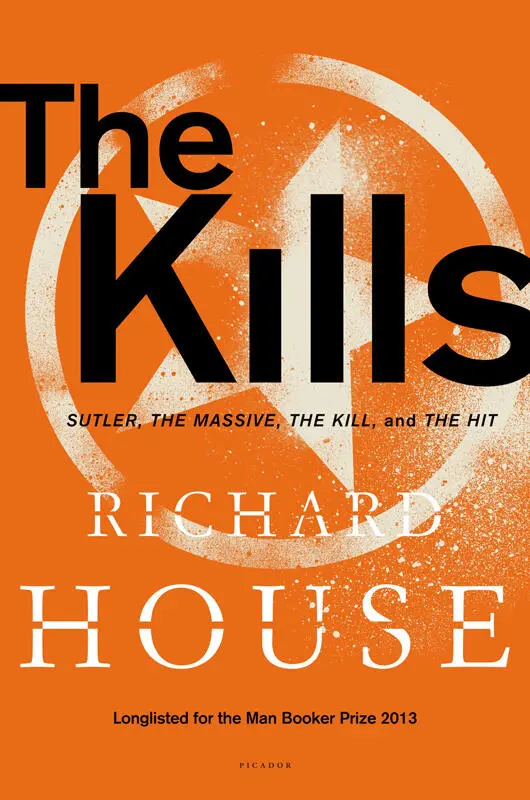
- Название:The Kills
- Автор:
- Издательство:Picador
- Жанр:
- Год:2013
- ISBN:нет данных
- Рейтинг книги:3 / 5. Голосов: 1
-
Избранное:Добавить в избранное
- Отзывы:
-
Ваша оценка:
The Kills: краткое содержание, описание и аннотация
Предлагаем к чтению аннотацию, описание, краткое содержание или предисловие (зависит от того, что написал сам автор книги «The Kills»). Если вы не нашли необходимую информацию о книге — напишите в комментариях, мы постараемся отыскать её.
The Kills — читать онлайн бесплатно полную книгу (весь текст) целиком
Ниже представлен текст книги, разбитый по страницам. Система сохранения места последней прочитанной страницы, позволяет с удобством читать онлайн бесплатно книгу «The Kills», без необходимости каждый раз заново искать на чём Вы остановились. Поставьте закладку, и сможете в любой момент перейти на страницу, на которой закончили чтение.
Интервал:
Закладка:
She satisfied herself with the idea that he was somewhere remote, with a new group of friends, people who shared the same passion. He would be climbing somewhere. Almost certainly. Somewhere remote. ‘I’ll come back. There’s another flight on Thursday, I’ll go to the airport and see if he’s there. But I’ll come back. I’m done with my work in any case.’
Anne made her excuses and promised to call later. As she cancelled the call she found herself alone.
5.7
Ford returned to Ca’ Floridiana early in the morning in the hope that he would see Anne leave and he could risk a closer look at the property. The road that swung about the villa appeared less dramatic in the daylight, the village of Marsaskala smaller, the houses strapped to the bay-side road all faced the sea. Now that the rain had stopped, the sun regained its heat and grew fierce enough to draw scents off the blacktop, the sides of houses, the tin that covered shacks and shop fronts. A burnt fuzz of scorched straw hung in the air. Ford waited two hours. Certain that Anne was not home he counted people coming in and out, and realized it was, as he had found on the previous night, too busy. People would want to know his business. Ford returned to the village and sat out his afternoon, feeling the opportunity slide away from him. Why, exactly, had he come here? He felt distant enough now, even secure; his concerns began to shift to other matters — what he should do, where he should move on to, how he could earn money? Without the dog tags, without Eric and his notebooks, he needed to refigure his plans. While he was free, he was also penniless.
The sun encouraged a kind of laziness, and he half expected to bump into Anne, to find her in one of the cafés or walking beside the port browsing the smaller shops. The longer he sat, the less he wanted to do. Money in any case was short. He had enough for food, and if he didn’t pay for his hotel he’d have enough for a flight. He’d paid for the first night in cash and the manager, pleased to see him stay, happily allowed the nights to accrue.
He found a small café-bar on the waterfront and bought himself a beer. The café offered free internet, and lost for what to do he sat at the terminal, knees just sliding under the table, and typed in names.
‘Eric Powell’ brought almost nothing: a comic-book enthusiast, a sculptor, Myspace and Facebook pages for high-school students, a video of a boy taunting a dog. ‘Eric Powell +Turkey’ returned photographs for Thanksgiving, some jokes about food poisoning. He searched for ‘Anne Powell’ and found information on an exhibition in Rome, lecturers at minor US universities — nothing of interest. For ‘Paul Geezler’ he found more substantial information, pages of reports from the New York Times, the Washington Post, the Financial Times, all linked to HOSCO. In separate reports he found that Geezler was supervising the break-up of HOSCO in southern Iraq, and that he would head a new company managing private construction and supply.
He bought himself a second beer, picked and scanned through pages, and learned that Geezler was returning to Washington to report on the decommissioning of HOSCO, its devolution into smaller companies. On an image search he found photographs of Kiprowski, a head shot accompanying a report on contractors in Iraq. On a first read it made little sense. Here, Kiprowski, looking not quite like himself — Ford couldn’t recall him smiling, at least not so unguardedly — and underneath a tagline noting his death from an insurgent attack on Southern-CIPA at Amrah City.
Kiprowski killed in a mortar attack on Southern-CIPA.
A memorial to be held at St Jerome’s in Rogers Park, Illinois, attended by his parents, his brothers, his sister.
He’d asked Kiprowski to come to Southern-CIPA after he’d changed his mind about Clark and Pakosta. He wanted Kiprowski because Kiprowski kept himself to himself; because Kiprowski could be asked to do something and he would automatically attend to the task; because Kiprowski was easier company; because if Ford was caught leaving the compound, deviating from their usual routine, Kiprowski would not raise any alarm.
Kiprowski had run after him the moment before the mortar strike. The boy came running out of Howell’s office with Ford steps away from the door. The boy had run, hammering down the corridor, teeth gritted, arms beginning to rise — and in that final moment he’d closed his eyes as if he knew.
For Ford the moment before the explosion stuck with him in clear definition. Kiprowski running with his eyes closed, sprinting hard, then everything in pieces, the corridor, the air, the ground suddenly liquid, dense with matter. Flung outward, thrown by the blast, Ford had landed on his back, winded, but was on his feet by instinct, and had run out of the dust to the perimeter fence. He couldn’t see, he couldn’t hear anything but a shrill mechanical jabber. He didn’t ache until he arrived at Balad Ruz two days later, when his hands had begun to burn and his back had seized up. He felt like he’d been beaten, kicked, but knew, even so, that nothing serious had happened. The blast had knocked them out of the building, small enough to damage an office, but nothing of substance. His assumption to this point was that Kiprowski, two steps behind, was fine, because he was fine.
* * *
Ford drank through the afternoon, he read through the articles, clicking back through his history, refreshing his searches, checking repeatedly on Geezler, and finding in every report mentions of Southern-CIPA and the Massive. Geezler: responsible for reorganizing HOSCO contracts in southern Iraq. Geezler: negotiating on behalf of the company, apologizing for the disarray. Geezler: the only company representative ready to step up to the mark. Geezler: apologizing and accepting that HOSCO was entirely responsible for the hiring of its personnel, but that questions about the mismanagement and misappropriation of government funding should be directed at the appropriate governing bodies. Geezler: admitting that the money was gone. Geezler: recovering part of the funding; first twelve million, then five, then another thirteen. Geezler quoted: the company can no longer continue to operate along these lines without accepting responsibility. Geezler: HOSCO operations must be redistributed, the company must be reorganized, restructured, rebuilt, trust needs now to be earned. Geezler: architect and director of a new company, CONPORT, taking over the support contracts for US military in southern Iraq. Geezler: the man of the moment.
He drank. He paid for the beers one by one to keep a check on his money, each time leaving a small tip. In the late afternoon he asked for a telephone, international, and the barman pointed him to a corner store where he spent the last of his money on a phone card.
It took a while to find the company number. Geezler’s extension he could remember: an easy rhythmic 6363. He could not remember the direct number for the company, nor the man’s private number, and could not find the line for the government offices at Southern-CIPA — it occurring to him too late that there was no number because Southern-CIPA no longer existed.
Central-CIPA government operations in Baghdad were split across divisions. Dealings with HOSCO, with outsourcing, with contractors, were managed across administrative departments contract by contract.
He felt them stalling, evading, every person he spoke with, and down to his last five minutes he cancelled the call then dialled the number for HOSCO at Hampton Roads, Virginia, and found himself routed to an answering service who recommended that he call Geezler directly at Southern-CIPA, although they had no number. Don’t you know, he said, don’t you pay attention to the news?
Читать дальшеИнтервал:
Закладка:
Похожие книги на «The Kills»
Представляем Вашему вниманию похожие книги на «The Kills» списком для выбора. Мы отобрали схожую по названию и смыслу литературу в надежде предоставить читателям больше вариантов отыскать новые, интересные, ещё непрочитанные произведения.






Обсуждение, отзывы о книге «The Kills» и просто собственные мнения читателей. Оставьте ваши комментарии, напишите, что Вы думаете о произведении, его смысле или главных героях. Укажите что конкретно понравилось, а что нет, и почему Вы так считаете.