Richard House - The Kills
Здесь есть возможность читать онлайн «Richard House - The Kills» весь текст электронной книги совершенно бесплатно (целиком полную версию без сокращений). В некоторых случаях можно слушать аудио, скачать через торрент в формате fb2 и присутствует краткое содержание. Год выпуска: 2013, Издательство: Picador, Жанр: Современная проза, на английском языке. Описание произведения, (предисловие) а так же отзывы посетителей доступны на портале библиотеки ЛибКат.
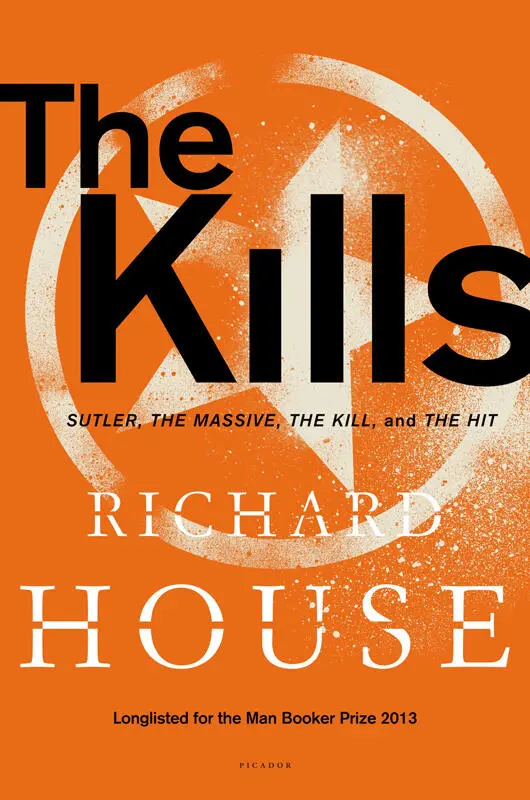
- Название:The Kills
- Автор:
- Издательство:Picador
- Жанр:
- Год:2013
- ISBN:нет данных
- Рейтинг книги:3 / 5. Голосов: 1
-
Избранное:Добавить в избранное
- Отзывы:
-
Ваша оценка:
The Kills: краткое содержание, описание и аннотация
Предлагаем к чтению аннотацию, описание, краткое содержание или предисловие (зависит от того, что написал сам автор книги «The Kills»). Если вы не нашли необходимую информацию о книге — напишите в комментариях, мы постараемся отыскать её.
The Kills — читать онлайн бесплатно полную книгу (весь текст) целиком
Ниже представлен текст книги, разбитый по страницам. Система сохранения места последней прочитанной страницы, позволяет с удобством читать онлайн бесплатно книгу «The Kills», без необходимости каждый раз заново искать на чём Вы остановились. Поставьте закладку, и сможете в любой момент перейти на страницу, на которой закончили чтение.
Интервал:
Закладка:
Walking through the market, Rike can believe in this transfiguration. It isn’t something that anyone would plan. But the situation is useable. A man this determined could make it work for him. It’s part of what he needs to do.
* * *
She can’t find her keys. Typical. And can’t believe her luck when she sees the door open, Isa home and complaining about the smell, a fan in the corridor blowing air into the apartment.
‘I just needed some fresh air.’
‘How did it go?’
‘Twins.’ Isa looks for a reaction which Rike won’t give. ‘Only kidding. Does it smell in here? I think it still smells. They’ve collected the trash, but the stink lingers.’
Rike checks the kitchen drawer and finds a second set of keys. She takes these and uses her body to block Isa’s view. She’ll have them re-cut. Henning, a stickler with keys, would make a big fuss if he knew.
‘So what did they say? Seriously?’
‘Nothing. I’ve put on a little more weight than I need — that’s me, not the baby. But nothing. Really. Nothing.’
‘Blood pressure?’
‘Fine. Not great, but fine.’
‘Did he say when?’
Isa smiles and nods, can’t help herself. ‘Same date. A little less, maybe. Maybe two days earlier. I have a feeling he’s right.’
The sisters hug and hold on to each other.
* * *
Isa speaks with Henning on the phone, her voice low, but not low enough. It’s possible that she’s unaware that Rike has returned. For almost an hour Rike has been reading in the garden, and when Isa went for a shower she slipped out quickly to have a new set of keys cut in the corner shop.
It takes a moment for her to realize that she is the subject of the conversation.
‘ That’s the problem. That’s it right there. It’s always the wrong person. At school she had this thing for an autistic boy. What was his name? It was like a project or something. Her project. I don’t know. You know how she is. And then Franco. That whole thing.’ Isa pauses, then interrupts. ‘No, she had this whole thing for him, fell in love with him.’ Another pause, and when she resumes speaking her voice has an unexpected sincerity. ‘Because I worry for her.’
Rike returns to the garden, is tempted to make some noise — make a point. Under the tree, stretched out, head up with bright little eyes, is the black cat — long and lovely. Rike pockets the keys, looks at the cat, and while she should feel delight, she doesn’t. She doesn’t feel anything other than irritation about being the third party to a conversation about her private life. Rike takes her seat a little distracted by her lack of outrage. It doesn’t mean anything. Isa always has to take things too far. All that nonsense about the autistic boy. And what was his name? Michael Something. Michael Koenig. Short, fat (didn’t Isa always point that out?), Michael Koenig with his pudgy face which generated any quantity of stuff: noise primarily, but also snot, tears, spittle. A boy whose tantrums and violence were unparalleled, but who was also, often, peaceful, calming. The boy behaved without constraint. In every action, every response, Michael Koenig never lied, had zero cunning, and despite his moods she knew exactly where she stood with him. Unlike Isa, Michael never disappointed her, because she expected little from him. Other people, on the other hand, were infinitely disappointing. Had she loved him? Certainly, in whatever way you love someone when you are younger. Her desire to include him in every activity (she insisted that he be invited camping with them) bordered on mania. Isa just didn’t like him. She probably felt replaced.
That Isa would still be resentful doesn’t surprise her.
The nonsense about Franco is so outrageous she can’t reason her way around it. And yet, isn’t this typical? Doesn’t Isa break every confidence between them, blab out everything they share, because this is what Isa does? And how ugly is it to take her concern and twist it in this way? She begins to feel some heat on the matter. Mattaus behaves like a shit toward Franco. For five years, perhaps longer, Franco is as good as family, so why shouldn’t she be concerned for him when Mattaus behaves the way he does? This is typical of Isa, so busy with herself that she doesn’t see the full picture. Isa doesn’t know how Mattaus behaves with Franco, not in the same way as Rike — and yes, why not, she does feel protective of Franco. But how typical. Really. How typical of Isa to say such a thing.
It’s possible that her overhearing the conversation wasn’t accidental. In any case, it doesn’t matter. Rike won’t be provoked.
Isa comes into the garden with news.
The man from the desert is being brought to Cyprus. Today or tomorrow. This is now definite. Henning will have his way, and he’ll return soon, although they don’t know exactly when, and she doesn’t know which hospital the man is being brought to: military or civil.
Rike says she knows, not about the hospital, but about the man. She spoke with Henning right after Udo gave his consent to the move.
‘No,’ Isa corrects her. ‘You must have heard wrong. He’s only just told me. This is probably why Udo was at the hospital today.’ Isa sucks air between her teeth, considering. ‘My guess is the military hospital at Akrotiri will have better facilities. And they’ll want to keep him secure, don’t you think?’
Rike agrees without showing interest. So Henning will be back soon? Good. This, at least, will make things easier.
3.4
In the morning the driver takes Gibson to Naples. Sullen after viewing the site of the incident, Gibson sits in the back seat and does not talk. The driver says that there are details which will need to be discussed, but this can wait for the moment. Rooms have been booked in Hotel Laurino on via dei Tribunali, and when they arrive, they find a man waiting for them in the lobby, knees together, arms crossed, unlikely to be a guest. He rises to shake the driver’s hand and Gibson realizes that he has this wrong. The man isn’t a driver but someone more senior. Gibson recalls the man introducing himself as Sandro, and giving a second name and rank he hadn’t caught. The ranking and organization of the Italian police is confusing. There’s the police, and then the carabinieri. He isn’t sure how the duties are divided. And magistrates? In Italy the magistrate is part of the investigation.
Gibson offers his hand to the other man, who smiles but says nothing. If Gibson would like, Sandro says, he can go over some of the details for him, and explain the procedures. It might make the day a little easier. ‘You will be seeing Laura Parson?’ he asks. Given the circumstances she has been helpful, and remarkably courageous.
* * *
Sandro believes he has everything straight. He understands the reason for Parson’s time in Italy. He understands the working relationships: how Parson worked for Gibson & Baker, and how HOSCO was their client. This he understands.
What is less clear is the reason why hotel rooms — in Palermo, Bari, Castellammare, and Naples — have been booked in Paul Geezler’s name.
‘I checked them,’ he says, and found that nearly eighty per cent of the bookings were not used. ‘A room was booked, but nobody stayed. In some cases the room was not paid for.’
Sandro has copies of the papers found on the train, if Gibson wouldn’t mind. He lays the papers out across the glass coffee table. Gibson recognizes Parson’s handwriting.
Читать дальшеИнтервал:
Закладка:
Похожие книги на «The Kills»
Представляем Вашему вниманию похожие книги на «The Kills» списком для выбора. Мы отобрали схожую по названию и смыслу литературу в надежде предоставить читателям больше вариантов отыскать новые, интересные, ещё непрочитанные произведения.







Обсуждение, отзывы о книге «The Kills» и просто собственные мнения читателей. Оставьте ваши комментарии, напишите, что Вы думаете о произведении, его смысле или главных героях. Укажите что конкретно понравилось, а что нет, и почему Вы так считаете.