Richard House - The Kills
Здесь есть возможность читать онлайн «Richard House - The Kills» весь текст электронной книги совершенно бесплатно (целиком полную версию без сокращений). В некоторых случаях можно слушать аудио, скачать через торрент в формате fb2 и присутствует краткое содержание. Год выпуска: 2013, Издательство: Picador, Жанр: Современная проза, на английском языке. Описание произведения, (предисловие) а так же отзывы посетителей доступны на портале библиотеки ЛибКат.
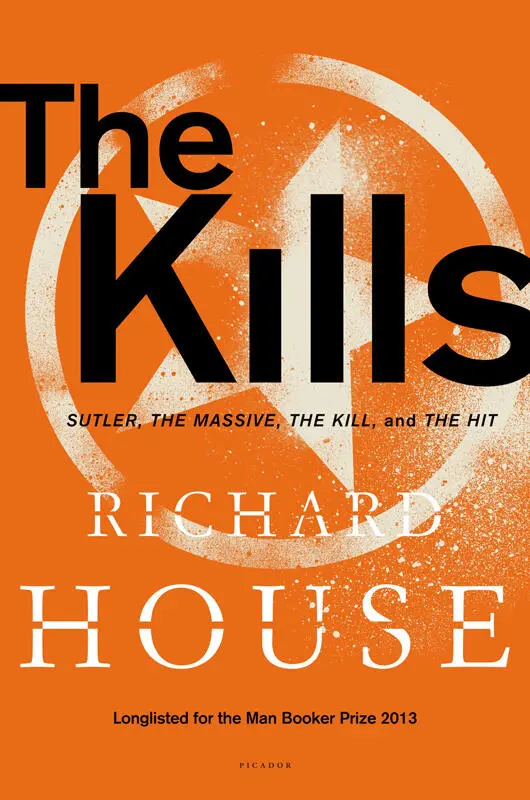
- Название:The Kills
- Автор:
- Издательство:Picador
- Жанр:
- Год:2013
- ISBN:нет данных
- Рейтинг книги:3 / 5. Голосов: 1
-
Избранное:Добавить в избранное
- Отзывы:
-
Ваша оценка:
The Kills: краткое содержание, описание и аннотация
Предлагаем к чтению аннотацию, описание, краткое содержание или предисловие (зависит от того, что написал сам автор книги «The Kills»). Если вы не нашли необходимую информацию о книге — напишите в комментариях, мы постараемся отыскать её.
The Kills — читать онлайн бесплатно полную книгу (весь текст) целиком
Ниже представлен текст книги, разбитый по страницам. Система сохранения места последней прочитанной страницы, позволяет с удобством читать онлайн бесплатно книгу «The Kills», без необходимости каждый раз заново искать на чём Вы остановились. Поставьте закладку, и сможете в любой момент перейти на страницу, на которой закончили чтение.
Интервал:
Закладка:
Rike waits at the door, makes small talk about the packets left out in the hall (insulation, no?) and for the first time she takes a proper account of the room; the loose water-stained parquet floor which makes the whole room feel unsteady; bare white walls bruised with grey scuffs. A window overlooks a small playground, and opposite, behind her, double doors lead to a balcony which overlooks the street. A sad room, if rooms can be sad, weighted by the absence of furniture and the fact that month after month new people live here.
Set ready by Tomas’s chair: a notebook, a newspaper, a dictionary.
‘No birds today?’
‘Yesterday,’ he says in German. ‘Today we have snow in the hall. Snow, in bags, fake snow, polystyrene, in bags as big as this.’ He gestures up to his chest, then shrugs. ‘I have my homework. Here.’ He points to the window overlooking the back of the apartments, and they stand side by side and look out.
The building describes a hard U. Tomas’s apartment is almost dead centre. The two wings of the complex, east and west, curve on either side; between them lies a small, bare playground. The flagstones have been recently hosed and swept. This view feels English to her despite the row of stumpy palms (in Peckham every estate had a play park with swings, a slide, and sometimes a roundabout, and how these parks became the territory for thugs not children). Rike looks at the wings, at the parallel lines of balconies and windows. Most of the shutters are closed, but where they are open it’s impossible not to invent stories of these lives. Once again there are the sounds of people, dishes chipping together, a radio, nothing as loud as the previous day. A man in swimming trunks vacuums his apartment. There’s a rhythm in his dips and sweeps, even in the way he pauses to smoke.
‘I was reading about Syria this morning. Again, the news is very bad.’
Rike hasn’t heard the news today. Most of what she knows comes via the internet or her sister. Neither is reliable.
‘It’s hard to know what’s happening.’
Tomas sips his coffee, his elbow on the window ledge so that the cup and saucer are held over the drop. Below, on the flagstones, a cat.
‘The Arabs. They should do something. They wait, and what for?’
Tomas Berens is making conversation and it would be polite to respond. Rike can’t quite formulate her thoughts. She can’t think of Syria without thinking of her sister, and then there’s the report Isa read out loud two nights ago about how the unrest was nothing more than war-by-proxy. This isn’t Egypt or Libya, this isn’t about freedom, not with Russia, China, Iran stuck in the mix. She doesn’t like to think of Syria as a place where something is enacted, where moves are made, but she isn’t naive enough to think that this is new, it’s impossible to think of a small country which doesn’t have associations with bigger, more ambitious neighbours. She can’t figure out the sides. Exactly who are the rebels the government are suppressing? Rike can’t make small talk because she doesn’t know what she thinks, so she asks instead to hear about Tomas’s neighbours. Even this isn’t simple. Her self-awareness has created tension. It’s strange to stand next to a man you have dreamed about, as if, by dreaming, some line has been crossed.
‘We should speak only in English? Yes?’
Once again Rike speaks slowly, aware that Tomas is watching her mouth. This is normal, students watch the shape of her mouth, how the lips stretch or curl to a word, to notice where the tongue is placed: visible or not. Not so normal were the three men she taught in London last summer who looked only at her breasts, expectant, not with lust, so much, as hunger, so she couldn’t look at them without thinking of them as being parched or starved. Her one discomfort with teaching is the sense that she’s being sapped dry, although, she admits it’s slightly nonsensical to think of knowledge as nourishment. It’s not uncommon, Isa tells her, for teachers to imagine that their students are obsessed with them. It isn’t that Rike actively considers these ideas as she stands beside Tomas, or even believes them, but they come at her as a package, one thought tied to another, bound by habit and connections. Isa’s ideas are crafted to be wicked, ridiculous, and sticky. Nevertheless, those grey Nordic eyes as they coolly watch her mouth are a little unsettling.
‘Show me where they live and tell me their location. You understand?’ She points to the apartment where the man has finished his cleaning. The blinds are still open but the room is now vacant. ‘Tell me where these people are. Describe their location. Inside? Outside? Behind? Beneath? On top. Tell me where they live.’ The dream sits with her as a residue. Everything she says today brims with innuendo. Rike focuses her attention on Tomas’s right hand, and such big hands. She hopes that Tomas doesn’t sense what passes through her mind.
Tomas nods, sets down his cup, then points to the windows to his right: east wing, one floor below. ‘Christos the driver and his wife live on the third floor.’ He points now at the west wing: a window with open shutters, where pale blue curtains, thin as a nightdress, drop over the sill. ‘Below. One floor,’ he points directly down, ‘is the Kozmatikos family. The mother is a speech therapist. Sometimes you hear the students. Peh-peh-peh. Treh-treh-treh.’ He trills the ‘r’. ‘It must be the school holiday because her son is always home. Maybe he is sick. I often see her son at the window,’ and again in German. ‘I spoke with her husband yesterday. I don’t remember his first name. He works as a pharmacist. The Kozmatikos family have lived here for a long time. It’s close to the hospital and easy for work. He inherited his apartment from his father. I think that’s what he said.’
Rike asks that he speak in English.
‘Before, there were fourteen children here, but now there are only three. He says that Limassol isn’t so friendly now, it’s bigger, and there are many people who come for their holidays. Many businessmen also, and many Russians.’ He points at the opposite building. ‘Most of the rooms on this side are bedrooms and bathrooms. On the front are the sitting rooms.’
They return to the room, then Tomas draws Rike to the balcony and points to the street and the opposite building, the last before the hospital.
‘A judge lives there. He lives on the top floor with his wife. In the evening you can see it’s one long room. The apartment is modern. You see, with the black and white painting? He wears a suit and house shoes. You would not know he is a judge. His wife is an elegant woman. Christos says that the judge has a house at the coast near Larnaca and another in the Troodos mountains. This is where he stays when the court is in session.’
Tomas quickly checks his notebook.
‘I sit here in the morning with my coffee. This is my routine. Every morning I watch the judge’s driver. His car is parked in the same place and the man stands in the same place, like this.’ Tomas folds his arms in demonstration. ‘According to Christos he is a police officer. He is always calm and relaxed. His expression is always the same. He notices everything.’
Tomas looks up from his notes and smiles his first proper smile.
‘The doctor’s son ran away — the Kozmatikos boy. This morning, the mother accused the supervisor of leaving the main door open. The boy is seven or eight and he’s always dressed in his football clothes. He was gone for four hours. He isn’t allowed out of the building on his own. Along the street there is a café which is managed by two brothers, then a news-stand which sells comics and books. There is a man who watches the parking spaces on both sides of the street. He never speaks with the judge’s driver, who is often waiting in the street. During the day the street appears respectable, but at night there are women on the corner. They sit on mopeds. I’m not certain they are all women.’
Читать дальшеИнтервал:
Закладка:
Похожие книги на «The Kills»
Представляем Вашему вниманию похожие книги на «The Kills» списком для выбора. Мы отобрали схожую по названию и смыслу литературу в надежде предоставить читателям больше вариантов отыскать новые, интересные, ещё непрочитанные произведения.




Обсуждение, отзывы о книге «The Kills» и просто собственные мнения читателей. Оставьте ваши комментарии, напишите, что Вы думаете о произведении, его смысле или главных героях. Укажите что конкретно понравилось, а что нет, и почему Вы так считаете.