Richard House - The Kills
Здесь есть возможность читать онлайн «Richard House - The Kills» весь текст электронной книги совершенно бесплатно (целиком полную версию без сокращений). В некоторых случаях можно слушать аудио, скачать через торрент в формате fb2 и присутствует краткое содержание. Год выпуска: 2013, Издательство: Picador, Жанр: Современная проза, на английском языке. Описание произведения, (предисловие) а так же отзывы посетителей доступны на портале библиотеки ЛибКат.
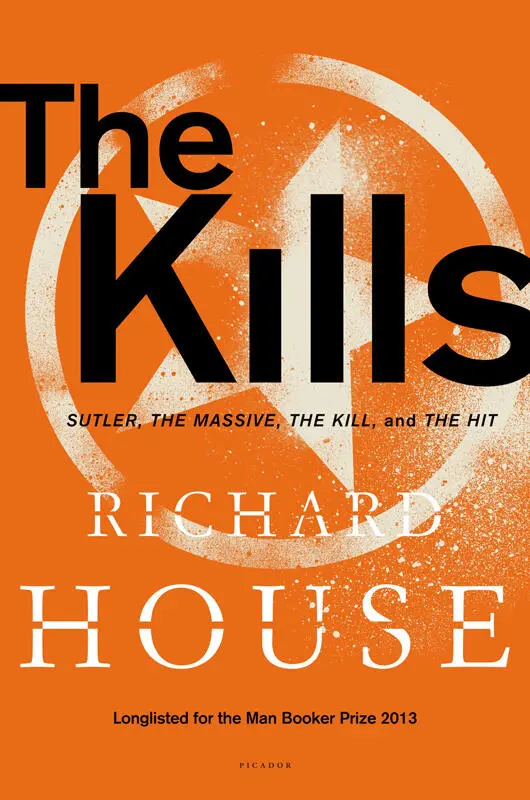
- Название:The Kills
- Автор:
- Издательство:Picador
- Жанр:
- Год:2013
- ISBN:нет данных
- Рейтинг книги:3 / 5. Голосов: 1
-
Избранное:Добавить в избранное
- Отзывы:
-
Ваша оценка:
The Kills: краткое содержание, описание и аннотация
Предлагаем к чтению аннотацию, описание, краткое содержание или предисловие (зависит от того, что написал сам автор книги «The Kills»). Если вы не нашли необходимую информацию о книге — напишите в комментариях, мы постараемся отыскать её.
The Kills — читать онлайн бесплатно полную книгу (весь текст) целиком
Ниже представлен текст книги, разбитый по страницам. Система сохранения места последней прочитанной страницы, позволяет с удобством читать онлайн бесплатно книгу «The Kills», без необходимости каждый раз заново искать на чём Вы остановились. Поставьте закладку, и сможете в любой момент перейти на страницу, на которой закончили чтение.
Интервал:
Закладка:
She sits at the edge of her bed, her back needling. The room is close, the air sticky, and she tries to calm herself by thinking of the swimmer instead of the student at the station. But the substitution of one man for another will not work. The man in the pool and the youth at the station, while not similar, were also too similar, and the sound of the traffic, the scooters, the taxis, the night bustle of the city, while not like the sounds of the station, were not unlike the sounds of the station. The familiarity, the associations were uncanny and close.
She thinks of opposites, of things that are not there and memories that will not trouble her. Instead of heat, she thinks of snow. Instead of the city, she imagines herself above it, safely distant, alone on the mountain. Her immediate memory is of her first close view of snow. She was five when her father drove her to the volcano and presented it to her as if it were of his own making. It was winter, the first day of the year, and she remembers the long and steep road along the flanks of the mountain, and her excitement at how strange it was to be looking back at the city rather than out at the mountain. The inner cone sheltered by the separate shattered ridge of Monte Somma, and between the two peaks ran a long and lower field of rucked and fluid lines of stone capped and softened with snow. The trees, so thin and precarious on the steep lip, appeared sparse and burned, black against a thin white drift, and it is with this thought, the notion of a field of blankness, of coldness, of everything alien to the physical heat currently pressing down upon her, that she is able to slowly shut the chatter out her mind. And to this place she brings the swimmer, and the two of them sit, silent, side by side, overlooking a plain snowbound void.
There was no killing. There were no brothers. The city does not exist.
THE HIT
THE FIRST SUTLER
1.1
The trouble starts as soon as they arrive. The flight to Damascus is delayed for an unspecified reason, which means another three hours with Udo.
Rike thinks they should leave him at the airport but doubts that Henning would approve. It doesn’t help that they are early. Udo wants to know if the trouble with the flight is a regular problem, or something more ominous. Damascus, he says, fretting the word. Damascus. He suggests a drive around the salt flats or into Larnaca, when Henning receives a call.
Henning dips his head to listen, one hand at his hip he strikes a pose of concentrated irritation. The call is bad news, and he looks to Udo. ‘We have identification,’ he says. ‘Papers on the train.’
Henning wants Udo to explain how an intelligent man can somehow disappear from inside a sealed train, moving at, what, sixty, seventy, eighty kilometres an hour, with doors which do not open, with windows which do not lower, to be found in pieces on the tracks? How is this possible? How does a man who has evaded capture for so long find himself caught between the Napoli — Roma Express and the Milano Eurostar? How?
In any case, he doesn’t believe that this is Stephen Sutler on the train tracks in Rome, any more than he believes Sutler was sighted in Grenoble, or that the man currently in hospital in Damascus is Sutler. Whatever identification they’ve found on the train will prove false.
Udo isn’t happy to be challenged. He isn’t happy to be talking about this in Rike’s presence. He begins to explain they don’t yet know what happened in Rome, and anyway, this isn’t their business. If he’s honest he doesn’t see why they should be responsible for the man in Damascus. He’s serious. ‘This isn’t our concern.’ Leave it to the Americans. Leave it to the British.
Henning holds out his hands, insulted.
‘This is your best advice?’
‘The police. The appropriate British authorities. Let them work this out.’
* * *
They view the salt lake from the car. The land slopes toward the sea then flattens in a perfect line to a field of white. Rike squints to take it in. There are stories of resurrections, visions, transpositions. Cities have been seen in the shimmering light, ships traversing or hovering above the plain. The salt is blindingly bright and moisture rises from the bed in waves which obliterate the horizon. While they have time, Udo doesn’t want to visit the shrine.
Henning asks Rike where else she wanted to go. Some mosque, right, a sepulchre or mausoleum? Could Rike explain to Udo about the sepulchre? Udo says he’s heard about it. Umm Haram? Hala Tekke? That building across the salt flat surrounded by palms. The only feature in an otherwise blank terrain.
None of them know for certain.
There’s some other place she’s thinking of in town.
‘I know,’ Udo says. ‘I know. I know what you’re going to say.’
Henning wants to make a point and won’t be robbed of the opportunity.
* * *
In town Rike visits the tomb on her own. Henning and Udo stay with the car and talk business. It’s exactly what you’d hope for. Something and nothing. Steps down to a chamber and an open tomb. A ceiling so low you have to bow. A row of censers. Stone and dust. The absent body of a saint. She isn’t sure how to behave in such a place, even on her own.
When she returns to the street Henning and Udo are leaning against the car, smoking and sulking.
‘Tell him,’ he says, ‘who was buried here.’
‘I know.’
Rike opens the car door, sits inside, winds down the window and tells Udo that this is Lazarus’s tomb, although the lid is shattered and the tomb is empty.
Udo holds up his hands, it’s the same gesture Henning uses. He rolls his eyes. ‘I know.’
Henning stands upright and the car adjusts.
‘We bring him here.’
‘We don’t bring him here.’
Henning turns to Rike. ‘Tell him why he’s here. Tell him about Lazarus.’
‘He isn’t here. It’s empty.’
‘But tell him. And tell him why he came here.’
‘He had to escape. He fled and came to Cyprus. This is where he died.’
‘We bring him here.’
Udo indulges Henning’s idea, although it’s clear that he doesn’t agree. ‘Why?’
‘Because he’s in our care. Because we can keep him safe.’
Udo straightens his suit jacket. He hates stories, he says, especially stories like this.
‘We bring him here,’ Henning turns to Udo, ‘to Cyprus, and we see who comes after him.’
‘This isn’t thought through. It’s undigested. It looks like a solution, but it isn’t.’
‘We bring him here.’
‘We do no such thing.’ This is Udo’s final word.
* * *
On their way home, Henning stops to show Rike the view. Behind him a single peak rises from a flat plain. On top of this peak sits a monastery. She’s seen the image in postcards, the blocked walls bridging boulders and outcrops. Without a bare blue summer sky it isn’t as impressive as expected. Henning sucks on an ice-pop. One hand on his hip again, but this time he isn’t annoyed. He asks Rike not to tell her sister about the man on the train. Not one word. Isa doesn’t need to know, and she isn’t to mention it. OK? Agreed? He tucks his tie into his pocket and leans forward so the lolly won’t drip onto his shirt. His lips are stained red and he laughs. He stands in front of a sign that says no photographs — military installation and asks Rike to take a photo. ‘Send it to Isa,’ he says, ‘tell her we’ll be back in an hour.’ They will stop by work first.
Читать дальшеИнтервал:
Закладка:
Похожие книги на «The Kills»
Представляем Вашему вниманию похожие книги на «The Kills» списком для выбора. Мы отобрали схожую по названию и смыслу литературу в надежде предоставить читателям больше вариантов отыскать новые, интересные, ещё непрочитанные произведения.





Обсуждение, отзывы о книге «The Kills» и просто собственные мнения читателей. Оставьте ваши комментарии, напишите, что Вы думаете о произведении, его смысле или главных героях. Укажите что конкретно понравилось, а что нет, и почему Вы так считаете.