Richard House - The Kills
Здесь есть возможность читать онлайн «Richard House - The Kills» весь текст электронной книги совершенно бесплатно (целиком полную версию без сокращений). В некоторых случаях можно слушать аудио, скачать через торрент в формате fb2 и присутствует краткое содержание. Год выпуска: 2013, Издательство: Picador, Жанр: Современная проза, на английском языке. Описание произведения, (предисловие) а так же отзывы посетителей доступны на портале библиотеки ЛибКат.
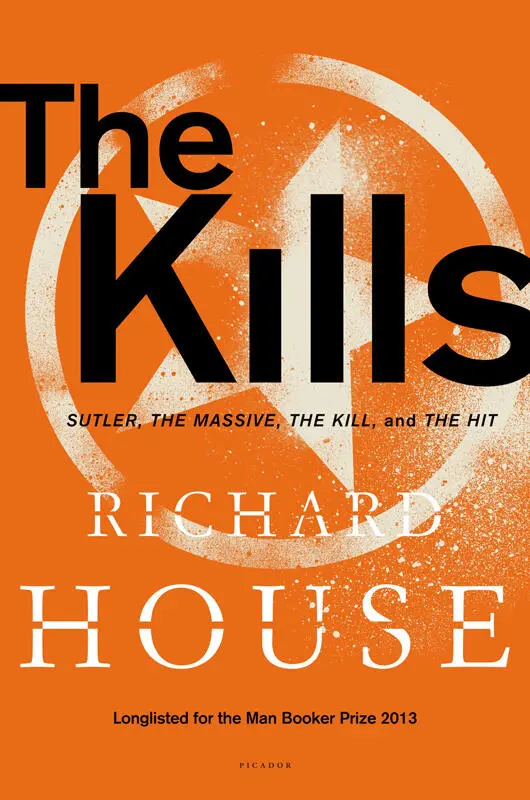
- Название:The Kills
- Автор:
- Издательство:Picador
- Жанр:
- Год:2013
- ISBN:нет данных
- Рейтинг книги:3 / 5. Голосов: 1
-
Избранное:Добавить в избранное
- Отзывы:
-
Ваша оценка:
The Kills: краткое содержание, описание и аннотация
Предлагаем к чтению аннотацию, описание, краткое содержание или предисловие (зависит от того, что написал сам автор книги «The Kills»). Если вы не нашли необходимую информацию о книге — напишите в комментариях, мы постараемся отыскать её.
The Kills — читать онлайн бесплатно полную книгу (весь текст) целиком
Ниже представлен текст книги, разбитый по страницам. Система сохранения места последней прочитанной страницы, позволяет с удобством читать онлайн бесплатно книгу «The Kills», без необходимости каждый раз заново искать на чём Вы остановились. Поставьте закладку, и сможете в любой момент перейти на страницу, на которой закончили чтение.
Интервал:
Закладка:
These ideas set fire to her skin. The rash won’t quieten.
She calls a specialist recommended by her sister-in-law and makes an appointment.
THURSDAY
Monica takes the morning off work and turns up early at the specialist’s office in Portici. The rash hasn’t improved. Dr Novi carefully checks her back and asks after her diet and sleeping pattern. He washes his hands after the inspection and says that this is minor, although he is certain that it must irritate her, it’s unlikely to be caused by the chlorinated water. More likely than not the condition is caused by stress (and this is something she didn’t know?), although it was always possible that they were using different chemicals, or more chemicals than they should. He cannot be certain. He will provide a prescription for a salve, and suggests that if she wishes to continue her exercise that she swims instead in salt water where she will benefit from both the ions and the iodine, but failing that, there’s a mineral pool in Lucrino, a small distance from the city. It is, he said, a far second best, because it might be better if she does not swim at all.
Monica sits on the doctor’s raised bed, dissatisfied with the examination. She’d mentioned swimming only because this was easier than explaining about the cause of her stress. She can’t be certain about his recommendation either. Can she or can’t she swim? It isn’t clear. Swimming offers her the one pure moment when she does not have to answer to her family, or to work. While she swims, in that brief thirty-five minutes each day, she is completely alone, and the isolation that the activity brings is a welcome and rare pleasure.
* * *
Immediately out of the office Monica takes the metro to Cavalleggeri d’Aosta, and in the heat and bustle her clothes irritate the skin, and send a small charge, a pulse around her back. She tries to scratch her wrist instead of her back but finds this useless.
The pool is new, less than a year old, and managed by a university. Monica changes in a private booth, conscious that her costume is old, and that chlorine is beginning to rot the stitching. The pool itself is steel, of even depth, and encased in glass, one side looks out to a bright view of a honey-coloured cliff, the lip of a crater, the other to a parking lot, and in the distance, the other side of the crater.
Monica is joined at the poolside by a young man. Like Monica the man has with him a towel, which he sets on the slate side away from the pool, and goggles, the straps wrapped about his hand. She watches as the man walks to the head of the pool and chooses the centre lane, and she considers quickly who she would be able to keep pace with, and picks the lane beside the young man.
On her first few laps she finds herself swimming faster than her usual pace. Her stroke, although clean, is usually underpowered, but once she is comfortable she begins to move with economy and feels the motion to be smooth and direct, and for twenty minutes she swims without a break, aware of the young man in the lane beside her. As Monica swims freestyle, the young man swims breaststroke, and they fall into an easy rhythm, swimming at points side by side. When she stops, the man continues, and she watches him set the pace for the lane with a powerful, simple stroke — as his hands dive forward his head ducks down and his shoulders follow in a sequence that is direct and uncomplicated. Unlike the other swimmers he causes little disturbance in the water, no splashing, and no hurry, just a smooth and considered series of movements. When she starts again, she finds herself falling into the same rhythm and is mindful to contain her stroke and make the movement as direct and uncomplicated as she can. Hand slightly cupped, she breaks the water, thrusts her arm full length, then folds it under her in a long swift swipe, and finds with this simple adaptation that she moves quicker, further, faster.
At the end of his swim the young man stands at the end of the lane. Tall and gangly, he has none of the poise and grace out that he commands when he is in the water.
Monica returns to the changing rooms exhilarated, not only by the swim but by the coincidence of swimming beside the young man. It is only when she sits to take off her costume that her mood changes and she remembers the boy at the station, and an unreasonable notion strikes her that if one man she had noticed disappeared, it could possibly happen again. As soon as the thought occurs she dismisses it. There was no killing, she tells herself. No such thing.
FRIDAY
Monica returns to the pool at the same time. As she walks into the building she’s surprised to see the young man ahead of her, smartly dressed with a small backpack. He leans forward a little as he walks. She guesses that he has come directly from work, and wonders if the people he works with understand how exceptionally graceful he is in the water. Out of the water there’s nothing exceptional about him, but when he swims everything about him seems in tune and in place. She stands beside him to pay for her ticket, neither smiles nor acknowledges the other, and the previous day’s anxiety is remembered but not felt. The man has returned, of course he has returned. Nevertheless, if she hadn’t seen him, his absence would have troubled her.
And so she swims beside the man again, each keeping pace, that one or the other sometimes breaks, and she finds this silent company comforting and imagines that a familiarity is growing between them. While she fights to keep pace she begins to recognize when her own stroke becomes similarly economical and pure. In just two sessions her stroke is beginning to change, she is becoming long, more decisive with her reach, so that the motion is unconsciously fluid. Afterward, she wonders if the man deliberately keeps pace with her, he made no attempt to force any other kind of contact between them. Out of the water they are strangers, in the water they are companions, and their bodies move at the same pace. She can feel his company as soon as she slips into the water. She is familiar now with the set of his mouth as he comes up for air, his quick efficient gasp, the hunch of his shoulders as he lunges forward, and the speed with which he pulls deep into the water.
This is, she understands, a distraction. The more preoccupied she becomes with the swimmer, the less she needs to think about the student at the station, about the boy at the piazza.
SATURDAY
On the Saturday, the swimmer does not appear, it shouldn’t surprise her, but she finds it impossible to swim, and sits at the poolside waiting. That night her anxieties return in a full and wide-eyed sleepless distraction. She sits upright in bed, her back irritating, the nerve ends prickle, sharp and sensitive. The heat of the room and the oily stink of traffic catch in the night air, familiar to her as the station that morning two years ago. She sees it time and time again, the train door, the boy crouched beside his bags with his back to her, the shirt as it was on his back, and the shirt as it was, bloodied and cut. Why hadn’t she delayed him? Why hadn’t she spoken to him?
On the news the boy’s parents, Mr and Dr Lee, who move like people who do not trust themselves, whose bodies might at any point fail them, who look torn by grief and unknowing. They beg for the release of their son. Dr Lee speaks in Italian, explains how much her son loves the city. Speaks in the present tense to keep him alive.
Monica watches the news. The footage of the vigil. The candles as a map or a sea, all comfort taken from the image. They show the brothers, a still of their faces which gives nothing away. A politician explains that Krawiec is to be released but banned from the country. She does not know how they can do this. These brothers, the politician struggles for adequate words, come to our city to feed on us, not once, but twice, like wolves. There are calls again for information regarding Mizuki Katsura, the thinking now is that the killers have taken her absence, her disappearance, the belief that she was killed to be instruction and script on the abduction of the boy. She must come forward. How then did they find the first American? Was this an accident? Did they choose him the moment she passed by, or had the decision already been made, the boy as good as dead?
Читать дальшеИнтервал:
Закладка:
Похожие книги на «The Kills»
Представляем Вашему вниманию похожие книги на «The Kills» списком для выбора. Мы отобрали схожую по названию и смыслу литературу в надежде предоставить читателям больше вариантов отыскать новые, интересные, ещё непрочитанные произведения.






Обсуждение, отзывы о книге «The Kills» и просто собственные мнения читателей. Оставьте ваши комментарии, напишите, что Вы думаете о произведении, его смысле или главных героях. Укажите что конкретно понравилось, а что нет, и почему Вы так считаете.