Richard House - The Kills
Здесь есть возможность читать онлайн «Richard House - The Kills» весь текст электронной книги совершенно бесплатно (целиком полную версию без сокращений). В некоторых случаях можно слушать аудио, скачать через торрент в формате fb2 и присутствует краткое содержание. Год выпуска: 2013, Издательство: Picador, Жанр: Современная проза, на английском языке. Описание произведения, (предисловие) а так же отзывы посетителей доступны на портале библиотеки ЛибКат.
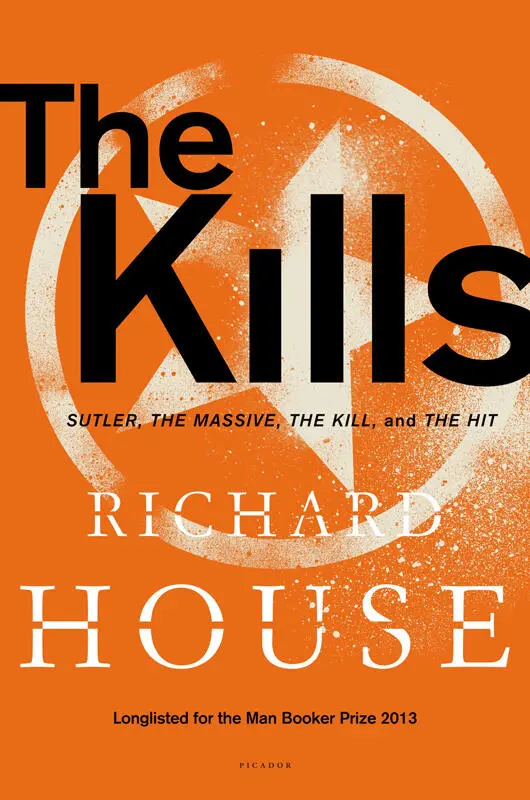
- Название:The Kills
- Автор:
- Издательство:Picador
- Жанр:
- Год:2013
- ISBN:нет данных
- Рейтинг книги:3 / 5. Голосов: 1
-
Избранное:Добавить в избранное
- Отзывы:
-
Ваша оценка:
The Kills: краткое содержание, описание и аннотация
Предлагаем к чтению аннотацию, описание, краткое содержание или предисловие (зависит от того, что написал сам автор книги «The Kills»). Если вы не нашли необходимую информацию о книге — напишите в комментариях, мы постараемся отыскать её.
The Kills — читать онлайн бесплатно полную книгу (весь текст) целиком
Ниже представлен текст книги, разбитый по страницам. Система сохранения места последней прочитанной страницы, позволяет с удобством читать онлайн бесплатно книгу «The Kills», без необходимости каждый раз заново искать на чём Вы остановились. Поставьте закладку, и сможете в любой момент перейти на страницу, на которой закончили чтение.
Интервал:
Закладка:
The police had said that they would get back to him if they needed help, and given this new witness he was certain that they would need more information once they understood a little more about the situation. He wouldn’t wait for the call, he would make his own investigation. It was almost two days now since his discovery, and during those two days Niccolò had been walking in a different world, breathing different air, separate and expectant. In the long hours sat monitoring cars and staff in and out of the dye plant, he nursed the idea that he was being tested and observed, as if the event itself, the murder of this student, was some kind of creature.
Closing the book Niccolò decided that he would conduct his own investigation, then he would contact the police and hand the notebook over to them along with his findings. He would say that someone left the little book outside his door, or that he had found it in a part of the field that they had not searched, or perhaps that he had found it a place that they had searched just to make a point of their uselessness.
Disappointed with the day Niccolò re-read the articles in Fede’s newspaper and could not shake the idea that whatever had happened was predetermined, that all of these people and coincidences combined to make the event not only inevitable, but possible. As if the event itself had some kind of intelligence, an ability to decide what would happen and who would be involved.
* * *
The evening was slow and Livia contrary, whatever mood he was in was bothersome to her, and she had no interest in speaking about the investigation, nor in hearing his ideas.
‘Stop,’ she told him. ‘Don’t make this into something it isn’t. Just stop. Take a walk.’
Avoiding confrontation Niccolò did exactly as Livia asked and took a walk and returned to the wasteland and the line of empty factories with his slingshot in his pocket to smoke and think a little about Livia and the baby, but more about how he would start his investigation. When he reached the factory the stink was now so foul that he couldn’t enter. And then it occurred to him. If the clothes were dumped on the wasteland, and the person wearing the clothes had been seen on the Circumvesuviana train, then they must have walked from the station to the wasteland.
He couldn’t decide which station the student would have taken. If he was a student or a tourist he would have alighted at the Scavi stop. This seemed the most logical. It was always possible, of course, that it was not the victim who took the train in the first place. In which case whoever had committed the crime would have taken the train from the city and brought the clothes with them, and they could have used either stop, Ercolano, or Ercolano Scavi.
As he walked the route, he began to think his logic was wrong. If the student was heading into the city, then why were the clothes found here, outside the city? And supposing the person who committed the crime did travel to Ercolano to dump the clothes, then there was no guarantee that they, like the victim, had taken the train. This walk was a waste of time. He needed to go to the station in Naples to see who came on the trains, and who left. To think about this properly, he needed to be at the station himself.
* * *
Later, when he settled into bed beside his sister and lay on his back, he doubted that he would sleep. It didn’t help either that Livia slumbered soundly beside him, out almost before she laid down, mouth open, breath softly chortling; even in sleep she sounded dissatisfied. He longed for the baby to be born, and he longed for her to go.
As he lay in bed he retraced his walks from the wasteland to the station, the night leaning on him as a palpable pressure, thick with possibilities: an American on a train, a woman at the station, clothes on the wasteland, and the hint that this all connected to him. It was likely that the person who killed the American student was also on that train with him that morning.
* * *
Mizuki rose early, dressed, sat on the balcony, then fell immediately into a deep, recuperative sleep. At seven thirty she was woken by a call from Lara. She watched the phone vibrate and allowed the call to go to message.
Mizuki took her morning shower then returned to the balcony. She held out her phone to read the screen and saw two missed calls.
‘Mizuki. The police came to the bakery yesterday. They wanted to know if the bakery have ever printed their logo onto any clothing.’ Lara paused, little more than a short intake of breath. ‘I’m talking about the bakery under the school.’ She paused again. ‘The sign, the star sign. Mizuki. Are you there? They were asking about a T-shirt. Call me.’
Star signs? Mizuki didn’t understand. She looked out at a wall of closed shutters and thought about the school and the palazzo, then remembered the small tin star that hung above the portico.
Lara called again, and again Mizuki allowed the call to go directly to message. ‘Mizuki. Have you seen the news? Call me. Have you heard? It’s on the news, right now, on the radio, on the TV.’ Lara carefully explained: a T-shirt with the same design as the bakery logo had been discovered cut and bloodied on wasteland outside the city. But stranger still, someone, a commuter, had come forward convinced that they had seen a tourist, a young boy, wearing this T-shirt at the Circumvesuviana station last Friday morning. Mizuki felt her chest tighten, and was surprised that this was anger, not fear. She had come to Naples to experience something, and here was that something — and she’d missed it. She wasn’t there.
Lara left a message asking to meet.
‘I’m worried,’ she said, ‘you haven’t called me back. I thought it was you. Did you contact the police? I’ll be at the station before class. I’ll meet you outside the station at eight.’
* * *
Mizuki came directly into the city. Once at the station she looked for the brothers, but they were not on the platform, not on the concourse, nor waiting, as before, under the long overhang from the station to the street, nor in the bright sunshine waiting by the taxis. Their absence came as a heavy disappointment, just to see them would offer some kind of solace — but what would she have said that wouldn’t have ended in some kind of disappointment?
Lara waited outside the station. Not ready to talk, Mizuki took the exit through to the main station and walked from Stazione Centrale all the way around, through piazza Garibaldi, back to the Circumvesuviana so that Lara would not see her, but she could see Lara. Her phone sang in her hand.
Mizuki returned to the cafe she where she had spoken with Lara and listened to the message as she watched the station through the window. She had seen the clothes on the news and felt sad that a relative would have to identify them. Until they found the young man these clothes would be the only record of what had happened. The clothes were made in America, this is what they were saying now. But the coincidence about the star was very strange.
‘I thought it was you,’ Lara said, and as Mizuki listened to the message, she saw Lara come into view. ‘The person who came forward. The woman who spoke with the police. I thought this is why I haven’t seen you.’
* * *
Lara’s final call came later that night while Mizuki was considering if she should or should not pack. Mizuki accepted the call but did not speak.
‘I know how this is,’ Lara spoke. ‘I know how this feels. My father, when he died — I had to collect his jacket from the police.’ At four thirty one summer afternoon her father had taken off his suit jacket, laid it carefully across the passenger seat, and before he could settle into the car had suffered a heart attack. ‘I brought everything back. Things they had taken from the car, and my mother, the first thing she did was check through the jacket, to empty his pockets as if she didn’t trust him.’
Читать дальшеИнтервал:
Закладка:
Похожие книги на «The Kills»
Представляем Вашему вниманию похожие книги на «The Kills» списком для выбора. Мы отобрали схожую по названию и смыслу литературу в надежде предоставить читателям больше вариантов отыскать новые, интересные, ещё непрочитанные произведения.





Обсуждение, отзывы о книге «The Kills» и просто собственные мнения читателей. Оставьте ваши комментарии, напишите, что Вы думаете о произведении, его смысле или главных героях. Укажите что конкретно понравилось, а что нет, и почему Вы так считаете.