Richard House - The Kills
Здесь есть возможность читать онлайн «Richard House - The Kills» весь текст электронной книги совершенно бесплатно (целиком полную версию без сокращений). В некоторых случаях можно слушать аудио, скачать через торрент в формате fb2 и присутствует краткое содержание. Год выпуска: 2013, Издательство: Picador, Жанр: Современная проза, на английском языке. Описание произведения, (предисловие) а так же отзывы посетителей доступны на портале библиотеки ЛибКат.
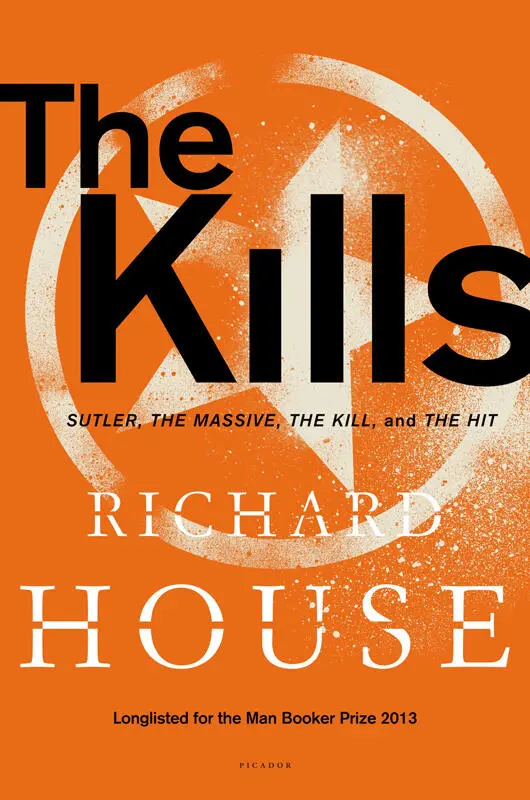
- Название:The Kills
- Автор:
- Издательство:Picador
- Жанр:
- Год:2013
- ISBN:нет данных
- Рейтинг книги:3 / 5. Голосов: 1
-
Избранное:Добавить в избранное
- Отзывы:
-
Ваша оценка:
The Kills: краткое содержание, описание и аннотация
Предлагаем к чтению аннотацию, описание, краткое содержание или предисловие (зависит от того, что написал сам автор книги «The Kills»). Если вы не нашли необходимую информацию о книге — напишите в комментариях, мы постараемся отыскать её.
The Kills — читать онлайн бесплатно полную книгу (весь текст) целиком
Ниже представлен текст книги, разбитый по страницам. Система сохранения места последней прочитанной страницы, позволяет с удобством читать онлайн бесплатно книгу «The Kills», без необходимости каждый раз заново искать на чём Вы остановились. Поставьте закладку, и сможете в любой момент перейти на страницу, на которой закончили чтение.
Интервал:
Закладка:
‘Why do men do that?’ she asked. Angry now, Livia told him to get up and prepare for work.
By the time Niccolò had dressed Livia was sitting at the table drinking hot water, calmer and less concerned, colour back in her face. ‘I’m OK.’ She gave a tight smile that said she was still not quite herself. It had been a hot night and the heat had made her uncomfortable. ‘I’m fine,’ she said. ‘Go. You’ll only make me more anxious.’
He said goodbye from the door and as she waved she told him to head directly to work.
* * *
Niccolò returned to the wasteland to find the cordon taken down from the field. After only one night the police and reporters were already gone. The wasteland was still sectioned with stakes and tape, but the vans and cars and massive steel stanchions that held the arc lamps were gone. With nothing left except a few posts and lengths of tape snagged in the flattened grass it was hard to believe that the wasteland had attracted any attention at all.
He drove his scooter by the abandoned factories on his way to work. You could walk to them quicker, straight down the hill toward the bay. After the crossroads the road led directly down to the shoreline, the factories, the railway, the water. He drove slower by the market gardens and the rows of covered greenhouses, the plastic sheeting fogged and tracked with condensation. To his right the factories now: most of the buildings were without roofs, many had their entrances and windows bricked up and sealed. Heat rose from the stony fields of sparse and scorched grass which, some summers, held a lone mule.
The scooter made a feeble warble as he passed the first buildings, a thin wail thrown off the concrete wall to the road and fields. He slowed as he came to the last building, an old paint factory, and stopped at the small alley that led down to the railway bridge and the shore. Discarded on the steep slope lay bags of trash, ripped open with papers and plastic. Bound, rotten and dried bouquets of flowers spilled out. Flies broke loose from the weeds as Niccolò hitched the scooter onto its stand. He shouldn’t be riding. He shouldn’t be lifting. The agreement was that he would walk to work. When you’ve come this far, remember, it doesn’t have to be everything at once. Niccolò checked to make sure he was not being watched or followed. A loose group of boys played football on the pumice road above the wasteland, and a white dust hung in the air.
The police had searched the paint factory the previous night and strings of black and yellow tape stretched across the doorway and lower windows.
As he approached the entrance Niccolò walked as if he intended to follow the alley down to the sea, but ducked quickly under the police tape and slipped inside, where he waited, head up, attentive, to ensure that the building was empty. Children often played in the building (possibly the same children who sometimes pelted him with stones when he rode to work). With its shattered walls daubed in graffiti the factory made an attractive haunt. Slogans and obscenities scrawled across the concrete named people he did not know.
Safe inside, Niccolò no longer felt the urgency he’d felt in the apartment. In the first room, cut into the floor, was a square metal tank with a round mouth, in which he dumped objects he no longer wanted. The animals he’d caught on the scrubland, cats mostly, stunned or dead, things he’d found, items he didn’t need. Niccolò walked about the hole, scuffed a half-brick to the rim and tapped it over. The drop could only be a couple of metres, three at the most and the water would not be deep. Now disturbed, the water stank. He thought of the things he’d dropped into the water — the cats, the cans, the playing cards — as things which passed through a mirror to an inverted world: from his hands to someone else’s.
He sat close to the hole, then carefully laid out the contents of the bag along the edge. After considering them for a moment, he divided the objects into two groups.
In the first line he laid out the blue notebook, a charger for a mobile phone, a black and white postcard of the port at Palermo, a wallet containing only receipts.
The second line, closer to the edge, included a receipt for the Hotel Meridian in Palermo, a mini-audio player with a crack in the plastic face, a small bottle of medication for insect bites, an open pack of chewing gum, a soap packet, a razor with a used blade, a novel with the cover torn off, a pocket-sized Italian — English dictionary.
In one last pass he looked through the items again and selected only the small blue notebook, which he returned to the sack. Its pages were greasy with oil, the ink smudged, and the paper translucent. Written in a small slanted hand that he couldn’t read or in any case understand.
With one gesture he swept everything else into the tank.
* * *
The two other members of the B-4 security guard at the Persano-Mecuri chemical dye plant, Federico Taducci and ‘Stiki’ Bashana, met late on Saturday afternoons and occasionally in the evenings before work to play cards, sometimes at Bar Settebello in Ercolano, and sometimes at Federico’s small apartment on the outskirts of town, less occasionally at a place closer to Stiki in Torre del Greco. Two years ago the shifts were managed with only one guard, but after the theft and assault, two men now monitored the facility during the night and one maintained security at the gate during the morning and through the afternoon.
Federico, a widower, always failed to invite Niccolò — not that Niccolò especially wanted to play Scopa or Sette e Mezzo — but he did want to be invited, and besides, Niccolò was the closer neighbour. Stiki lived in a single room in one of the larger blocks overlooking the train station at Torre del Greco. Younger than Niccolò by only two years, Stiki seemed much younger. He studied engineering, and worked nights to subsidize his studies. Always obliging, he smiled frequently but seldom laughed, and Niccolò mistook Stiki’s poor and formal Italian as a sign that he was uninterested. At night Stiki slept while Fede played cards solo or taught himself English. Fede bought one American newspaper a week and made a show of completing a word puzzle. Niccolò often looked at the paper, but could make no sense out of it.
On this morning Federico stopped to speak with Niccolò. Fede greeted Niccolò warmly and asked for news about the investigation, they had both seen the news before the start of their shift and followed the reports on the radio. This is why he was late, no? The police had business with him? Stiki, ready to leave, loitered for a while, his backpack slung across his shoulder.
Niccolò bowed his head modestly and confessed that both the police and journalists were gone.
‘Gone? Already?’ It was mysterious, he said, very strange, they had listened to the news through the night. ‘Are you sure?’ Fede narrowed his eyes. ‘You’re not hiding anything, right? If there was something you’d tell me?’
Niccolò opened the windows and started a small fan. The booth carried a stale smell of sleep that Niccolò found unpleasant, but he could smell something else, as if the stink from the paint factory had clung to him, stuck to his hands or clothes.
‘Don’t you think it’s strange?’ Fede gave a reasoning shrug. ‘They leave after one night? One night. Think about it. It’s suspicious.’
Stiki agreed. It was suspicious.
Niccolò recognized that the two men were not entirely serious and said he didn’t see how.
‘It makes you think, though? No? Something is going on,’ Fede considered. ‘I’m telling you, there’ll be more news tomorrow and they’ll come back. This isn’t over yet. You’ll see.’
Читать дальшеИнтервал:
Закладка:
Похожие книги на «The Kills»
Представляем Вашему вниманию похожие книги на «The Kills» списком для выбора. Мы отобрали схожую по названию и смыслу литературу в надежде предоставить читателям больше вариантов отыскать новые, интересные, ещё непрочитанные произведения.



Обсуждение, отзывы о книге «The Kills» и просто собственные мнения читателей. Оставьте ваши комментарии, напишите, что Вы думаете о произведении, его смысле или главных героях. Укажите что конкретно понравилось, а что нет, и почему Вы так считаете.