Yvonne Owuor - Dust
Здесь есть возможность читать онлайн «Yvonne Owuor - Dust» весь текст электронной книги совершенно бесплатно (целиком полную версию без сокращений). В некоторых случаях можно слушать аудио, скачать через торрент в формате fb2 и присутствует краткое содержание. Год выпуска: 2014, ISBN: 2014, Издательство: Knopf, Жанр: Современная проза, на английском языке. Описание произведения, (предисловие) а так же отзывы посетителей доступны на портале библиотеки ЛибКат.
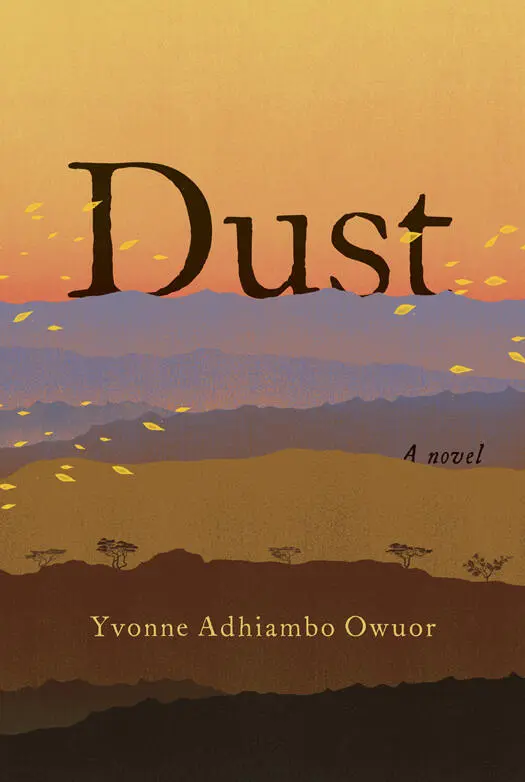
- Название:Dust
- Автор:
- Издательство:Knopf
- Жанр:
- Год:2014
- ISBN:9780307961204
- Рейтинг книги:5 / 5. Голосов: 1
-
Избранное:Добавить в избранное
- Отзывы:
-
Ваша оценка:
Dust: краткое содержание, описание и аннотация
Предлагаем к чтению аннотацию, описание, краткое содержание или предисловие (зависит от того, что написал сам автор книги «Dust»). Если вы не нашли необходимую информацию о книге — напишите в комментариях, мы постараемся отыскать её.
Odidi Oganda, running for his life, is gunned down in the streets of Nairobi. His grief-stricken sister, Ajany, just returned from Brazil, and their father bring his body back to their crumbling home in the Kenyan drylands, seeking some comfort and peace. But the murder has stirred memories long left untouched and unleashed a series of unexpected events: Odidi and Ajany’s mercurial mother flees in a fit of rage; a young Englishman arrives at the Ogandas’ house, seeking his missing father; a hardened policeman who has borne witness to unspeakable acts reopens a cold case; and an all-seeing Trader with a murky identity plots an overdue revenge. In scenes stretching from the violent upheaval of contemporary Kenya back through a shocking political assassination in 1969 and the Mau Mau uprisings against British colonial rule in the 1950s, we come to learn the secrets held by this parched landscape, buried deep within the shared past of the family and of a conflicted nation.
Here is a spellbinding novel about a brother and sister who have lost their way; about how myths come to pass, history is written, and war stains us forever.
Dust — читать онлайн бесплатно полную книгу (весь текст) целиком
Ниже представлен текст книги, разбитый по страницам. Система сохранения места последней прочитанной страницы, позволяет с удобством читать онлайн бесплатно книгу «Dust», без необходимости каждый раз заново искать на чём Вы остановились. Поставьте закладку, и сможете в любой момент перейти на страницу, на которой закончили чтение.
Интервал:
Закладка:
Ali Dida Hada’s face, now drained of emotion, is a void. Dem Hira! He curses within his mind.
Forefinger to lips, Petrus says, “Shhh.” He then adjusts his glasses. “Me amnesia, you amnesty, or vice versa.” Petrus salutes Ali Dida Hada. He turns around and flings open the metal door. Whistling “Sina Makosa.”
Receding footsteps.
Ali Dida Hada tries to shove air into his lungs.
30
INSIDE A NAIROBI GUEST ROOM, A SKULL ACQUIRES ITS OWN eyes. Fingers mold contours and crevices, drawn from worlds of feeling that she has known and that she imagines. The light changes as she seeks its moods to offer gradations to her work. Ajany has done this before, always returning to the memory of the cave for meaning. She wipes down the plaster of Paris; her fingers shape eye orbits. More certain now of how to build the nose and mouth, she shapes the nasal opening and spine. Tingle in her arms, glow in her heart, Ajany becomes the shaping, the finding, the becoming. Later, she will adjust the skull on a black metal stand with a broad base.
First, Isaiah wipes the sandman’s crusts from his eyes. Next, he waits for the bite of despair that is the companion to his waking. Third, he remembers the early morning, how it started and ended, and when he raises his body to find the woman again, a movement stops his eyes and he sees that the colors of the late afternoon have muted her being and submerged her in her story making and if he moves too soon she might disappear.
She is looking at a broken skeleton from the cave of memory. Ajany stretches clay across a plaster-of-Paris cranium.
In the midst of molding, she stops.
Glancing over her shoulder, seeing Isaiah watching her. A small smile. Soft-voiced, she says, “I need your father’s photograph.”
He reaches for his wallet in the discarded trousers, pulls out the photograph, steps over their clothes to reach her and give it to her, fingers touching, hands clinging.
He says, “It’s late?”
“About two.”
“Slept well.”
She smiles.
“Here’s Dad.”
Ajany stares at the sepia image.
Her mind returns to the cave, and its skeleton.
She closes her eyes.
Hugh Bolton’s gaze.
Obarogo.
She drops the photograph. Picks it up, hands it over to Isaiah. Not looking. Composing herself, she touches his face instead, tugging at skin.
He watches her.
She applies clay to the object’s upper and lower eyelids. She touches Isaiah’s mouth to learn it and transfer it to clay.
Strips of clay. A mouth of clay. She thinks of Hugh’s mouth in the photograph.
When she moves again, Isaiah grabs her right wrist, catches her fingers between his teeth. Scrapes his teeth down her palms to the soft part of her wrists. She reaches up for him. Isaiah bends, kisses her, sucking, suckling, curious. Waiting for someone to move away.
The wind slams the window shut.
They pull away slowly.
She turns to her work.
Stillness.
She breathes out abruptly.
Fighting temptation — this need to cling to another, to touch and be touched, burrowing out simple spaces and escaping despair for a season.
Three days later, almost four — an imperfect face returns to the world after a full night’s crafting. It is made of distance, silence, frozen time, and old light. Its essence transfixes two people, the woman who has textured him to life, and the man who would be his son who cannot speak.
“This is what I know,” Ajany says, hugging herself.
Isaiah swoops her up. Squeezes her hard.
Nothing lasts.
Not hope, or pleasure. Isaiah wanted more to be in control over. He wanted a place to go to, to look and find. He had questions:
How do you know?
Where do I look?
How can you know?
Where is he?
“I don’t know,” she repeats.
I don’t know .
“What do you know?” His fingers grab at her arm.
There’s a cave made of red , she could say. But if she did, she would have to imagine how its agitated occupant got there, and if she did, she would have to start with Wuoth Ogik, and if she tried, she would hear both Odidi and her old I swear . The silence.
She says, “I must go home.”
He suddenly asks, “Bernardo?”
She swivels her body, eyes wide. Startled.
He says, “You called out to him in your sleep — he makes you cry.”
“Cry?” she asks.
Isaiah leans forward to wipe tears from Ajany’s face. He shows them to her, the glistening on his fingers.
She sinks to the floor, legs crossed. Her stammer is so bad she has to pause to breathe in.
“Who is he?” Isaiah asks.
Choose .
“A man,” she says.
“He makes you afraid.”
Silence.
She looks to the floor.
“A hungry man I made God.” And now there’s a blank . She thinks.
Isaiah stares down at her. “Is he ‘home’ for you?”
“No.” She shivers. “Oh no.”
“Where is he?”
“Bahia. Where I live … lived … We were together. Four years. More.”
“Not long.”
“Long enough.”
“For what?”
“To get lost.” Her face is pinched.
“You’re here.”
“I cut myself out.”
“Cut?”
An empty-eyed look, speaking with reluctance. “From him. His ghost.” A wry twist of mouth. “Blood. Butterfly shaped. Like an oryx mask.” She gestures.
“Oryx mask?” Isaiah rubs his face.
She nods. “Had to cut myself away. Had to.”
Isaiah leans toward Ajany. “Meaning?”
She looks up at him, mute.
“What?”
“Was tied up inside him. Had to cut free.”
“From Bernardo?”
“Yes.”
“So? How?”
“I … uh … the knife … uhm …” No other way to put it. And there was an odd relief in speaking the truth aloud. “… stabbed him.”
Isaiah jars his spine when he sits on the floor.
Long exhale.
Churning deep-inside turbulence. Aware of fragility, its sometimes-madness. The woman hugging her knees beside him.
He asks, “Why?”
The question he asked his warlord-photography subjects.
She repeats the same answer they gave him: “I don’t know.”
Quiet.
Somewhere outside; an early-evening cicada vibrates a song.
“When?” Isaiah asks.
Christmas Eve.
A woman in a turquoise dress with a flower in her hair, hips swaying in the night. No doors open for stragglers desiring explanations for why stars twinkle when the world had fallen apart. Kormamaddo the sky camel should have fled. The song of stars became still. She would call Odidi. He always knew what to do.
“Onde Bernardo, Arabel?” Good-natured laughter, the tangle of a web made of other people’s expectations.
Find Bernardo .
She would beseech him to keep her. She had taken off her shoes to return to the party that much faster, had stepped out of the lift.
Isaiah says, “You were afraid.”
“No.”
“Why stab?”
She says, “The knife was there. Next to the big-boobed woman’s golden thong. My replacement.”
“Anger,” Isaiah says.
“No.”
“Why stab?”
She squirms. “To loosen myself.”
“You could have gone.”
“He always finds … found me.”
“What was so awful that you couldn’t speak it?” He addresses other ghosts. He remembers how he fell from lofty power’s altitudes.
Ajany’s lips tremble.
Silence.
Isaiah smells words, hears smells, and tastes sounds. Inhales blood and sea and salt and the sound of waves that once swept away huge portions of his life.
Now.
Chin dropping to chest, refuge in the mundane. “Meet for dinner in thirty?” He gets up. No reply sought.
Читать дальшеИнтервал:
Закладка:
Похожие книги на «Dust»
Представляем Вашему вниманию похожие книги на «Dust» списком для выбора. Мы отобрали схожую по названию и смыслу литературу в надежде предоставить читателям больше вариантов отыскать новые, интересные, ещё непрочитанные произведения.







Обсуждение, отзывы о книге «Dust» и просто собственные мнения читателей. Оставьте ваши комментарии, напишите, что Вы думаете о произведении, его смысле или главных героях. Укажите что конкретно понравилось, а что нет, и почему Вы так считаете.