Nam Le - The Boat
Здесь есть возможность читать онлайн «Nam Le - The Boat» весь текст электронной книги совершенно бесплатно (целиком полную версию без сокращений). В некоторых случаях можно слушать аудио, скачать через торрент в формате fb2 и присутствует краткое содержание. Год выпуска: 2008, Издательство: Knopf, Жанр: Современная проза, на английском языке. Описание произведения, (предисловие) а так же отзывы посетителей доступны на портале библиотеки ЛибКат.
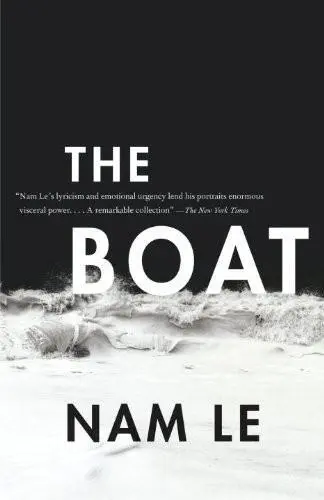
- Название:The Boat
- Автор:
- Издательство:Knopf
- Жанр:
- Год:2008
- ISBN:нет данных
- Рейтинг книги:3 / 5. Голосов: 1
-
Избранное:Добавить в избранное
- Отзывы:
-
Ваша оценка:
The Boat: краткое содержание, описание и аннотация
Предлагаем к чтению аннотацию, описание, краткое содержание или предисловие (зависит от того, что написал сам автор книги «The Boat»). Если вы не нашли необходимую информацию о книге — напишите в комментариях, мы постараемся отыскать её.
In the magnificent opening story, “Love and Honor and Pity and Pride and Compassion and Sacrifice,” a young writer is urged by his friends to mine his father’s experiences in Vietnam — and what seems at first a satire of turning one’s life into literary commerce becomes a transcendent exploration of homeland, and the ties between father and son. “Cartagena” provides a visceral glimpse of life in Colombia as it enters the mind of a fourteen-year-old hit man facing the ultimate test. In “Meeting Elise,” an aging New York painter mourns his body’s decline as he prepares to meet his daughter on the eve of her Carnegie Hall debut. And with graceful symmetry, the final, title story returns to Vietnam, to a fishing trawler crowded with refugees, where a young woman’s bond with a mother and her small son forces both women to a shattering decision.
Brilliant, daring, and demonstrating a jaw-dropping versatility of voice and point of view,
is an extraordinary work of fiction that takes us to the heart of what it means to be human, and announces a writer of astonishing gifts.
The Boat — читать онлайн бесплатно полную книгу (весь текст) целиком
Ниже представлен текст книги, разбитый по страницам. Система сохранения места последней прочитанной страницы, позволяет с удобством читать онлайн бесплатно книгу «The Boat», без необходимости каждый раз заново искать на чём Вы остановились. Поставьте закладку, и сможете в любой момент перейти на страницу, на которой закончили чтение.
Интервал:
Закладка:
"I'm still here," said Jamie. "Come on."
It hurt to speak: his jaw felt locked and he was pushing, pushing down on it.
"That's enough, son."
He stepped clear of his dad. "I said I'm still here!"
Dory was stumped, you could tell. It didn't make sense. He took a deep breath and then came at Jamie, his arm outstretched. Something grainy about his face, unfocused. Something sounded like balsa wood breaking and suddenly Jamie's dad was on the ground, lying on his elbow, his face flecked with dirt. Everything froze. Then Dory hit Jamie as well: it felt like pity, and Jamie was down, too, in the midst of the mud and the shattered light. Bursts of color so bright they must speak, surely, for something.
No one talked. Then Dory's blunt, blurred voice: "It was an accident."
Alison's voice started up: "Stupid. . stupid…"
Lester: "Shut up, cunt."
"I didn't mean to hit his dad — he jumped in. He just jumped in."
"Jesus," said Dory's uncle.
But what if this was all of it? What if, when you saw things through, this was all that waited for you at the end? He lay on the ground and saw the black line of mud and the yellow lines of sand and sedge and then the bottle-green ocean. How wonderful it would be to be out there on the water. The wind scoured in and stung his eyes until they were wet. He'd watched her paint, once, at the courthouse. It was before dawn and he was half-asleep. Blue and blue-green and then dark blue. A hasty white swath. He watched as she turned the bay into a field of color. Then he looked out and, in his grogginess, saw it all through her eyes — the town, the dunes and flats, the foreshore with its man-made outcrops, the bay, sandbars, reef and deep sea. All of it motionless — slabs of paint, smeared on and scraped off, just so, fixed at a time of day that could never touch down. And here was his father, picking himself up from the black sludge, his face in its old grief. Here was Dory, who, despite everything-his emptiness-seemed uninterested, or incapable, of holding Jamie's hate. Michael, who still could. Alison. Watching from within her immaculate uniform. Only Lester's face brimmed with epiphany — a line had been crossed — and nothing had changed.
His dad got to his feet. He was shorter than Dory but spoke straight up into his face.
"That's enough."
They looked at each other and then Dory looked away. A second later, Alison coughed into her hands and ran inside the shack. Michael waded into the mud and helped pull Jamie up. His face, Jamie realized, bore the same clear, graceful expression Jamie had last seen on their mum's face-his hands on Jamie's wrists surprisingly strong. Again — despite everything — he'd chosen to come. Jamie felt himself falling apart. Now, as Michael hauled him up from the ground, he braced his pain against his brother's strength. His dad held him under the armpits. Now, for the first time, Jamie gave over his weight to them entirely.
His dad tightened his embrace. He said, "You okay?"
Michael, face tracked with mud, went to pick up his bike, steered it around. He wheeled it close by them. Jamie held fast to his dad's shoulder. At the edge of the clearing his dad stopped, turned, as though to kiss him on the head, then said, "You're okay, son." They started the long walk home.
Hiroshima
KEEP A STRAIGHT BACK, Mrs. Sasaki says. Wipe the floor with your spirit. The floor is still cold from night and stings my knees. On my left, Tomiko makes her back straight and stretches out her legs behind her, left, right, like the morning exercises. She holds each leg for two breaths, in, out, in, out. I look away from her. I look down and see my face in the shiny wood. It looks half-asleep. The rag hides and then reveals my face, left, right, like a spirit peering through the wood. Father knows many stories about tree spirits. The biggest tree at his Shrine in the city is older than Grandfather — than Grandfather's grandfather, he says. The shadows are large and cool even in summer. But Father says its spirit is young in appearance, maybe as young as me. Camphor, he says, teaching me the name. Father's garden is full of spirits. I like it there. Maybe I am a spirit of the pine boards in the hallway between the entrance and the main room. In this Temple up in the hills. I am safe here. Spirit? So foolish, little turnip. This is what Big Sister calls me. Her face is white and filled with the Yamato spirit and I think of it every night before going to sleep. I want to look like her. You don't become a spirit until you die, little turnip. Honorable death before surrender. She says this a lot. The radio says this a lot. Mother says nothing when Big Sister says this, wearing her designated nametag and armband and headband. She looks like a warrior when she comes home from mobilization. Covered in gray dust like she is made from stone. Left, right, on the floor — my knees don't hurt like they did at the beginning but being in this position makes the emptiness of my belly feel even bigger. Do without until victory! After we recite the Imperial Rescript on Education at assembly each morning, Mrs. Sasaki reminds us we are all small citizens. Sometimes, after I dip the rag in the bucket, the wooden floorboards squeak like small dogs. Hungry ! they yelp. Hungry hungry ! My spirit smiles back at me, more open-eyed now. Some of the younger children like making this noise; when three or four of them do it at the same time they giggle. Children, says Mrs. Sasaki. Citizens.
Last night there were no warnings and it was hard to sleep. Behind the paper door where the teachers sleep, the radio did not speak but made the sounds of a sick person breathing. My mat is four mats away from the radio. I sleep in the front corner of the room with all the other girls, next to one of the stone Buddha statues. The boys sleep at the back of the room by the Temple doors. If I lie down and look at the ceiling, on my left is Tomiko and on my right is Yukiyo. Tomiko is my friend and Yukiyo is one year older than me but she is nice. She is in the fourth grade. Two days ago, Yukiyo told me her father is a science teacher at the PrefecturalTechnicalSchool and chief of the air-raid evacuation team in Yokogawa-cho. She said he was studying in Tokyo to be a doctor but went to China to fight our reviled enemy after the Manchurian Incident in the sixth year of Showa, period of enlightened peace. Father went to China too, I told her. He hurt his legs serving the Emperor with unquestioning loyalty. She nodded in approval. I did not tell her he came back to become a Shinto priest in Zaimoku-cho. Mother says we are at war and that some people do not wish to be reminded of the gods. She tells me to press my hands together for those people.
After cleaning we eat soybean rice. We have eaten soybean rice every day since the last Visiting Day. Tomoe says out loud that she hates soybean rice as much as she hates the American beasts. She is a sixth grader and everyone laughs. But I see Mr. Sasaki, who is married to Mrs. Sasaki, give her a look like the one Father gave Big Sister on the ferry. Then, like Father, he looks away. Father's face is wet from the rain and he turns to look at me instead of her. Mr. Sasaki is a teacher from my old elementary school in the city. Now he lives in the hills with us. Waste is the enemy! I say in my head. My sister's face is shiny with spirit. Do without until victory! I remember the story of the little boy-prince of Sendai. He says to his servant: See those baby sparrows in the nest, how their yellow beaks are opened wide, and now see! there comes the mother with worms to feed them; how happily the babies eat! But for a samurai when his belly is empty it is a disgrace to feel hungry. I do not like soybean rice either but I like it better than pounded rice balls with bran. Or parched soybeans. We third graders are allowed to choose the bowls with parched soybeans before everyone else. The sixth graders are allowed to choose the bowls with rice. All of us weigh the bowls with both hands. On our first day here we had luxurious food: rice with red beans, then red and white rice cakes in the nearby village. See, children, said Mrs. Sasaki to the younger ones still crying for their mothers, is it not better here? But the night before that, at home, I had had sweet rice cake dumpling with bean paste, with extra sugar Father brought home from the Shrine. It was my favorite meal in months. We set an extra bowl at the table for Big Brother, who is with the Emperor's West Eighty-seventh Division in the confidential place. He has been confidential since the Chinese Incident in the twelfth year of Showa, period of enlightened peace. Everything is given to the holy war but everything about the holy war is confidential. We must press our hands together for Tojo-san and the leaders of His Imperial Majesty's government. No, we do not say Tojo-san anymore, little turnip. Koiso-san, says Mother. Suzuki-san, says Father. No, says Big Sister. Just press your hands together for the Fatherland. Mother has a photograph of Big Brother wearing a khaki uniform with a rifle in his hands and a dagger on the right side of his belt. It was taken at UjinaPort. We made a photograph to send to Big Brother too. Look here. Don't blink now. The man's rabbit teeth above the box, the sky behind him dark and green-looking. Your brother Matsuo held you when you were a baby, Mother tells me, and said you were as strong as a carp. At night, sometimes she unfolds a letter from him. I was promoted to First Class Private, she reads. I am grateful that I have skill with the anti-aircraft guns. If you can spare it, please send some ink and a safety razor. And some cigarettes, if you can spare it. Banzai to the Emperor. Well, good-bye, and good-bye to Sumi and little Mayako. Mayako-he is talking about me, but I do not remember him.
Читать дальшеИнтервал:
Закладка:
Похожие книги на «The Boat»
Представляем Вашему вниманию похожие книги на «The Boat» списком для выбора. Мы отобрали схожую по названию и смыслу литературу в надежде предоставить читателям больше вариантов отыскать новые, интересные, ещё непрочитанные произведения.



Обсуждение, отзывы о книге «The Boat» и просто собственные мнения читателей. Оставьте ваши комментарии, напишите, что Вы думаете о произведении, его смысле или главных героях. Укажите что конкретно понравилось, а что нет, и почему Вы так считаете.