Nam Le - The Boat
Здесь есть возможность читать онлайн «Nam Le - The Boat» весь текст электронной книги совершенно бесплатно (целиком полную версию без сокращений). В некоторых случаях можно слушать аудио, скачать через торрент в формате fb2 и присутствует краткое содержание. Год выпуска: 2008, Издательство: Knopf, Жанр: Современная проза, на английском языке. Описание произведения, (предисловие) а так же отзывы посетителей доступны на портале библиотеки ЛибКат.
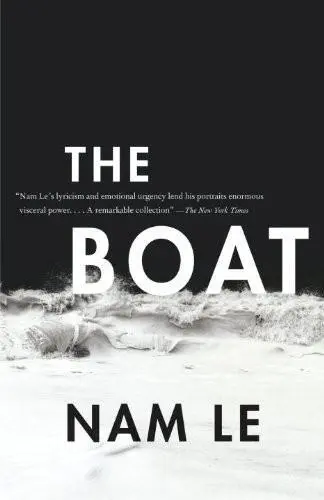
- Название:The Boat
- Автор:
- Издательство:Knopf
- Жанр:
- Год:2008
- ISBN:нет данных
- Рейтинг книги:3 / 5. Голосов: 1
-
Избранное:Добавить в избранное
- Отзывы:
-
Ваша оценка:
The Boat: краткое содержание, описание и аннотация
Предлагаем к чтению аннотацию, описание, краткое содержание или предисловие (зависит от того, что написал сам автор книги «The Boat»). Если вы не нашли необходимую информацию о книге — напишите в комментариях, мы постараемся отыскать её.
In the magnificent opening story, “Love and Honor and Pity and Pride and Compassion and Sacrifice,” a young writer is urged by his friends to mine his father’s experiences in Vietnam — and what seems at first a satire of turning one’s life into literary commerce becomes a transcendent exploration of homeland, and the ties between father and son. “Cartagena” provides a visceral glimpse of life in Colombia as it enters the mind of a fourteen-year-old hit man facing the ultimate test. In “Meeting Elise,” an aging New York painter mourns his body’s decline as he prepares to meet his daughter on the eve of her Carnegie Hall debut. And with graceful symmetry, the final, title story returns to Vietnam, to a fishing trawler crowded with refugees, where a young woman’s bond with a mother and her small son forces both women to a shattering decision.
Brilliant, daring, and demonstrating a jaw-dropping versatility of voice and point of view,
is an extraordinary work of fiction that takes us to the heart of what it means to be human, and announces a writer of astonishing gifts.
The Boat — читать онлайн бесплатно полную книгу (весь текст) целиком
Ниже представлен текст книги, разбитый по страницам. Система сохранения места последней прочитанной страницы, позволяет с удобством читать онлайн бесплатно книгу «The Boat», без необходимости каждый раз заново искать на чём Вы остановились. Поставьте закладку, и сможете в любой момент перейти на страницу, на которой закончили чтение.
Интервал:
Закладка:
The drawing takes shape. She's looking at me and her mouth is open. Her hair so dark it looks wet. My wife's sitting on a suitcase crying. They'll be staying, she says, at her friend's place in Bushwick. In her carriage, Elise is asleep, features clouding in dream. She lets out a slight gargle as I pick her up. "Don't," my wife says through her sniffling, "she's sick." I put her back down and tuck her in. It's a relief; she's the only thing that can make my hands feel graceless. Now I see the perfect little beads of sweat on her forehead. Her body giving off warmth like a hot-water bottle. I think about kissing her but don't want to scratch her awake with my whiskers. To the dramatic sounds of my wife's surfacing, strangled sobs, I duck my head and go upstairs. Leaving them on the front stoop. Not knowing that the taxi that comes will take them not to a friend's place in Bushwick but to JFK. Not knowing that it will smuggle my daughter seventeen years away from me. But all that night — night after night — my dreams are filled with the image of her doll-small body on the stoop, burning, fevered with her father's sin.
I try to capture her eyes on the page. In my head — my mind's eye-they're stern, accusing. But then it was either-or, either-or, and knowing what I knew, feeling what I felt, how could she have expected me to choose differently? How much does a moment carry? Across a gap of seventeen years, now she shows me shame again? Blood made hard and broken to bits. On the stage, her eyes were so clear and deep and large and true. The light from them-if she had turned them fully on me-could have made even a dirty old man like me look new again.
I throw down the pad and charcoal, stand up, clean as a corpse. Olivia always got a kick out of that, standing naked in full view of passersby on the street. Apelman's right. Family is family. I look at the floor, at the drawing, her gray-sketched face made bleary by spots of bathwater. As I climb out of the bath I feel warmth dribbling down my legs. I look down and see it — for the first time — blood — in the water: suspended, its pink wisps shifting like the petals of a flower.
Here's what I'll do: Look at myself in the mirror. My face stark white, a shock of bone and skin and hair. My teeth yellow, carious. The valves of my body corroded. Get your clothes on and get working . The order of the day: Get dressed — she's coming today.
Something swanky, maybe the white-tie suit. The satin peak lapel, besom pockets, with the white piqué vest. I pad my underwear with Kleenex to catch the blood. Outside, it's still raining — I skate the sidewalk, finding my way by the light of office buildings. The streets vacant, dark as a lung. When the wind is up it sounds like the trees talk to each other above the noise of a crowd.
I'm late. The performance has already started. In fact, it's almost over. The ticket clerk repeats this before he trots out his supervisor. I tell them who I am. There's a buzzing in my head — the sound of a fluorescent tube — as we argue, and then, finally, I have it in my hands — my ticket.
Side balcony. The signs leading up and up. The carpet is red-plaided and oil-darkened and feels like freshly mown grass — each step sinking in a bit. My footsteps leave damp craters. Music, all the while, audible from behind the neoclassically reliefed walls, floating to me as though from a distant boat. The stairs get steeper. I imagine I can hear it, her centuries-old cello. By the time I reach the top my legs feel weak, hollowed out, flush with hot bathwater and whiskey. My cummerbund is up underneath my nipples, my collar like wet cardboard, every seam in my shirt stamping itself into my skin. Sweat spurting out of every furrow.
"Sir," the gilt-brocaded usher begins, but I stare him down. I recover my breath. Then, slowly, I lean open the heavy door. The sound sudden, heart-flooding. She's onstage, the four of them forming an almost closed circle: playing as though only to each other.
The people in my row half rise, half brace, anything to avoid touching me as I sidle to my seat. My ass smarts when I sit down. There's a buttress blocking half of my face. I imagine the Leech in the front row, the hatchet silhouette of his head, his gangly legs all stretched out. It doesn't matter, though — I can still hear her, the sound of her cello, full, sonorous, rising through my body and slowly transmuting the pain into warmth, the carry of it through the auditorium, and it's as though my body is without substance and I'm dissolving into the sound she scratches out of her contraption of wood and steel and hair. The concert hall the space inside my skull.
Rain and sweat puddle the floor at my feet. It's getting hot. The music goes on in its slow, gorgeous, devastating burn. When I lean over for a better view my neighbor recoils, initiating a long sequence of public sighing. Now I see her, my Elise. Her head remains still: her bowing neat, precise. Her hair gleams burn-white and black under the spotlight — she's floating out there on a skiff of light — my daughter, my baby girl. A severe beauty all the way through her. My heart hitches underneath its tight cummerbund. I see her. She has everything she needs. She has wrung all my weaknesses out of her strong, straight body.
Get up. I get up. Light in myself, brittle — unable to hear, hold, any more — I breast, woozily, the row of half-risen knees. On the hallway stairs the applause starts up. It sounds like rain. Then, amazingly, there are shouts, stamping feet. I leave the building and go outside-into the brindled rain, the rain become iridescent — into the steel-lamp night. Above the world's dead weight. It's raining outside. I catch my breath and watch as the crowd comes out. She's coming out. She'll be out any second now.
Then I see her — in the walk of a young boy, in the languor of a twenty-year-old — uncommon economy for someone so young — no, there — at fifty, on a billboard, heartbreakingly beautiful and advertising the power of business solutions. Eyes gray, smile gas-blue. A deeper run of colors in her cheekbones. No, no-the darkness, through rain, is deceptive. The crowd empties out of the theater like a last exhalation. I count her as she passes.
It's raining. There she is. Stooped and somehow swanlike, waiting under the corner streetlight. The light drawn into her skin, soaking it, making it refulgent in the black mine of city. A serious young girl. Wind splaying her dark hair. No, I never had a shot-not really. Move, out of breath, toward that shore of light. Catch her and she'll smile, teeth showing-draw it for me-this matter of memory, word by word. Dirty old man. Wait up, Olivia, I'm coming. I see you now! Are you ready? Wait up for me!
Halflead Bay
IT WAS SHAPING UP TO BE A good summer for Jamie. Exams were over. School was out in a couple of weeks — the holidays stretching before him, wide and flat and blue. On top of that he was a hero. Sort of. At assembly that morning, the principal had paused after his name and the school had broken into spontaneous cheering and clapping. Jamie was onstage with the rest of the first eighteen. He could barely make out the faces beneath him — the lights turned off on account of the heat-but what he remembered were voices swelling out of the large, dim hall as though out from one of his daydreams. You couldn't buy that feeling. Still, his dad. Seated in the front row with the other guests of honor — unimpressed as ever. His smile as stiff as his suit.
"C’arn, Halfies!" the principal called out. He opened his arms. From the back of the hall students started stomping their feet.
Jamie had scored the winning goal in last week's semifinal. For the first time in five years, Halflead Bay High had a real crack at reclaiming the pennant. All his school years Jamie couldn't recall even having a conversation with Alan Leyland, the principal, but now Leyland turned around from the podium and half bowed to him. Everyone looked at the two of them. Then the cry was taken up — Halfies! C’arn, Halfies! — even teachers, parents, joining in — Jamie still and rapt in the hot roar until he arrived, again, at his dad's face. The uneasy grin. Of course. The stomping, chanting, Leyland's theatrical attitude: a faint film of mockery slid over it all. Jamie pushed it aside. His dad was wrong, he thought. He was wrong, and anything was possible.
Читать дальшеИнтервал:
Закладка:
Похожие книги на «The Boat»
Представляем Вашему вниманию похожие книги на «The Boat» списком для выбора. Мы отобрали схожую по названию и смыслу литературу в надежде предоставить читателям больше вариантов отыскать новые, интересные, ещё непрочитанные произведения.







Обсуждение, отзывы о книге «The Boat» и просто собственные мнения читателей. Оставьте ваши комментарии, напишите, что Вы думаете о произведении, его смысле или главных героях. Укажите что конкретно понравилось, а что нет, и почему Вы так считаете.