Pete Hamill - Why Sinatra Matters
Здесь есть возможность читать онлайн «Pete Hamill - Why Sinatra Matters» весь текст электронной книги совершенно бесплатно (целиком полную версию без сокращений). В некоторых случаях можно слушать аудио, скачать через торрент в формате fb2 и присутствует краткое содержание. Год выпуска: 2009, ISBN: 2009, Издательство: Hachette UK, Жанр: Современная проза, Биографии и Мемуары, Искусство и Дизайн, на английском языке. Описание произведения, (предисловие) а так же отзывы посетителей доступны на портале библиотеки ЛибКат.
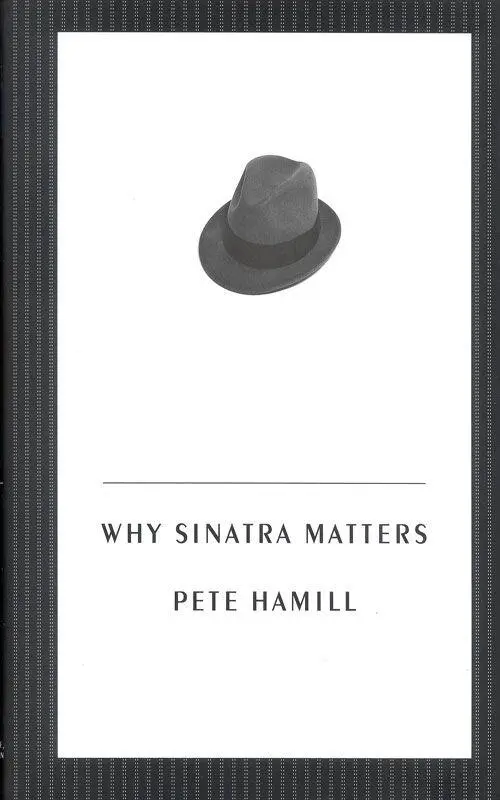
- Название:Why Sinatra Matters
- Автор:
- Издательство:Hachette UK
- Жанр:
- Год:2009
- ISBN:9780316069540
- Рейтинг книги:5 / 5. Голосов: 1
-
Избранное:Добавить в избранное
- Отзывы:
-
Ваша оценка:
Why Sinatra Matters: краткое содержание, описание и аннотация
Предлагаем к чтению аннотацию, описание, краткое содержание или предисловие (зависит от того, что написал сам автор книги «Why Sinatra Matters»). Если вы не нашли необходимую информацию о книге — напишите в комментариях, мы постараемся отыскать её.
From Publishers Weekly Like a musical Elements of Style, Hamill’s slim meditation on Frank Sinatra is confident, smart and seamless. Since (and immediately before) Sinatra’s death in May 1998, countless tributes have been made to the singer; Hamill (A Drinking Life) seems to be writing to set the record straight, for he knew Sinatra and, before that, knew the singer’s music. But Hamill doesn’t fawn over Sinatra the way other, younger writers have recently done. Rather, he elegantly tells the Sinatra story, dwelling on the singer’s best recordings, dismissing “the Rat Pack, the swagger, the arrogance, the growing fortune, the courtiers,” because in the end, he writes, they are “of little relevance.” What matters, according to Hamill, is the music, chiefly that of Sinatra’s early mature years, when the singer released his celebrated albums on the Capitol label. Where a starry-eyed author might vaguely praise these albums for their pathos and vulnerability, Hamill points out that, before the singer’s Capitol comeback years, Sinatra’s fans were almost exclusively young women. The stubborn, post-Ava Gardner heartache of Sinatra’s later records, however, with their lack of self-pity, gained Sinatra a chiefly male audience. Of this, perhaps the singer’s greatest musical period, Hamill writes that Sinatra “perfected the role of the Tender Tough Guy… Before him, that archetype did not exist in American popular culture.” That may be true, but Hamill sets his book apart from the many others about Old Blue Eyes by tempering intelligent superlatives with the retelling of touching, revelatory moments the two men shared. Hamill’s is a definitive introduction to Sinatra’s work.
Copyright 1998 Reed Business Information, Inc.
From Library Journal The barrage of recent Frank Sinatra books has resulted in his being the most written-about celebrity in the world after Monroe and Presley. Hamill’s slim essay is distinguished from other recent works by its objective focus on the components of the late singer’s enduring musical legacy. Veteran writer Hamill (e.g., A Drinking Life, LJ 1/94) is comfortable in the New York City milieu of late nights, saloons, and prizefighters, and he has captured the essence of Sinatra, who created something that was not there before he arrived: an urban American voice. The book’s strength is its insight into and evocation of the Italian American immigrant experience that had such a strong influence on Sinatra. Minor weaknesses are an oversimplified examination of prejudice and an underdeveloped 1974 vignette about Ava Gardner that fails to make its point. Recommended for public and academic libraries.?Bruce Henson, Georgia Inst. of Technology, Atlanta
Copyright 1998 Reed Business Information, Inc.
Why Sinatra Matters — читать онлайн бесплатно полную книгу (весь текст) целиком
Ниже представлен текст книги, разбитый по страницам. Система сохранения места последней прочитанной страницы, позволяет с удобством читать онлайн бесплатно книгу «Why Sinatra Matters», без необходимости каждый раз заново искать на чём Вы остановились. Поставьте закладку, и сможете в любой момент перейти на страницу, на которой закончили чтение.
Интервал:
Закладка:
Assured that Riddle was only conducting, because May was on the road with his own band, Sinatra recorded “South of the Border” and “I Love You.” Both had some of the slurping saxophone mannerisms of Billy May, and Sinatra sounded better than he had in years. Then they turned their attention to “I’ve Got the World on a String,” written in 1932 by Harold Arlen and Ted Koehler for a Cotton Club revue. Sinatra had sung it in clubs and a few larger venues, using an arrangement from an old radio show. But he had never done it this way. With its wonderful decrescendo opening and the passionate trombone playing of Milt Bernhart, the recording was their first masterpiece.
Years later, Alan Dell, then a Capitol executive, gave Friedwald an account of the session. When it was over, Sinatra said, “Hey, who wrote that?” Dell replied, “This guy, Nelson Riddle.” Sinatra said, “Beautiful!” Dell added, “And from that the partnership started.”
That partnership would include 318 recordings made over the next quarter of a century. Sinatra recorded with many other arrangers, including Billy May, but Riddle brought a special sound to the work that became the mature sound of Frank Sinatra, the sound of the Comeback, the sound of the years when Sinatra always wore a hat and truly seemed to have the world on a string. The relationship wasn’t always easy; according to Riddle, Sinatra was one of those men incapable of paying compliments to the people he truly admired. He expressed approval with silence; if he thought something wasn’t working, he said so. Each had taken from Tommy Dorsey a sense of discipline and excellence.
“Frank and I both have, I think, the same musical aim,” Riddle said in 1961. “We know what we’re each doing with a song, what we want the song to say. The way we’d work is this: he’d pick out all the songs for an album and then call me over to go through them. He’d have very definite ideas about the general treatment, particularly about the pace of the record and which areas should be soft or loud, happy or sad. He’d sketch out something brief, like, ‘Start with a bass figure, build up second time through and then fade out at the end.’ That’s possibly all he would say. Sometimes he’d follow up with a phone call at three in the morning with some other extra little idea. But after that he wouldn’t hear my arrangement until the recording session.”
Sinatra also admired Riddle’s care for details: “Nothing ever ruffles him. There’s a great depth somehow to the music he creates. And he’s got a sort of stenographer’s brain. If I say to him at a planning meeting, ‘Make the eighth bar sound like Brahms,’ he’ll make a cryptic little note on the side of some crappy music sheet and, sure enough, when we come to the session the eighth bar will be Brahms. If I say, ‘Make like Puccini,’ Nelson will make exactly the same little note and that eighth bar will be Puccini all right, and the roof will lift off.”
There were a number of components to the Sinatra-Riddle collaboration. Friedwald emphasizes one of them: “Lightness shines as the primary ingredient of the Riddle style. Whether he has ten brass swinging heavily or an acre of strings, Riddle always manages to make everything sound light; that way, the weightiest ballad doesn’t become oversentimental and insincere, and the fastest swinger doesn’t come off as forced.”
The many records Sinatra made with Gordon Jenkins don’t have this quality; the strings are heavy, gloppy, like musical cream cheese, and Sinatra’s own ironical readings often sound more sentimental than they really are, because they are overwhelmed by the heaviness of the arrangements. Riddle was always too hip to clog the music with a lot of sugar.
“A lot of musicians and writers don’t get the full value out of a tune,” Miles Davis said in 1958. “[Art] Tatum does and Frank Sinatra always does. Listen to the way Nelson Riddle writes for Sinatra, the way he gives him enough room and doesn’t clutter it up. Can you imagine how it would sound if Mingus were writing for Sinatra? But I think Mingus will settle down; he can write good music. But about Riddle, his backgrounds are so right that sometimes you can’t tell if they’re conducted.”
Riddle’s own distinctive sound almost always included flutes; a muted, commenting trumpet played by Harry (Sweets) Edison, who provided accents and emphases; trombones, of course; and a solid rhythm section. But he experimented with the combinations, always hoping to keep the sound fresh, while serving the needs of Sinatra as a singer. On the Only the Lonely album, for example, he used for the first time a full woodwind section, made up of two flutes, two oboes, two clarinets, and two bassoons. He would use that combination again and again, sometimes playing into and against sheets of strings, all of them united by harmonies he had absorbed from listening to Ravel, Debussy, and other impressionist composers.
“I loved how Nelson used Ravel’s approach to polytonality,” said Quincy Jones, who has written arrangements for everyone from Count Basie and Ray Charles to Michael Jackson. “Nelson was smart because he put the electricity up above Frank. He put it way upstairs and gave Frank the room downstairs for his voice to shine, rather than building big, lush parts that were in the same register as his voice.”
Sinatra, the musician, was always involved in the actual execution of the complete piece of music.
“Frank accentuated my awareness of dynamics by exhibiting his own sensitivity in that direction,” Riddle would later write. “It is one thing to indicate by dynamic markings … how you want to have the orchestra play your music. It is quite another to induce a group of blase, battle-scarred musicians to observe those markings and to play accordingly. I would try, by word or gesture, to get them to play correctly, but if after a couple of times through, the orchestra still had not effectively observed the dynamics, Frank would suddenly turn and draw from them the most exquisite shadings, using the most effective means yet discovered, sheer intimidation.”
Within a year they would combine on “Young at Heart,” and Sinatra would have his first single to make the top five since 1947. The amazing comeback would be complete.
IV . While Sinatra was practicing his art with renewed vitality, he was still struggling to make sense of his private life. The relationship with Ava Gardner remained jagged and self-destructive. They were together, fought, split, reconciled: a familiar pattern of obsession. The squalid little drama was in horrid counterpoint to the rise in his fortunes in other areas. In August From Here to Eternity was released, and Sinatra received rave reviews. The movie also shifted the way he was viewed by large numbers of men. Many seemed to merge Sinatra with Maggio, and when the thin, brave character of the movie is beaten to death by the character played by Ernest Borgnine, it was a kind of symbolic expiation. Sinatra had shown an aspect of his character that many had never witnessed before in a Sinatra movie or heard singing from jukeboxes. Sinatra/Maggio had lost. But in death, he had won.
Before the movie opened, Sinatra had been booked into Bill Miller’s Riviera, on the New Jersey side of the George Washington Bridge. Only a year before, he had played that room to many empty tables. Now, suddenly, the place was packed, celebrities were using pull to get in, the parking lot was jammed, and even the gangsters had problems getting tables. Sinatra was exultant.
At the same time, in the fall of 1953, Ava Gardner decided to end the marriage. Her account of the decision in her autobiography has a kind of hard-boiled poignancy:
“I don’t think I ever sat down and made a conscious decision about leaving Frank; as usual I simply acted on impulse and allowed events to sweep me along. But I remember exactly when I made the decision to seek a divorce. It was the day the phone rang and Frank was on the other end, announcing that he was in bed with another woman. And he made it plain that if he was going to be constantly accused of infidelity when he was innocent, there had to come a time when he’d decide he might as well be guilty. But for me, it was a chilling moment. I was deeply hurt. I knew then that we had reached a crossroads. Not because we had fallen out of love, but because our love had so battered and bruised us that we couldn’t stand it anymore.”
Читать дальшеИнтервал:
Закладка:
Похожие книги на «Why Sinatra Matters»
Представляем Вашему вниманию похожие книги на «Why Sinatra Matters» списком для выбора. Мы отобрали схожую по названию и смыслу литературу в надежде предоставить читателям больше вариантов отыскать новые, интересные, ещё непрочитанные произведения.



Обсуждение, отзывы о книге «Why Sinatra Matters» и просто собственные мнения читателей. Оставьте ваши комментарии, напишите, что Вы думаете о произведении, его смысле или главных героях. Укажите что конкретно понравилось, а что нет, и почему Вы так считаете.