Martin Amis - Yellow Dog
Здесь есть возможность читать онлайн «Martin Amis - Yellow Dog» весь текст электронной книги совершенно бесплатно (целиком полную версию без сокращений). В некоторых случаях можно слушать аудио, скачать через торрент в формате fb2 и присутствует краткое содержание. Год выпуска: 2004, Издательство: Vintage, Жанр: Современная проза, на английском языке. Описание произведения, (предисловие) а так же отзывы посетителей доступны на портале библиотеки ЛибКат.
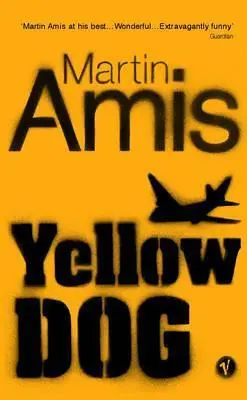
- Название:Yellow Dog
- Автор:
- Издательство:Vintage
- Жанр:
- Год:2004
- ISBN:нет данных
- Рейтинг книги:3 / 5. Голосов: 1
-
Избранное:Добавить в избранное
- Отзывы:
-
Ваша оценка:
Yellow Dog: краткое содержание, описание и аннотация
Предлагаем к чтению аннотацию, описание, краткое содержание или предисловие (зависит от того, что написал сам автор книги «Yellow Dog»). Если вы не нашли необходимую информацию о книге — напишите в комментариях, мы постараемся отыскать её.
We are introduced to the inverted worlds of the 'yellow' journalist, Clint Smoker; the high priest of hardmen, Joseph Andrews; the porno tycoon, Cora Susan; and Royce Traynor, the corpse in the hold of the stricken airliner, apparently determined, even in death, to bring down the plane that carries his spouse. Meanwhile, we explore the entanglements of Henry England: his incapacitated wife, Pamela; his Chinese mistress, He Zizhen; his fifteen-year-old daughter, Victoria, the victim of a filmed 'intrusion' which rivets the world — because she is the future Queen of England, and her father, Henry IX, is its King.
Yellow Dog — читать онлайн бесплатно полную книгу (весь текст) целиком
Ниже представлен текст книги, разбитый по страницам. Система сохранения места последней прочитанной страницы, позволяет с удобством читать онлайн бесплатно книгу «Yellow Dog», без необходимости каждый раз заново искать на чём Вы остановились. Поставьте закладку, и сможете в любой момент перейти на страницу, на которой закончили чтение.
Интервал:
Закладка:
‘When I come out after me fourteen — that was 1949, so this’d be 1963—I find meself in an awkward situation. That’s what so often happens after you come out: like as not, you’re straight back in. Me sister Polly was at that period the common-law wife of Pongo Droy. A while ago Pongo’ve cut Noel Shortly — who’s nicked him! That’s to say: Noel’s reported Pongo to the Law. Which, for me … Well Pongo’s not having that, is he? He’s pulled three months, which is a bit stiff, because in them days you could go berserk with a blade and expect no more than a ten-bob fine. While Pongo’s away his brother Hughie’s done Duncan Shortly, Noel’s dad. So Duncan’s nephew, Cecil O’Rourke, puts Hughie’s lights out in the World Upside Down. Pongo’s fucking come out, he’s [ click ] fuck … Ah, fuck it [ click ] he’s glassed Cecil, and now he’s gone looking for Noel. Who was waiting for him, with a sawn-off. Pongo’s lost both legs from the knee down and Polly’s come running to me. I’ve only been out a week. I wasn’t interested till she told me Noel’d nicked Pongo for the stabbing. That got me off me arse. The result was I drew an eight for Aggravated Manslaughter.
‘It was 1975 when I come out — I served an extra three for me part in the so-called “mangle riot” at Winson Green. And by now I’m going: enough’s enough. As you yourself know, a man has to adapt and change with the times. A further two-year term for Grievous give me more leisure to think. I hadn’t been out for long when I was fancied for a murder [ click ] which I fucking done [ click ], the case being dismissed in the absence of any evidence whatsoever. And Life was eighteen years in them days. No, son, I said to meself. Time to turn over a new leaf. Strike out on a different path. I’ve gone and emigrated to the Costa del Sol. And thus began me long and, in the end, tragic association with Keith the Snake. [ Click. ]
‘Get this in here. [ Click. ] You don’t know of me personally, but me name might ring a bell. I don’t know — are you a reading man? Me, I never was a reader. Didn’t seem to have the time. Nah: wasn’t that. See, in prison, it’s just another way they can hurt you. “Where’s your book gone, Jo? Bookworms must have eaten it.” And then the little smirk. And then of course you’d do them and they’d do you. Goes with the territory. I never held with reading in the nick. Don’t believe in it. You hear about blokes getting degrees from fucking Oxford while they’re banged up. I never held with that because as soon as they start the reading they get religious and all. Nutters who’ve sliced up families of six going round with they hands clasped behind they back. Praying and that. Don’t hold with it. If I see a con with a Bible they was due a bash. I know what loss of freedom is, what confinement is, but me thoughts are me own. It’s like the Kray Twins, from their book: “Flowers are God smiling at us.” And if that don’t send you to the bog then I don’t know what will.
‘But one day the book trolley come round. As it’s gone past I see the spines and one of them’s only called Joseph Andrews ! Me first thought was: someone’s gone and taken a right raging liberty. Someone’s gone and done me uh, me life story with no permission whatsoever. I give the screw a shout — and the slag’s name is Henry Fielding. But of course after a while I’ve calmed meself down. Joseph Andrews was one of the first English novels, published as early as 1742. I got me TV glasses for a read of it and I’ve not made head or tail of the language they use in them days. But there’s something very near the beginning, about a good man being more … influential than a bad. And them’s wise words …
‘Years later I’ve come across another book, in three volumes, entitled Tom Jones. Must be the life story of the singer, I’ve thought, him of “It’s Not Unusual” fame. But no: it was only by the same fella — Henry Fielding. I always was an avid Tom Jones fan, and to this day I’ll get on a plane to attend one of his concerts. “It’s Not Unusual” was his greatest hit, but me own favourite’s got to be “The Green, Green Grass of Home”.
‘I want you to think about that. If you would: the green, green grass of home.’
Click. Joseph Andrews now summoned his amanuensis, Manfred Curbishley: braces, a horseshoe of hair going round the back of his head, mouth and eyes as moist as oysters. He looked as though he’d never left London — never left the bookies’ office in the Mile End Road. And a drinker’s face, with its pattern of heat: its oxbow of oxblood.
With a wag of the head: ‘There’s more, but you can start turning this into English. And take out all the language … Where’s Rodney?’
‘Accompanying Miss Susan to the airport, Boss.’
‘Course he is, course he is.’
The frowning gaze of Joseph Andrews (every mote of age visible in the carbonated air) settled on the green file, which lay open on his desk. Cora, he now saw, had underlined a name in one of the clippings. He adjusted his glasses: Pearl O’Daniel. With an inner murmur he pictured her father: Ossie O’Daniel. A good man, a sound man, a man of principle: never took any fucking rubbish from the screws. Remember once he came into Association in the middle of the day with his privates hanging out. This was at Strangeways. There’d just been an off — someone kicking up. No one said anything about Ossie and his privates, not even the screws. He’d just had twenty-four of the Birch that morning, so you made allowances, and tactfully turned the other way.
7. We two
Brendan Urquhart-Gordon lay in bed with his laptop. The imagery being fed through to him was from Oughtred; it attempted to duplicate, by the use of ‘isosurfaces and volumetric rendering’, the material on the Princess. Emboldeningly, the counterfeits of the first stills could not be distinguished from the originals — or at least not by the unassisted eye; and the four-second loop, where the Princess swivelled in the bath, was an apparently perfect simulacrum, down to the very eddies of the water. But the attempt to morph the enemy’s latest offering, the attempt to carve it out of light and magic, was a clear failure. Here the technology came up against its structural limits. Brendan could feel his body temperature climb: the inner casuist was acknowledging the first great wound in his defence. He thought (again): if the enemy so much as gave the time and place — the Château, the Yellow House … A chimerical mischief would at once become something actual, something to be investigated, and the media …
The new image, anonymously remailed on to the Net that morning, showed the Princess in three-quarter profile. It was an enlargement, and the quality — the definition — seemed relatively weak. Yet this much became clear: she was not alone. It wasn’t a shadow, louring above her. It was an implicit presence, demanded by the demeanour of the Princess. Her crossed hands resting on her shoulders, the angle of her torso minutely averted from the hypothetical entity, her expression … This was what the technology couldn’t capture: it couldn’t capture the complexity of the Princess’s expression. She looked surprised, and shocked too, but not quite startled or fearful; she looked intensely anxious; she looked slightly sick. But it was the eyes and their pitiful attempt at comity, at courtesy, at good manners : this could not be duplicated.
Retaining his pyjamas, and adding all his sweaters, Brendan got dressed and went to the King. He found him in his dressing-room, sitting before the empty grate with his face in his hands. Without looking up Henry pointed at something on the low table. Was it a golf ball? No, it was a crumpled sheet of paper. Brendan didn’t find it pleasant to watch the King flatten and straighten this out, his lower lip pendulous with reluctant concentration, and then pass it on with a sigh that closed his eyes. Brendan asked for and was given permission to activate the one-bar electric fire. Don’t like that colon, he thought, as he settled down to it:
Читать дальшеИнтервал:
Закладка:
Похожие книги на «Yellow Dog»
Представляем Вашему вниманию похожие книги на «Yellow Dog» списком для выбора. Мы отобрали схожую по названию и смыслу литературу в надежде предоставить читателям больше вариантов отыскать новые, интересные, ещё непрочитанные произведения.

Обсуждение, отзывы о книге «Yellow Dog» и просто собственные мнения читателей. Оставьте ваши комментарии, напишите, что Вы думаете о произведении, его смысле или главных героях. Укажите что конкретно понравилось, а что нет, и почему Вы так считаете.