Martin Amis - Yellow Dog
Здесь есть возможность читать онлайн «Martin Amis - Yellow Dog» весь текст электронной книги совершенно бесплатно (целиком полную версию без сокращений). В некоторых случаях можно слушать аудио, скачать через торрент в формате fb2 и присутствует краткое содержание. Год выпуска: 2004, Издательство: Vintage, Жанр: Современная проза, на английском языке. Описание произведения, (предисловие) а так же отзывы посетителей доступны на портале библиотеки ЛибКат.
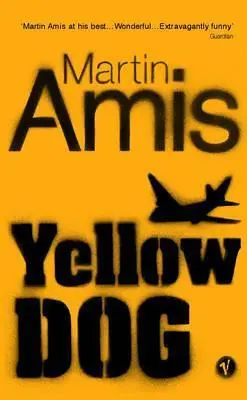
- Название:Yellow Dog
- Автор:
- Издательство:Vintage
- Жанр:
- Год:2004
- ISBN:нет данных
- Рейтинг книги:3 / 5. Голосов: 1
-
Избранное:Добавить в избранное
- Отзывы:
-
Ваша оценка:
Yellow Dog: краткое содержание, описание и аннотация
Предлагаем к чтению аннотацию, описание, краткое содержание или предисловие (зависит от того, что написал сам автор книги «Yellow Dog»). Если вы не нашли необходимую информацию о книге — напишите в комментариях, мы постараемся отыскать её.
We are introduced to the inverted worlds of the 'yellow' journalist, Clint Smoker; the high priest of hardmen, Joseph Andrews; the porno tycoon, Cora Susan; and Royce Traynor, the corpse in the hold of the stricken airliner, apparently determined, even in death, to bring down the plane that carries his spouse. Meanwhile, we explore the entanglements of Henry England: his incapacitated wife, Pamela; his Chinese mistress, He Zizhen; his fifteen-year-old daughter, Victoria, the victim of a filmed 'intrusion' which rivets the world — because she is the future Queen of England, and her father, Henry IX, is its King.
Yellow Dog — читать онлайн бесплатно полную книгу (весь текст) целиком
Ниже представлен текст книги, разбитый по страницам. Система сохранения места последней прочитанной страницы, позволяет с удобством читать онлайн бесплатно книгу «Yellow Dog», без необходимости каждый раз заново искать на чём Вы остановились. Поставьте закладку, и сможете в любой момент перейти на страницу, на которой закончили чтение.
Интервал:
Закладка:
ps: 3 cheers 4 ‘readers’ richards’. a real tonic 4 the gentler 6: gr8 scott, there’s hope 4 us all!
‘Your messages are like a breath of fresh air,’ mused Clint as he precomposed his reply. ‘Now you’ve seen my ugly mug often enough in the Lark. I’m no looks snob — can’t afford to be! But it would be nice to put a face to your words of wisdom. And maybe a name …’ And she still hadn’t said whether she thought size mattered.
Only one thing troubled him. Market research had shown, time and time again, that the Morning Lark had no women readers. So the question remained: what sort of bird read the Lark ?
He paused there, at his desk. Clint was about to begin a piece. But he paused at his desk there.
‘… Uh, is uh, is And around?’
‘Who’s this?’
‘Uh, Pete.’
‘No he ain’t,’ said a much smaller voice than the one he was used to. ‘Harrison, careful, darling. They’ve got him down as missing. No, don’t do that, sweetheart — there’s a good boy. They’ve got him down as a missing person.’
Clint said he was sorry to bother. He thought: Jesus — don’t say Joseph Andrews. Then: pop round and cheer her up. Then: no. Leave all that out. Or: the proverbial’ll—
‘— Ah Clint,’ said Heaf. ‘It’s not as serious, but something else has just blown up in our faces.’
‘And what’s that, Chief?’
‘Pervs Him Right.’
‘Ah. The Walthamstow Wanker.’
‘The same. But one crisis per day, eh? A couple of things, Clint. There’s a word in your Video Review column that gave me a bit of a turn. Where are we.’
He flattened the page out on Clint’s worksurface. The strapline said Blinkie Bob’s Video Review. In the corner was a mugshot. Not Clint, but some portmanteau imaging creation: a face grotesquely wall-eyed, and bent at an angle, tongue lolling, with two hair-matted palms loosely raised.
Heaf said, ‘Now where …? Here we are. Uh, “and have your bogroll handy for when gueststar Dork Bogarde pumps his lovepiss over the heaving norks of our very own Donna Strange”. What, may I ask, is lovepiss ?’
‘Semen, Chief.’
‘Oh. Oh. I thought our house style was “manjuice”. Oh. Well that’s all right then. You know, it disgusts me, sometimes, what we do here. It does. How are things progressing with Ainsley Car?’
‘Well the ice-boot’s come off. Have to wait till he’s playing again, for the visibility. But it’s looking good, isn’t it, with the new charges.’
Clint remembered that Heaf didn’t follow football. He went on, ‘They’re nicking him for match-fixing now. Said he took half a mil from a Malaysian businessman to throw it for Rangers last season. Our wankers’ll hate him for that: sacrilege, Chief. Maybe we can get Beryl done during the trial.’
‘Proceed as you think fit, Clint. And you said you were following through with our royal coverage.’
‘I’m on it, Chief.’
‘It warms your heart, doesn’t it, Clint. We always assumed that the royals were felt to be an irrelevance — an anachronism. And old Queen Pam, of course, was a rather forbidding figure. But now she’s been gone for two years, and what with the Princess flowering into maturity, there’s been a tremendous upsurge of affectionate interest — reflected in Mackelyne’s figures — across the entire spectrum of our wankership.’
‘Yeah well what it is is, now that Vicky needs a bra, it’s reminded them that Henry’s still on bread and water. They think it’s time he started getting stuck in again.’
‘You think?
‘Read Smoker on Saturday. Long think-piece.’
‘Title?’
‘“Is The King Normal?”’
3. Excalibur
He was in a ridiculous situation.
On the day of his birth the guns of the Royal Fleet all over the world boomed forth their joy. ‘Our thoughts go out’, said Churchill in the House of Commons (the Second World War was in memory yet green), ‘to the mother and father and, in a special way, to the little Prince, now born into this world of strife and storm.’ He was only a few hours old when he made headlines in every language and every alphabet. At school he discovered that his father’s face was on the coins he presented at the tuckshop, and on the stamps he used to send his letters home. Before his visit, as a twelve-year-old, to Papua New Guinea, the island tomtoms sounded all night long. He was still a teenager when he represented his country at the funeral of Charles de Gaulle: he stood between Mrs Gandhi and Richard Nixon. Then came majority, marriage, murder — and the crown: the recognition, the oath, the anointing, the investiture, the enthronement, the homage.
All his personal dramas were national dramas. He was in a ridiculous situation. He was the King of England.
Henry IX was staying at the Greater House, his unheatable 300-room drum in Southern Hertfordshire. He had dined à deux with his little brother, Prince Alfred, Duke of Clarence, in the private room of a three-star restaurant on the Strand.
‘The barman here, Felix, is absolutely marvellous,’ he had said. ‘He makes a truly splendid drink called a Scorpion. Ah, there you are. Two Scorpions! No: make that four Scorpions … Now tell me, dear boy. Are you going to merry this “Lyn” of yours?’
‘You know, old thing, I don’t see how I can marry anyone. ’
‘Why ever not, you ass?’
‘Because I’m such a disgusting lech. We all are. Except you. Old chap.’
‘… Now where are those Scorpions?’
The words stayed with him. And as he sat up, alone, at home (before the fire, under a heap of rugs and dogs), waiting for Bugger’s call, Henry thought: yes, true enough. And why? Prince Alfred, at forty-nine, was still the hyperactive satyromaniac he had been from the age of thirteen (when he raped his first housemaid). His father, Richard IV, had gratified epic appetites, before his late marriage; and his grandfather, John II, was a notorious debauchee. And Henry IX?
By the time he reached his twentieth year, the Prince of Wales, as he then was, showed no more interest in sexual intercourse than he showed in polo or parachuting. He had a hectic and quite drunken social life, and many women friends. What, then, made him decline or ignore the countless importunities, ranging from the near-undetectable to the melodramatic, that tended to come a prince’s way? It seemed to be nothing more complicated than fear of effort. A concerned Richard IV, abetted by the Queen Consort, arranged for the Prince to be visited by a lady-in-waiting — a young widow called Edith Beresford-Hale. Edith surprised Henry one night in the Kyle of Tongue. The Prince had retired after a damaging night with the forty or fifty ‘guns’ who had come up to scrag his wildlife. Of course, Henry himself never had anything to do with that. But he gamely went along with Edith Beresford-Hale. She bounced him around on top of her for a couple of minutes; then there was a smell of fire-tinged male changing-rooms, and Edith made a joke.
Then the Prince did what the King and Queen had by no means intended. He fell in love with Edith — or, at any rate, he confined himself to Edith. Though press and public assumed that he was sleeping with at least one or two of the young beauties he frequently squired, Henry was faithful for the next five years. He looked in on Edith about three times a month. She was thirty-one, and of comfortable figure and temperament. Not unlike his mother: the tweed skirt, the hardwearing shoes.
So Henry was in his mid-twenties when he began to be disquieted by a younger friend: the Honourable Pamela North. He gave Edith a house, a world cruise, and a pension, and started paying court to Pamela. On the day after the Royal Wedding (and a princely marriage, said Bagehot, was the most brilliant edition of a universal fact) Henry wrote to his brother, Prince Alfred: ‘Everything was plain sailing, which was a relief. You saw when I kissed her on the balcony and the crowd went absolutely bonkers? Well, it was a bit like that in the bedroom. I felt the country’s expectations on my shoulders, albeit in a rather agreeable way. I felt them urging me on. And everything was plain sailing. You know what I mean: I was very good!’ And how could it have been otherwise, on that night, with his blood so thrilled and brimmed by the people’s love?
Читать дальшеИнтервал:
Закладка:
Похожие книги на «Yellow Dog»
Представляем Вашему вниманию похожие книги на «Yellow Dog» списком для выбора. Мы отобрали схожую по названию и смыслу литературу в надежде предоставить читателям больше вариантов отыскать новые, интересные, ещё непрочитанные произведения.




Обсуждение, отзывы о книге «Yellow Dog» и просто собственные мнения читателей. Оставьте ваши комментарии, напишите, что Вы думаете о произведении, его смысле или главных героях. Укажите что конкретно понравилось, а что нет, и почему Вы так считаете.