E. Doctorow - Loon Lake
Здесь есть возможность читать онлайн «E. Doctorow - Loon Lake» весь текст электронной книги совершенно бесплатно (целиком полную версию без сокращений). В некоторых случаях можно слушать аудио, скачать через торрент в формате fb2 и присутствует краткое содержание. Год выпуска: 2007, Издательство: Random House, Жанр: Современная проза, на английском языке. Описание произведения, (предисловие) а так же отзывы посетителей доступны на портале библиотеки ЛибКат.
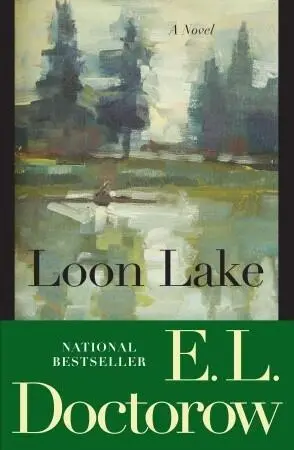
- Название:Loon Lake
- Автор:
- Издательство:Random House
- Жанр:
- Год:2007
- ISBN:нет данных
- Рейтинг книги:4 / 5. Голосов: 1
-
Избранное:Добавить в избранное
- Отзывы:
-
Ваша оценка:
Loon Lake: краткое содержание, описание и аннотация
Предлагаем к чтению аннотацию, описание, краткое содержание или предисловие (зависит от того, что написал сам автор книги «Loon Lake»). Если вы не нашли необходимую информацию о книге — напишите в комментариях, мы постараемся отыскать её.
Loon Lake — читать онлайн бесплатно полную книгу (весь текст) целиком
Ниже представлен текст книги, разбитый по страницам. Система сохранения места последней прочитанной страницы, позволяет с удобством читать онлайн бесплатно книгу «Loon Lake», без необходимости каждый раз заново искать на чём Вы остановились. Поставьте закладку, и сможете в любой момент перейти на страницу, на которой закончили чтение.
Интервал:
Закладка:
Shit, how many more hours of this … I thought of Clara I thought of us driving to California in the spring. And then I thought, What if she just left, what if she met someone and said to him, How do I get out of here?
And then I resolved not to think at all, if I couldn’t think well of Clara, I’d turn my mind from her knowing I was racked, knowing I couldn’t physically feel hope in this hammering noise. But I didn’t have to try not to think, by the middle of the afternoon my bones were vibrating like tuning forks. And so it had me, Bennett Autobody, just where it wanted me and I was screwed to the machines taking their form a mile away in the big shed, those black cars composed bit by bit from our life and the gift of opposition of thumb and forefinger, those precious vehicles, each one a hearse.
On the other hand everyone had the same problem I heard stories of people hauling off on a foreman, or pissing on the cars, or taking a sledge hammer to them, good stories, wonderful stories, probably not true. But the telling of them was important. I was the youngest on my line, jokes were made about that — what a woman could still hope for from someone my age. Jokes were important.
The line was a complex society with standards of conduct honor serious moral judgment. You did your work but didn’t kiss ass, you stood up for yourself when you had to but didn’t whine or complain, you kept your eyes open and your mouth shut, you didn’t make outlandish claims brag threaten.
Yet none of this was visible when we pressed through the gates in the evening, a nameless faceless surge of men in soft caps in full flight.
Clara and I lived on Railroad, the street of the endless two-family bungalows. I had my choice — to take the streetcar, which was faster, or walk and save the carfare.
I ran.
I stopped only long enough to pick up a movie magazine or True Confessions , I liked to bring her small surprises keep her busy keep her occupied.
Sometimes I’d find her waiting at the window looking out the window — the dark industrial sky, the great bobbing crowd of men flowing down Railroad Street making a whispering sound on the cobblestones like some dry Midwestern sea — and she’d be holding her arms, the bleak mass life scared her as some elemental force she hadn’t known, not even realized by the way she stood and watched that she gave it her deference.
We ate things heated from cans. We had two plates two cups two spoons two knives two forks. Our mansion was furnished army-camp fashion by the company. Behind the back porch was the outhouse.
We stayed in the kitchen till bedtime, I tossed pieces of coal in the stove, it never seemed to be enough. Clara sat reading, she wore her fur jacket she wore it all the time. She was fair and couldn’t take the cold, the winter had done something to her face, coarsened it, rubbed the glamour from it. Five minutes out of doors her eyes watered, her cheeks flamed up. She didn’t use make-up anymore.
All of it was all right with me. I still couldn’t take my eyes off her. I tried to remember the insolent girl with the wineglass in her hand and the firelight in her eyes.
“I’m glad you’re laughing,” she said.
I had a scheme for getting us from kitchen to bed. I heated water in the black coffee pot and then ran the pot like a hot iron over the mattress. I undressed her under the covers.
I loved it cold, I loved the way she came to me when it was cold, as if she couldn’t get close enough. But this particular evening I remember she stopped me in my lovemaking, she put her arm on my shoulder and said Shhh .
“You hear that?” she said.
“What?”
“Next door. They’ve got a radio.”
I lay on my back and listened. I heard the wind blowing the snow in gusts along Railroad Street. Sometimes the snow came in through the cracks and in the morning you’d find it lying like dust inside the front door.
“I don’t hear anything,” I said.
“Listen.”
And then I heard it, very softly through the wall, it was dance music, the swing band of a warmer world, it made me think of men and women on a terrace under a full moon.
29
Their place — the mirror of our three rooms — astounds me. No trace of company domicile, it’s all been washed from the walls and strained from the light coming in off the street. We sit on stuffed horsehair chairs, there is a matching sofa, behind the sofa a lamp with a square translucent shade of the deco design. A braided rug covers the parlor floor and glass curtains adorn the windows. Amazing. On the desk in the corner a private phone. Who would have thought people on Railroad Street had their own phones?
The subtle giving to the newcomers of their protection. Lyle James smiles sitting on the sofa with his hands on his overalled knees, he’s one of those crackers, hair like steel wool, reddish going to gray, a face of freckles so that he appears to be behind them looking from his pink-lidded eyes through them as from some prison of his own innocence, buckteeth smiling.
What does he see? In Jacksontown, crossroads of the world, he thinks he’ll see everything given enough time. These two are just getting their legs, the boy looking at her as if she’s sick about to die, or have a fit, but it’s his fit more likely, that’s what’s important to this boy, not how he feels but how she feels. And she, one spooked little old girl, she smokes her cigarettes, crosses her legs, stares at the floor, that’s the way it is with folks from the East.
Mrs. James comes in from the kitchen holding a platter with chocolate cake and cups and saucers and napkins. Another freckled-face redhead, but a pretty one with light eyes, a plump mouth sullen in a child, provocative in a woman. Which is she? She is very shy, blushing when her husband boasts that she baked the cake herself. She wears an unbuttoned sweater over her dress, school shoes, ankle socks.
We’re all Bennett people, neighbors, fellow workers, this is Clara, hello, this is Sandy, hi, Clara, this is Lyle, this is Joe.
They are Southerners, like so many of them here, but with my tenacity, I recognize it, they talk slower but feel the same. He must be thirty-five, a lot older than his wife, crow’s-feet under the freckles, they act dumb but I don’t believe it.
I detected the sly rube who liked to take city slickers.
Clara talks to the wife. Clara in this conversation is the older woman from New York, Mrs. James maybe sixteen years old stands in awe of that sophistication. And then a baby is brought out, the child wife has a baby!
The establishment of them sitting modestly for our admiration: people are strong, they prove themselves. You see, Clara? You can wrest life from a machine and walk away.
“’A course,” he was saying, “all this work ain’t just the season. You wouldn’t know but they was a wildcat strike last summer. Quite a to-do at the main gate. The company brought in strikebreakers. A feller was killed. They closed the plant down, fired everone. Everone!”
I nod, this is man talk.
The baby began to cry, the young mother unbuttoned and gave her breast right in the parlor, neither of them made anything of it. I glanced at Clara. She was intent. She watched the infant suck, she watched the mother and child. Expressed in Sandy James’ face just that absorption in the task as the doll mother’s in her solemn game.
“I started out in trim,” Lyle says. “Now I hang doors. You get a few more cents a hour. Hands don’t cut up so bad. Lemme see your hands,” he said. I held them out, swollen paws, a thousand cuts. “Yeah,” he says, “that’s it.”
After a while he went over to the radio we had heard, obviously his pride and joy, a Philco console of burled wood big as a jukebox. A circular dial lit up green when he turned it on, it had regular and shortwave broadcasts, and a magic tuning eye like a cat’s green eye with a white pupil that grew narrow when he brought in a station.
Читать дальшеИнтервал:
Закладка:
Похожие книги на «Loon Lake»
Представляем Вашему вниманию похожие книги на «Loon Lake» списком для выбора. Мы отобрали схожую по названию и смыслу литературу в надежде предоставить читателям больше вариантов отыскать новые, интересные, ещё непрочитанные произведения.









Обсуждение, отзывы о книге «Loon Lake» и просто собственные мнения читателей. Оставьте ваши комментарии, напишите, что Вы думаете о произведении, его смысле или главных героях. Укажите что конкретно понравилось, а что нет, и почему Вы так считаете.