E. Doctorow - Loon Lake
Здесь есть возможность читать онлайн «E. Doctorow - Loon Lake» весь текст электронной книги совершенно бесплатно (целиком полную версию без сокращений). В некоторых случаях можно слушать аудио, скачать через торрент в формате fb2 и присутствует краткое содержание. Год выпуска: 2007, Издательство: Random House, Жанр: Современная проза, на английском языке. Описание произведения, (предисловие) а так же отзывы посетителей доступны на портале библиотеки ЛибКат.
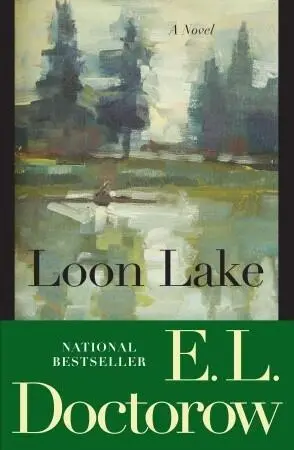
- Название:Loon Lake
- Автор:
- Издательство:Random House
- Жанр:
- Год:2007
- ISBN:нет данных
- Рейтинг книги:4 / 5. Голосов: 1
-
Избранное:Добавить в избранное
- Отзывы:
-
Ваша оценка:
Loon Lake: краткое содержание, описание и аннотация
Предлагаем к чтению аннотацию, описание, краткое содержание или предисловие (зависит от того, что написал сам автор книги «Loon Lake»). Если вы не нашли необходимую информацию о книге — напишите в комментариях, мы постараемся отыскать её.
Loon Lake — читать онлайн бесплатно полную книгу (весь текст) целиком
Ниже представлен текст книги, разбитый по страницам. Система сохранения места последней прочитанной страницы, позволяет с удобством читать онлайн бесплатно книгу «Loon Lake», без необходимости каждый раз заново искать на чём Вы остановились. Поставьте закладку, и сможете в любой момент перейти на страницу, на которой закончили чтение.
Интервал:
Закладка:
“And then my mother died but my father didn’t handle it, someone else from another funeral parlor came and took her away. Just like doctors don’t treat their own families. But maybe it was because she was religious. None of our church got buried with us. We were Greek Orthodox but the business was nondenominational. My father was not highly regarded in church. I saw more Romans and Jewish rabbis at Lukaćs’ than I did priests. Anyway, my father moped around a long time. He didn’t know what to do with me. He hired this black lady to take care of me. She was okay but she drank. She stood at the window whenever there was a funeral downstairs. She’d count the numbers of cars to see how important the dead guy was. She’d count the number of flower cars. Sometimes she called me to come look and I began to look too. You’d see all these flowers in the flower cars, sometimes in three, four cars of flowers, it was too much, like huge mounds of popcorn, I didn’t like it. I hate cut flowers. All my life they made a stink coming up through the floor below, there was always somebody downstairs you could smell flowers through the dumbwaiter.
“But then if it was really a big affair it would be worth watching. My father and brother all dressed up in their shiny black suits. He’d hire on men on these days. People coming to pay their respects, filling the parlor, crowds standing out on the street. And then outside all the cars in a line, double-parked with their headlights on, all these black mourners’ cars twice around the block. And the cops would be there checking on who showed up, standing across the street and watching. And the photographers with their big flash cameras taking pictures, and the next morning in the News or the Mirror there was a picture of somebody and in the background the canopy said Lukaćs’ Funeral Parlor.
“But he didn’t need the publicity and he didn’t care. He was just some dumb hunky, he didn’t care about anything, he didn’t talk much, he just did this work. And he got this clientele over the years, he wasn’t in the rackets himself, but he kept his mouth shut and didn’t make judgments and he just got to be the one they used. He didn’t care who he buried, why should he, the kind of work he did why get excited. After a while he had to expand. He bought the brownstone next door, and put a new streamlined face across both houses. And then there was a showroom and a reception desk.
“And I was pretty grown-up now. I wouldn’t stay in school. I’d worked for a while at the five-and-ten just to have something to do. But he was getting fancy now and he needed someone for the reception desk and to answer the phone who could talk right. So he asked me. So I thought, Why not? I mean when I was a kid I used to get it at school. That’s why I had no friends at St. Clare’s. They came around at Halloween with sheets on and rang the front bell. Clara Cadaver, Clara Cadaver. Well, shit, I only had boyfriends, anyway. I mean as a kid my friends were boys. I played street hockey.
“But anyway, I didn’t mind. I wore a black dress. I wore stockings and high-heeled shoes. I had an allowance for the beauty parlor. And that was my job. I got to meet some real people. It was an entrée, as they say. What’s that sound? The engine doesn’t sound right.”
“No,” I said, “it’s okay. Maybe I need a little oil.”
“It’s getting dark, anyway — where do you suppose we are?”
“Are you hungry?”
“A little.”
I had a terrible feeling, a chilled feeling because of her lineage, her criminal lineage, I thought of it as a caste, some kind of contamination she had been born into through no fault of her own and I thought it was mine now too; if I wanted her, what she was was mine too, what she brought with her we both had now.
But I was also happy that she had told me, that in the dreamlife of the road the hours sitting next to each other and facing in the same direction brought things out we might not have otherwise said. We told each other about our lives, we gave each other our lives while we looked at the road backward into ourselves. Even though afterward we didn’t remember what we said, or were too proud to admit we remembered.
“We lived across the river from each other, you realize that? We could have shouted at each other across the Hudson, two snot-nosed kids. Little did we know we were destined to meet! We saw the same Tom Mix movies. We ran along the sidewalks pointed to the sky at the same airships!”
“What?”
“No, really, playing hockey”—I wanted to make her smile—“don’t you remember? Maybe our teams played each other. We made the puck from the end of the wooden cream-cheese box, right? We wrapped it in black tape, am I right?”
It seemed very important in this moment to make her smile.
“Don’t you remember? Don’t you remember the ‘I cash clothes’ man? On Twenty-ninth Street? The water wagon, running alongside it for the spray? Don’t you remember how we went to the candy store for ice cream?”
“What are you talking about?”
“No, really, Clara. One hot afternoon we bought Dixie cups and stood on the sidewalk in the sun with our wooden spoons. You remember. Licking the ice cream off Joan Crawford’s face?”
26
When Clara fell asleep I put on my coat, closed the door quietly and went out to look around. In addition to everything else snow had hit this burg, a heavy wet fall that stuck to your eyelashes and got into your shoes.
The rooming house was highway robbery — twelve dollars a week, paid in advance. Restaurants came to another two, three dollars a day. If I took her to the movies, another forty, fifty cents.
I had even bought her a gold wedding band — for her protection, I said.
I hadn’t told her there was no money to get the valves reground. She thought we were in Jacksontown another day or two at the most. I could manage two day-coach fares to Chicago. But what would we do in Chicago — freeze our ass there?
And so, hunched in his khaki coat from the Great War, the big spender wandered through downtown Jacksontown, Indiana — Heart of the Hoosier Nation, as the sign said. Everything built of red brick, the bank, the library, the city hall, the armory. Stores occupied, the black cars parked at angles against the curbs, he notices the traffic, a heavy traffic rolling quietly through the snow, the sky gray, heavy flakes like soundproofing tamping down the horns, muffling the engines, even the streetcars grinding along hushed in the flanges, sparks flaring in the dark afternoon, the dark turrets of the armory the dark green cannon on the lawn with the mantle of white snow.
I saw everywhere on every street jalopies of every description, valises and boxes strapped to their fenders, children and grandparents high in the rear seats, scarfs wrapped around their heads. I saw furniture covered with blankets tied with rope on the beds of broken-down trucks. I saw out-of-state license places: Kentucky Tennessee Georgia Arkansas Michigan Missouri.
I boarded the Railroad Street trolley to see what would happen. It banged its way sharply around corners and picked up speed. Soon it was out of the downtown area barreling between two endless rows of semiat-tached bungalows, block after block. Eventually it veered into a dark street, a canyon of the sides of buildings, moving slowly now, many men walking in the street, the bell clanged, an unbroken chain-link fence blurred my eyes, if I opened the window I could touch it.
Last stop the doors hissed open at the main gate. Here a crowd of men stood waiting to get in, a quiet intense crowd not orderly but silent. The snow came down. Even as I watched, the crowd grew pulsing like something underwater.
Behind the locked gates uniformed men stood chatting as if nothing was going on.
Читать дальшеИнтервал:
Закладка:
Похожие книги на «Loon Lake»
Представляем Вашему вниманию похожие книги на «Loon Lake» списком для выбора. Мы отобрали схожую по названию и смыслу литературу в надежде предоставить читателям больше вариантов отыскать новые, интересные, ещё непрочитанные произведения.









Обсуждение, отзывы о книге «Loon Lake» и просто собственные мнения читателей. Оставьте ваши комментарии, напишите, что Вы думаете о произведении, его смысле или главных героях. Укажите что конкретно понравилось, а что нет, и почему Вы так считаете.