Rafael Yglesias - Hot Properties
Здесь есть возможность читать онлайн «Rafael Yglesias - Hot Properties» весь текст электронной книги совершенно бесплатно (целиком полную версию без сокращений). В некоторых случаях можно слушать аудио, скачать через торрент в формате fb2 и присутствует краткое содержание. Город: New York, Год выпуска: 2010, ISBN: 2010, Издательство: Open Road Integrated Media LLC, Жанр: Современная проза, Юмористическая проза, на английском языке. Описание произведения, (предисловие) а так же отзывы посетителей доступны на портале библиотеки ЛибКат.
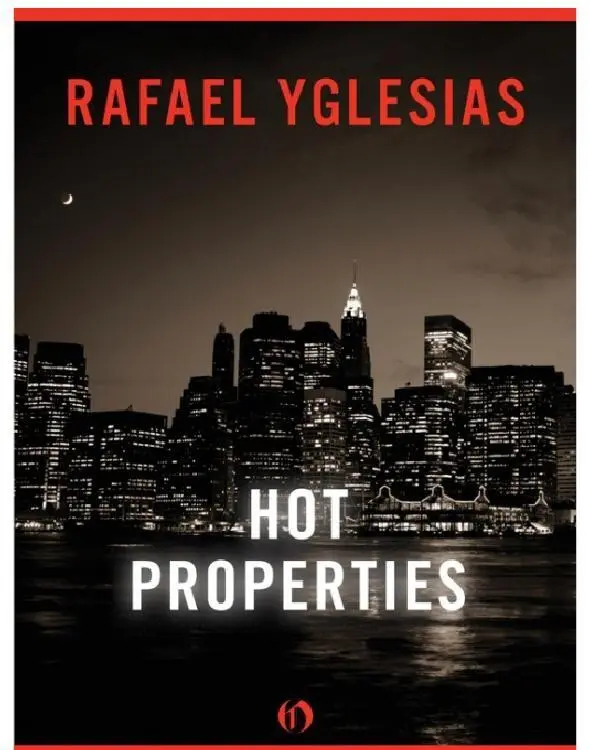
- Название:Hot Properties
- Автор:
- Издательство:Open Road Integrated Media LLC
- Жанр:
- Год:2010
- Город:New York
- ISBN:9781453205082
- Рейтинг книги:3 / 5. Голосов: 1
-
Избранное:Добавить в избранное
- Отзывы:
-
Ваша оценка:
Hot Properties: краткое содержание, описание и аннотация
Предлагаем к чтению аннотацию, описание, краткое содержание или предисловие (зависит от того, что написал сам автор книги «Hot Properties»). Если вы не нашли необходимую информацию о книге — напишите в комментариях, мы постараемся отыскать её.
Rafael Yglesias’s most sharp-tongued satire,
exposes the greed, envy, and backbiting in a media world bloated with money and power.
This ebook features a new illustrated biography of Rafael Yglesias, including rare photos and never-before-seen documents from the author’s personal collection.
Touted by the gossip columns as a roman a clef about the publishing world, Yglesias's fourth novel has definite commercial potential, since there are always people who like to read sordid tales about the media. Focusing on a group of ambitious, opportunistic New York yuppies, each desperate for success, power, fame, money and glamorous sexual partners, Yglesias follows his characters as their aspirations flourish or fade. And even for the one person who comes up with a smashing bestseller, happiness is an elusive emotion, banished by inner fear and self-loathing. The leading players in this fermenting brew are introduced in the book's opening scene, a dinner party so exquisitely awkward that even the reader is embarrassed. Thereafter we watch an aspiring playwright sell out to Hollywood; a sexy blonde discover she can really write, but must use her body to assure publication; a blocked novelist lose his scruples, professional and personal; a journalist at a leading newsmagazine realize that his way to the top has been sabotaged by office intrigue. Yglesias views his characters with cynicism, but he knows how to create the dramatic momentum that will have readers turning the pages. And if his book does become a bestseller, he will have the ironic last laugh.
Copyright 1986 Reed Business Information, Inc.
“
[is] the novel you want in the Hamptons. It lambastes the pretensions of the people you’ve been glaring at on the beach all day, and excoriates the city you’ve left behind.”
— “Sharp, funny, and fresh insight into the American literary world…”
—
From Publishers Weekly
Review
Hot Properties — читать онлайн бесплатно полную книгу (весь текст) целиком
Ниже представлен текст книги, разбитый по страницам. Система сохранения места последней прочитанной страницы, позволяет с удобством читать онлайн бесплатно книгу «Hot Properties», без необходимости каждый раз заново искать на чём Вы остановились. Поставьте закладку, и сможете в любой момент перейти на страницу, на которой закончили чтение.
Интервал:
Закладка:
“Oh, if your tickets are courtside, the way I jump up and down, they’re sure to notice.” Tom laughed at himself. Fred did not. Tom cut himself off at the lack of response. “No, I’m kidding. I know he probably wouldn’t. But if, by some chance, he did, it would be very embarrassing. Anyway, I was going to suggest that you come up to the box at halftime and have a drink. Meet whoever’s there. Maybe a starlet or two.” Tom laughed. “I assume you won’t bring the wife.”
Who am I going to bring? Fred wondered. Especially if he planned on visiting the box. He could hardly invite his old childhood friend Pete. Pete still used words like “farout” and “heavy.” “Um, I don’t think she wants to.” he said, not loudly. Marion was standing nearby, laying out hot dogs on a frying pan. Marion might want to go but Fred wasn’t sure he wanted her to come along. Not because he had any illusions about picking up starlets: he had an uneasy sense he didn’t want her on his arm in a private box at Madison Square Garden. It was a peculiar feeling. Marion, after all, was bright and well-spoken.
“Well, whomever you bring, come up at halftime. It’s Box Nine. All right? I have to rush out to meet someone for a drink. Thanks again for the offer. I’ll be courtside in spirit.”
“You’re welcome.”
“See you at the game.” He rang off.
Fred hung up slowly. Marion opened a can of baked beans, pulling back the metal lid with a scraping noise. “Who was that?”
“Tom Lear.”
“About the poker game?”
“No. He was inviting me to join him at one of the private boxes at the Garden.”
“Really?” Marion looked surprised. And pleased.
“Yeah. What’s so amazing about that?”
“I didn’t know you were friends.”
“Oh. Well, I guess I’m the only person at the game who’s a basketball fan.”
“So what did you say? Are we going to go?”
Fred stared at her. “Uh …”
Marion’s eyes narrowed. “You didn’t ask if I could come,” she said, making an accusation, not asking.
“No, it isn’t that.” Fred felt stupid. He had let her think Tom had instigated this, and judging from her reaction, he would be teased if she found out the reverse was true. Now he had a particular reason for not wanting her to come. If she stayed home, he could keep her false impression intact.
“Oh, there isn’t room!” Marion said, pleased, a student guessing right on a difficult quiz. “He’s taking you.”
“Right,” Fred said. “Do you mind? I can call him back and cancel.”
“No, of course not. You always get to go to the good things. I’ll just stay home alone. Again.” This sort of teasing was unlike Marion. Her mood had unaccountably changed since her outburst over his lack of attention to domestic details.
“Since when do you want to go to a basketball game? I can always get us tickets, you know.”
“I’m kidding. I wanted to see what one of those boxes is like. And I’d like to meet Tom Lear.”
“You would?” This, too, surprised Fred. Marion made fun of other people for wanting to meet the well-known. She called Tony Winter a “star-fucker” with the contemptuous-ness of someone who wouldn’t look up from the newspaper to glance at Greta Garbo dancing with Howard Hughes.
“He’s a good writer. I loved his book.”
Fred fell silent at this. He watched her heat the beans and turn the franks, thinking that he should say something, lest she decide he was made jealous by her praise of another writer. He wasn’t. He also admired Tom Lear. His quiet came from feeling how distant he was from being spoken of that way. He thought of his half-finished manuscript, of his uncertainty whether it had any merit, or how he had not only been made to feel unwelcome at the poker game, but had actually been barred. Tom Lear was about his age, didn’t seem to know more, or to speak better — there seemed so little difference between them. And yet Fred felt that if Tom had been born a king in the eighteenth century and he a peasant, there couldn’t have been a greater gulf between them.
After dinner, Marion said she had some editing to do, and he returned to his study to write more. He was still at his desk when she took a bath. He was rewriting the opening paragraph for the twentieth time when she came in her nightgown to kiss him good night.
He rubbed her belly through the soft material and felt hard immediately. He kissed her, his tongue pushing in and out anxiously, while he roughly sneaked a hand inside her neckline and reached for a breast. She pulled away, giggling at the feel of his cold fingers. “I have to go to sleep,” she said, smiling to soften the rejection.
“Okay,” he said, and his eyes went to the pages in front of him.
“Don’t go to bed too late.” she said.
“Okay,” he answered, already hypnotized by his words, prepared to sit up through the lonely hours of the night, until, exhausted by the fever of his ambition, he could slide beside his wife and listen enviously to the tranquil breathing of her sleep.
David noticed an ambition had been realized without a clear moment for its recognition. He was a senior editor. Syms had moved along with his old boss to another magazine, and four weeks ago David’s temporary position senior-editing Business had been made permanent. His dinner was conceived as a kind of celebration, a social confirmation of his elevated work status, but it had felt to him more like the opening gong of a new fight. Somehow, because of his eyeglasses breaking, an illusion of danger had been created in his mind. Until his joke broke the sense that he was an object of analysis by the others, a figure of affectionate amusement, like a three-year-old running in the buff through a group of loving but condescending relatives, David had the feeling that he had won nothing through his promotion.
Indeed, was he any less a prisoner of the magazine as a senior editor than he had been as a writer? The Marx Brothers now directly vetoed his story ideas instead of doing so through a proxy. True, he could now argue his own case rather than rely on the persuasiveness of someone else, but the dull logic of national newsmagazine writing always triumphed. If interest rates fell below ten percent, could he choose to ignore it in favor of a possibly more significant but less visible phenomenon such as the world-debt crisis? No, he would have to wait until Argentina or Mexico actually defaulted before ordering a piece on its significance. He could, and had, succeeded in getting a sidebar (a two-column box in a different color and bordered by a black rule) explaining that the Federal Reserve might have loosened because of the debt fears, leading to lower rates — flatly contradicting the cover story, which gave credit for the lower rates to the economic recovery. But his predecessor would have fought and gotten just such a story. Such frustrations were constant. He knew, for example, that a shakeout in the computer industry was coming — all business insiders knew it — and he wanted to do the story now, not in three months when the Weekly, Business Week, and everybody else would be doing it because the rash of bankruptcies had begun.
But isn’t my complaint foolish? he asked himself. Here I am, a journalist, bitching that I’m a prisoner of events. The illusion of being an essayist, created by the circumstance of working at a weekly news organization whose appeal had to be one of summarizing, analyzing, and predicting the effect of events, since it couldn’t compete with the immediacy of newspapers, much less television’s blood-spattering “live” coverage, was just that — an illusion which made the editors of Newstime delusional; persuaded them that not only should they reach for a deeper understanding of American life than the rest of journalism, but that they actually possessed profound insights. Indeed. David himself could make the argument that his desire to jump the event of the computer shakeout was nothing more than publishing an insider consensus, which could, like so many others, turn out to be wrong: “experts” predicting the obvious because of its safe logic, making error easy to defend.
Читать дальшеИнтервал:
Закладка:
Похожие книги на «Hot Properties»
Представляем Вашему вниманию похожие книги на «Hot Properties» списком для выбора. Мы отобрали схожую по названию и смыслу литературу в надежде предоставить читателям больше вариантов отыскать новые, интересные, ещё непрочитанные произведения.









Обсуждение, отзывы о книге «Hot Properties» и просто собственные мнения читателей. Оставьте ваши комментарии, напишите, что Вы думаете о произведении, его смысле или главных героях. Укажите что конкретно понравилось, а что нет, и почему Вы так считаете.