Dag Solstad - Novel 11, Book 18
Здесь есть возможность читать онлайн «Dag Solstad - Novel 11, Book 18» весь текст электронной книги совершенно бесплатно (целиком полную версию без сокращений). В некоторых случаях можно слушать аудио, скачать через торрент в формате fb2 и присутствует краткое содержание. Год выпуска: 2011, Издательство: Random House, Жанр: Современная проза, на английском языке. Описание произведения, (предисловие) а так же отзывы посетителей доступны на портале библиотеки ЛибКат.
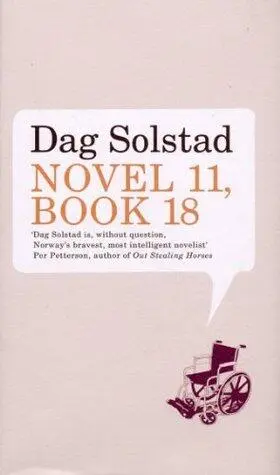
- Название:Novel 11, Book 18
- Автор:
- Издательство:Random House
- Жанр:
- Год:2011
- ISBN:нет данных
- Рейтинг книги:5 / 5. Голосов: 1
-
Избранное:Добавить в избранное
- Отзывы:
-
Ваша оценка:
Novel 11, Book 18: краткое содержание, описание и аннотация
Предлагаем к чтению аннотацию, описание, краткое содержание или предисловие (зависит от того, что написал сам автор книги «Novel 11, Book 18»). Если вы не нашли необходимую информацию о книге — напишите в комментариях, мы постараемся отыскать её.
He finds a fellow conspirator in Dr Schiøtz, who has a secret of his own and offers to help Bjørn carry his preposterous and dangerous plan through to its logical conclusion. However, the sudden reappearance of his son both fills Bjørn with new hope and complicates matters. The desire to gamble with his comfortable existence proves irresistible, however, taking him to Vilnius in Lithuania, where very soon he cannot tell whether he's tangled up in a game or reality.
Novel 11, Book 18
Novel 11, Book 18 — читать онлайн бесплатно полную книгу (весь текст) целиком
Ниже представлен текст книги, разбитый по страницам. Система сохранения места последней прочитанной страницы, позволяет с удобством читать онлайн бесплатно книгу «Novel 11, Book 18», без необходимости каждый раз заново искать на чём Вы остановились. Поставьте закладку, и сможете в любой момент перейти на страницу, на которой закончили чтение.
Интервал:
Закладка:
And so he wandered about in the flat, planning the changes that were forced upon him because his son was coming to stay. He was excited. This would turn his whole existence upside down. He actually had a son who was coming to live with him. It was an undeserved joy and he understood that he ought to appreciate it. He tore down the bookshelves in his cherished library, except for one which he thought would suit Peter’s books to perfection. Started rigging them up in the living room. He also made a reading nook in his own bedroom, with a bookcase along one wall and a good easy chair to sit in. The son’s room was now completely crammed with books, in piles on the floor. Before putting them in place, in the living room and in his own bedroom, he took a stroll about town to look for a good sofa bed. And a microwave. When he returned he put the books on the shelves. In a few days the sofa bed arrived. Bjørn Hansen walked about in the flat, wondering if he had forgotten anything, something that a young student must have in his bedroom, which might also become his study. ‘Finally something to look forward to!’ he exclaimed. ‘Yes, I must say! This I hadn’t expected. To think that he is going to live here, if only for a few weeks! How wonderful that he intends to become an optician! And also that he was admitted! My whole existence will be turned upside down!’
He was going to be reunited with his son. It was Peter who had not stayed in touch. But he was also the one who now took the initiative to restore contact. Bjørn knew it could be difficult. Six years had passed since he last saw Peter and then his son was a child, now he was an adult. He didn’t even know what he looked like. Perhaps he had not wanted to break contact with his father when he was fourteen. Though he had found an excuse not to visit every summer. Maybe he had hoped that his father would beg him to come on bended knee. That, however, Bjørn had not done, because losing contact was part of the price he had paid for abandoning his little son of two, and his mother. That’s why he simply put up with hearing this son, on turning fourteen, telling his father that he had altogether different plans for the summer than visiting him, and that this is repeated when the son turns fifteen, sixteen, seventeen, eighteen… As the time of Peter’s arrival approached, Bjørn realised more and more clearly how uncertain and scared he felt about this meeting. He observed it in the way he talked to others about his son’s coming. To Berit and Herman Busk, for example. He spoke about Peter like an altogether ordinary father. He would remark, casually, that it would not be easy having a young man in the house, and he expressed a paternal concern as to whether the study of optics was ‘good enough’. It was as if he were practising to take on a role he had not even considered for eighteen years, and which he now tried to make everyone believe was made for him. But he gave himself away to the eighteen-year-old Mari Ann, who cleaned his flat. Because of the changes he had made in the flat, he told her he expected his son in the autumn. Then she suddenly became interested and asked, quite naturally in fact, if he had a photo of him. But he didn’t! The most recent photograph he had of his son showed Peter on a summer’s day the year he turned eleven. Mari Ann stared, open-mouthed. Afterwards Bjørn Hansen could see to his annoyance that she had tried to hide what she really thought about a fifty-year-old man who seemed to care so little about his son. The girl clearly felt fully justified in her moral condemnation, which was not lessened by her attempt to act as if nothing were the matter, having initially gaped in wonder, because she did not dare to show openly what she thought of him. After all, he was the one who gave her pocket money and, moreover, he was old and a sort of pillar of society. And he was her mother’s boss.
Actually, he had felt no need for having photos of Peter as he grew up. If he had got some, it would have been nice, but not having any did not make him feel deprived. He did not feel a tremendous urge to know how his son looked on his eighteenth birthday, the day he received his matriculation certificate, or the day he left for his military service. He had a son, that was enough for him, and he felt little need to speculate on how he looked. He saw no reason for having a familial relationship with his son, because they did not belong to the same family, nor had they ever done so except for a brief spell. But Peter was his son. He was proud to have a son, but under the circumstances he felt no need for that son to have a face that he might contemplate in a photograph. And he wouldn’t have an eighteen-year-old girl staring at him as if he were some kind of monster because of it.
He had often thought about his son over the years. Not night and day. Nor had he ever lain awake wondering how he was getting on. He had assumed that Peter would lead his own life, without him, growing from a child to a man without having him nearby, as a corrective. He liked the thought of his son running about in Narvik and growing up. When Peter still visited in the summertime, he looked forward to it, and he spent a fortnight with him, which was rich in high points; but when the fortnight came to an end, it was only with sadness, rather than sorrow, that he drove him to Fornebu and took him to the plane that was to take him back to his home in Narvik. Indeed, to tell the truth, he felt a kind of relief that it was over, that it had gone well, and that he could now resume his customary life. Still, it was these fourteen summer days each year, from the time when Peter was a little boy, that connected him directly to his son. He knew very well that Peter was now a young man, far removed from the little Peter of his boyhood days, and it was likely to make the young man embarrassed if reminded of them. It was not Peter but memories that Bjørn Hansen had preserved, all but palpably. Such as twitches in the small boy’s hand at the sight of a big stray dog right in front of them, which he feels because he is holding Peter’s hand. The boy who stops short, clutching his father’s hand to hold him back. The boy’s fear before a big stray dog, combined with his realisation that he must learn to control this or at least not betray it, acting like his father, who says there is no danger, come on! Bjørn felt glad that this tug on his hand was intact inside him. Yes, Bjørn Hansen thought, luckily it was. But how would that help when he met the young stranger who was on his way to Kongsberg to study optics and who was to live, at least for the time being, with him? This twenty-year-old with a face he had never seen before? Who would suddenly appear. Here. To live with his father.
And so, there he stands one morning at the end of August. At Kongsberg Railway Station. Waiting for the train. Waiting for his unknown son. Being early, he was waiting on the platform. Suddenly he caught sight of Dr Schiøtz, who was also waiting for the train. For some preparations for the hospital. Bjørn Hansen found it rather strange that Dr Schiøtz picked up the preparations himself, but assumed that he did so because he wanted some fresh air. Bjørn Hansen told him that he was waiting for his son, who was about to begin studying optics at Kongsberg Engineering College. ‘Your son? I didn’t know you had a son. How nice,’ said the doctor, making Bjørn Hansen wonder whether there was a trace of irony in his voice. But there was no time to think about that, because now the train from Oslo could be seen on the attractively curved railway track. The long train glided slowly into the station and stopped. It was the South Country Express, which halted briefly at Kongsberg before going farther inland, down through Telemark, before it finally reached the coast at the southernmost point of Norway, Kristiansand. Bjørn Hansen craned his neck, for now the passengers were getting off and making their way among those who were waiting to get on.
Читать дальшеИнтервал:
Закладка:
Похожие книги на «Novel 11, Book 18»
Представляем Вашему вниманию похожие книги на «Novel 11, Book 18» списком для выбора. Мы отобрали схожую по названию и смыслу литературу в надежде предоставить читателям больше вариантов отыскать новые, интересные, ещё непрочитанные произведения.










Обсуждение, отзывы о книге «Novel 11, Book 18» и просто собственные мнения читателей. Оставьте ваши комментарии, напишите, что Вы думаете о произведении, его смысле или главных героях. Укажите что конкретно понравилось, а что нет, и почему Вы так считаете.