Dacia Maraini - Train to Budapest
Здесь есть возможность читать онлайн «Dacia Maraini - Train to Budapest» весь текст электронной книги совершенно бесплатно (целиком полную версию без сокращений). В некоторых случаях можно слушать аудио, скачать через торрент в формате fb2 и присутствует краткое содержание. Год выпуска: 2011, ISBN: 2011, Издательство: Arcadia Books, Жанр: Современная проза, на английском языке. Описание произведения, (предисловие) а так же отзывы посетителей доступны на портале библиотеки ЛибКат.
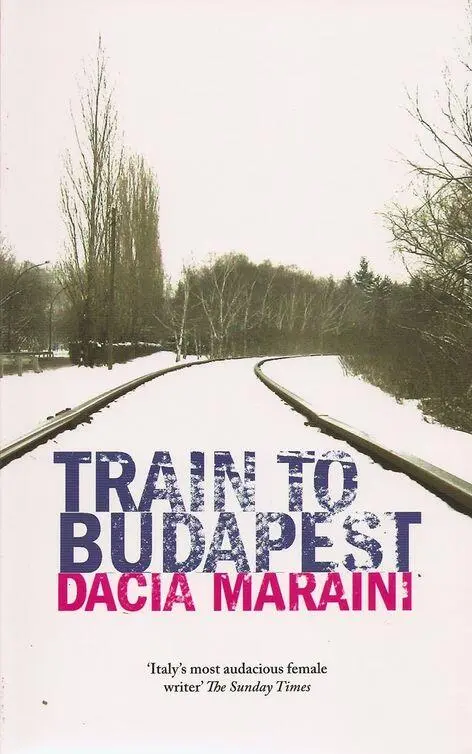
- Название:Train to Budapest
- Автор:
- Издательство:Arcadia Books
- Жанр:
- Год:2011
- ISBN:9781908129086
- Рейтинг книги:4 / 5. Голосов: 1
-
Избранное:Добавить в избранное
- Отзывы:
-
Ваша оценка:
Train to Budapest: краткое содержание, описание и аннотация
Предлагаем к чтению аннотацию, описание, краткое содержание или предисловие (зависит от того, что написал сам автор книги «Train to Budapest»). Если вы не нашли необходимую информацию о книге — напишите в комментариях, мы постараемся отыскать её.
Train to Budapest — читать онлайн бесплатно полную книгу (весь текст) целиком
Ниже представлен текст книги, разбитый по страницам. Система сохранения места последней прочитанной страницы, позволяет с удобством читать онлайн бесплатно книгу «Train to Budapest», без необходимости каждый раз заново искать на чём Вы остановились. Поставьте закладку, и сможете в любой момент перейти на страницу, на которой закончили чтение.
Интервал:
Закладка:
Amara opens the windows of her room, which smells stuffy, and thinks of the beautiful slim body of Luca Spiga. In hospital? How can she have known nothing about it? Logic tells her he’s probably blackmailing her, but a gut feeling is urgently pressing her to rush to the sick man’s bedside. Before she has even had time to wash her hands she finds herself thinking how to change the ticket she had already reserved and what to put in her suitcase. She will come back, she knows she must do that, but how long will she have to be away? Reason tells her to wait, to think things over, to find out more before leaving. But instinct has already made her pull down her case from on top of the large wardrobe, and open drawers large and small to start collecting together her things.
20
Three p.m. The train to Italy. With a bag bought at the last minute, into which she has hastily thrust her nightdress, some underclothes, the exercise book in which she drafts her articles and two books. She has left her father Amintore’s suitcase with her jumpers, skirts, blouses and shoes in the care of Frau Morgan. It was not easy to tell the man with the gazelles that she was about to rush away.
‘If you are separated from your husband why hurry to him the moment he calls for you?’
‘He’s ill, in hospital. He wants to see me before he dies. I’d be a monster not to go.’
‘I think you’re making a mistake, just when we’ve discovered something definite.’
‘There’s nothing definite, Hans. We’re all at sea.’
‘We were about to go and see where Emanuele lived. I’ve already phoned the woman who is caretaker there. The building survived, it wasn’t destroyed by the bombs. They were expecting us tomorrow morning.’
‘Well, tell them we’ll come next week. I’m going and coming back, but I can’t just not go.’
‘And who’s paying for this trip?’
‘Luca sent me money for my ticket.’
‘So it’s serious.’
‘I really think it is.’
‘But haven’t you always said he’s a man who would rather forget?’
‘Well, goodnight Hans. You go back to your daughter in Poznań, and I’ll send you a telegram the minute I’m free to come back. I promise we will go on with our researches together.’
The man with the gazelles looks at her, discouraged. But he stops insisting. He senses her determination. Will he wait for her? When she sees him turn and move away with his usual swinging step, shoulders slightly rounded, his fine bold neck bent forward, she is seized by apprehension and pain. ‘I’ll be back soon, I promise!’ she shouts at his back. She sees him turn slowly. Even at a distance, she can see his eyes shining with joy. ‘I’m counting on it!’ he calls and disappears round the corner.
The train is a mobile home that favours more intimate thoughts. Amara has found a window seat. The air is full of that atmosphere of sweaty socks, apples and cigarettes typical of third-class carriages, but in compensation she has the compartment to herself. She is free to shut herself into her corner and bury herself in her book.
When the future captain climbs the stairs of the navigation office in London he finds himself faced with two women knitting. Conrad doesn’t say it in so many words but describes them as though they were the Fates intent on spinning the thread of life. The captain stops for a moment dumbfounded. What are those two women doing in his path? Is it a presentiment of disaster? But he is a young man and tosses fear aside with a bold gesture. He will accept command of that ship, even if he knows she is old and in poor condition. He will go to Africa. Something tells him it will be a trip to hell, that it will teach him the horror human beings are capable of. But this will not stop him. He will go on to the end. Because this voyage is his destiny. And the reason he has eyes in his head is to watch and observe. To understand? Perhaps not even that. But to watch, certainly, and to bear witness to that horror. Halfway through the chapter she lifts her eyes from the printed words of the book to the window streaming with water. Outside, a dense landscape of trees. The train seems to be entering an unending forest. The branches beyond the wet panes are green with a touch of blue and then of red. Her thoughts go to Emanuele whom she feels she is betraying with this sudden abandonment. Emanuele whom death has transformed into an eternal small boy with a seductive face: a lock of blond hair perpetually falling across his broad brow, a little strong-willed nose, bright brown eyes and a sarcastic, rebellious smile sometimes shot through with pure tenderness. Those the gods love die young. Can she be sure she is not pursuing a ghost? Only ghosts can always stay themselves, always equally lovable and ready to appear at every turn of the eyes. And Luca Spiga, the man of the caresses, the man who though twenty years her senior once enchanted her with his soft, low voice and his abstention from any abrupt, angry or even irritable gesture; why does he now present himself in such a dominant way to her memory? She thought she had forgotten him. And instead, there he is, tender and precise as in the first year they lived together. Only later, only when he was beginning to get bored, did he change into an absent husband. Was that a ghost too? Who is it calling to her from his deathbed, the first Luca or the second?
Now the forest changes to a cupola or tunnel, with a dark interior. A darkness made up of curious watching eyes. Predatory eyes that penetrate the dim carriage, searching for prey. Eyes with a suspicious look. This is the cold war, this is the cold war. The terrified words of the man with the gazelles. Who should she listen to? For now she will go where the most basic duty takes her: to open the door to anyone who knocks.
At the border: another long wait. Armed guards taking away people’s passports, two men smoking as they chat in the corridor. Amara can’t distinguish their words but the sound of their voices reminds her of the light rumble of thunder among clouds heavy with rain. Now the train has emerged from its tunnel of trees. It stops at a station sheltered by badly lit roofs. She can hear the piston rhythms of the engine. Memory mixes personal experience with images from films seen with Luca in the little auditorium of the Charlie Chaplin Cineclub at Rifredi. Maybe Jean Cocteau’s Orphée or Carol Reed’s The Third Man . A figure in a long white raincoat is standing stiffly on the pavement watching her as rain falls on him. Then unexpectedly he smiles, takes off his hat and makes her a light bow. Could it be Humphrey Bogart?
Better to return to Marlow and his Congo River, over which the sails of the ivory-traders lightly float. Why is the young captain so insistent in his search for that Kurz who is believed to know more than any other European about blacks and elephants? Who is it forcing him to follow that unscrupulous man who has put down roots in a world of slaves where each head is worth less than a piece of ivory? Where the darkness grows ever more dense and complex and at the bottom of which nothing can be found except the horror of a heart of darkness? Is Marlow a ghost too? Is it not too early, at twenty-six, for her to be chasing shadows rather than real live people? But her mind sees little difference. In the village square at the centre of her thoughts people who have really existed, imagined people, living people and dead people all walk and talk absolutely naturally. Even if she can tell them apart, she does not want to use a tape measure to establish who belongs on the one side and who on the other, who is worthy of her attention and who not. It is perhaps war, privation, fear, the absolute throw-of-the-dice chance of places and refuges, even of life itself, that have taught her this: to welcome the dead and the living with equal joy. In fact here is little Emanuele who, she now sees, is opening the sliding door of the compartment and, terribly serious, comes to sit facing her on one of the empty seats. He has a book in his hands. He opens it. He buries himself in his reading. He has the same dry, agile body as when he was eleven, the same dark eyes, the same quick, nervous hands. Only his quiff of hair is now grey. A child grown prematurely old.
Читать дальшеИнтервал:
Закладка:
Похожие книги на «Train to Budapest»
Представляем Вашему вниманию похожие книги на «Train to Budapest» списком для выбора. Мы отобрали схожую по названию и смыслу литературу в надежде предоставить читателям больше вариантов отыскать новые, интересные, ещё непрочитанные произведения.











Обсуждение, отзывы о книге «Train to Budapest» и просто собственные мнения читателей. Оставьте ваши комментарии, напишите, что Вы думаете о произведении, его смысле или главных героях. Укажите что конкретно понравилось, а что нет, и почему Вы так считаете.