Dacia Maraini - Train to Budapest
Здесь есть возможность читать онлайн «Dacia Maraini - Train to Budapest» весь текст электронной книги совершенно бесплатно (целиком полную версию без сокращений). В некоторых случаях можно слушать аудио, скачать через торрент в формате fb2 и присутствует краткое содержание. Год выпуска: 2011, ISBN: 2011, Издательство: Arcadia Books, Жанр: Современная проза, на английском языке. Описание произведения, (предисловие) а так же отзывы посетителей доступны на портале библиотеки ЛибКат.
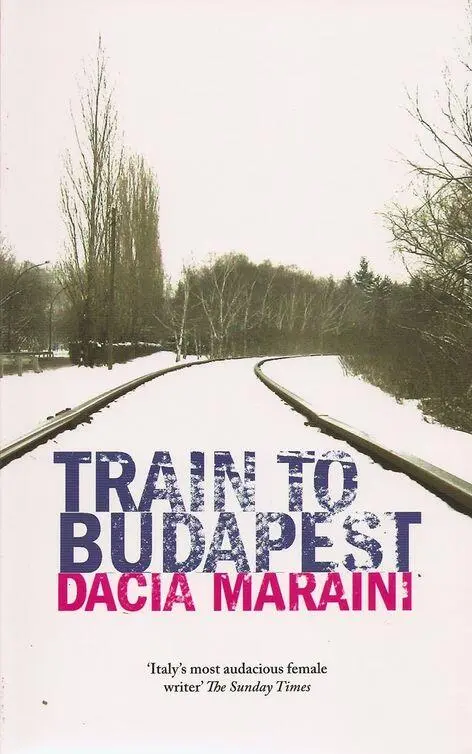
- Название:Train to Budapest
- Автор:
- Издательство:Arcadia Books
- Жанр:
- Год:2011
- ISBN:9781908129086
- Рейтинг книги:4 / 5. Голосов: 1
-
Избранное:Добавить в избранное
- Отзывы:
-
Ваша оценка:
Train to Budapest: краткое содержание, описание и аннотация
Предлагаем к чтению аннотацию, описание, краткое содержание или предисловие (зависит от того, что написал сам автор книги «Train to Budapest»). Если вы не нашли необходимую информацию о книге — напишите в комментариях, мы постараемся отыскать её.
Train to Budapest — читать онлайн бесплатно полную книгу (весь текст) целиком
Ниже представлен текст книги, разбитый по страницам. Система сохранения места последней прочитанной страницы, позволяет с удобством читать онлайн бесплатно книгу «Train to Budapest», без необходимости каждый раз заново искать на чём Вы остановились. Поставьте закладку, и сможете в любой момент перейти на страницу, на которой закончили чтение.
Интервал:
Закладка:
The survivor had remembered the other two families deported at the same time as his own. He described them and in his portrait of a dressmaker who never stopped sewing day or night, using tablecloths and curtains torn from windows that she carried folded in a small suitcase to make shirts for men and women, Theodor had recognised his mother the seamstress, Magdalena Ruthmann, Frau Orenstein. Thus he came to know for certain that his own family had been deported that same morning as he listened eagerly to the story the survivor told.
But what exactly had the man on the radio revealed?
At this point Theodor Orenstein stops as if gripped by sudden shame. The shame of pain, the shame of words imbued with translucent beer. Shame before strangers who might misunderstand. Though he knows the man with the gazelles also lost his mother in a concentration camp.
‘I did everything I could to trace that survivor, I phoned the radio, but they wouldn’t give me his name and address. So I went to the Jewish community and asked them to put me in contact with the former deportee who had been interviewed on national radio, and finally I discovered his address. I went to see him and he told me about the ‘dressmaker’ Magdalena Ruthmann who had become famous in the camp for her sewing skills. The SS wives competed for her and she could always get something to eat. While my father, who had tried at the roll call to seem more robust than he was, had been sent out to work. Getting up at five and wearing only the regular striped uniform of an inmate and with hard cold clogs on his feet, he would go with a group of young men to move heavy frozen wooden railway sleepers from one side of a country road to the other. With no gloves and no hat. Two of his toes developed frostbite and were unceremoniously cut off in the infirmary. But the wound would not heal. Blood leaked out night and day and no rag could staunch it. My father got steadily weaker. Then one day the weight of a sleeper made him slip and fall in the snow, and he couldn’t get up again. The guard prodded him and pushed him with a stick, but it was no use. Two of his more charitable companions helped him to his feet, but he fell down in the snow again. He had no more will to fight. The guard, himself a prisoner, called to the SS man who was supervising them and who was standing apart beating his gloved hands together, wrapped in a greatcoat that reached to his feet. The SS man came over and loudly ordered the fallen man to get up. Huddling on the ground, my father knew quite well what to expect. Disobedience was not tolerated. But he could not go on, quite simply he could not go on and no longer even wanted to try. The SS man shouted at him one last time to get up, then pulled out his pistol. My father’s companions went on urging him to get to his feet, but he curled up even more tightly on the ground and the officer shot him in the head.’
Such had been the fate of the father of the painter Theodor Orenstein. Or at least, this was how it had been described to him. Who knows if that man, who no longer had a name but had been reduced to a mere number shouted out at the dawn roll call, had really been the civil servant Adolf Orenstein, who once had dressed himself for the office every morning from head to foot in grey trousers with grey braces, a pearl-grey waistcoat, an iron-grey jacket, a mouse-grey tie decorated with tiny bluebells, and with a lead-grey hat on his head. Had he really been that faithful patriotic office-worker who voted for Dollfuss, the self-styled democrat who no sooner elected abolished all the political parties? Had he really been the nationalist Adolf Orenstein, who saw himself as having no religion since he practised no religion, and who had devoted all his efforts to the preservation of an Austrian state whose great traditions meant more to him than any god in the sky? Had it really been he who let himself fall in the snow, hiding his bandaged but constantly bleeding foot? The faithful husband of one single deeply-loved woman, Magdalena Ruthmann, dressmaker by profession, with whom he had shared home and bed for more than twenty years?
The painter Theodor Orenstein has no doubts. Hans seems a little puzzled, but doesn’t dare speak. He knows the painter is deeply moved. How long since the last time he told the story of his father’s death at Auschwitz that morning in January 1945, crushed by a railway sleeper, his foot with its two amputated toes that never stopped bleeding, his ribs so prominent in his chest that they could be counted one by one, his face hollow after his front teeth fell out one evening when he was trying to bite through a bread crust made from potato peel and, who knows, sawdust or even the plaster used to stop up holes in the huts? Who knows how long Theodor has been reliving that death, unable to come to terms with it? That useless, devastating, humiliating death. A death he has tried to forget but which rises again as if regurgitated in his throat every time he talks of his past. Perhaps he hates his visitors, thought Amara, for having forced him to remember. Will he be able to go on painting angels on roofs after being lacerated by that bloody memory? Or will he have to change the subject matter of his paintings? Why did such a painter with such memories not paint his father with his prison companions and his bandaged and bleeding foot, shifting frozen railway sleepers one morning in the snow? Amara would like to ask him but refrains. There is no room in Theodor’s pale, desperate face for reasoning, only for a pain that demands respect.
16
Magdalena Ruthmann Orenstein escaped the gas chambers. He had discovered this too, but not from the survivor he had heard on the radio and later tracked down and interviewed. But rather from the diary of the widow of an SS officer who, seven years after her husband’s death just before the camp was liberated, and after starving in a hovel among the ruins of Berlin, had found a publisher for her diary of the years 1944–1945. Its title was Auschwitz , and its subtitle I Was There Too . It was not the memoir of a surviving inmate, but of a woman who had lived with her SS officer husband in a little house all flowers and pretty curtains at the edge of the camp.
This woman had described how as a young bride she had lived in Bremen with her young husband who had started as an ordinary soldier in the Wehrmacht. Then with the growth of Nazism she had found herself first the wife of an SS-Hauptscharführer (Chief Squad Leader) and then of an SS-Untersturmführer (Junior Storm Leader or Second Lieutenant) and finally, transferred overnight to Berlin, the wife of an SS-Obersturmführer (Senior Storm Leader or First Lieutenant), which had made her very proud indeed. During these years three children had been born, of whom the youngest, Adolf, was a most beautiful blond child with blue eyes, just as recommended by the great Hitler. When her husband the SS-Obersturmführer received relocation orders he did not tell her where they were to live. It was only when they got there that his wife understood that they had been transferred to a work camp for Jewish prisoners. It was almost impossible for Aryan women even to pronounce the word ‘Jewish’ at that time. When they could not avoid it, they felt bound to add a grimace of disgust. According to the newspapers they all read, the Jews had been responsible for every kind of wickedness: as born loan-sharks they had stolen money from poor Austrians forced to struggle all day for a living, and had made secret pacts with the enemies of the fatherland, plotting to kill the Aryans and create a country in their own image. They were violent and domineering and wanted to impose communism, meaning the immediate and total confiscation of all private property, with the possible shooting of anyone who kept back anything at all for themselves, even a ramshackle old bicycle. On top of this they were usually physically ugly, with hooked noses, prominent negroid lips and greasy black hair. This was how they were depicted in caricatures; stooping, bony, hunchbacked and hostile, ready to grab any poor unsuspecting Austrian and suck his blood by sinking two canine teeth as sharp as corkscrews into his neck.
Читать дальшеИнтервал:
Закладка:
Похожие книги на «Train to Budapest»
Представляем Вашему вниманию похожие книги на «Train to Budapest» списком для выбора. Мы отобрали схожую по названию и смыслу литературу в надежде предоставить читателям больше вариантов отыскать новые, интересные, ещё непрочитанные произведения.









Обсуждение, отзывы о книге «Train to Budapest» и просто собственные мнения читателей. Оставьте ваши комментарии, напишите, что Вы думаете о произведении, его смысле или главных героях. Укажите что конкретно понравилось, а что нет, и почему Вы так считаете.