Richard Mason - History of a Pleasure Seeker
Здесь есть возможность читать онлайн «Richard Mason - History of a Pleasure Seeker» весь текст электронной книги совершенно бесплатно (целиком полную версию без сокращений). В некоторых случаях можно слушать аудио, скачать через торрент в формате fb2 и присутствует краткое содержание. Год выпуска: 2012, Издательство: Knopf, Жанр: Современная проза, на английском языке. Описание произведения, (предисловие) а так же отзывы посетителей доступны на портале библиотеки ЛибКат.
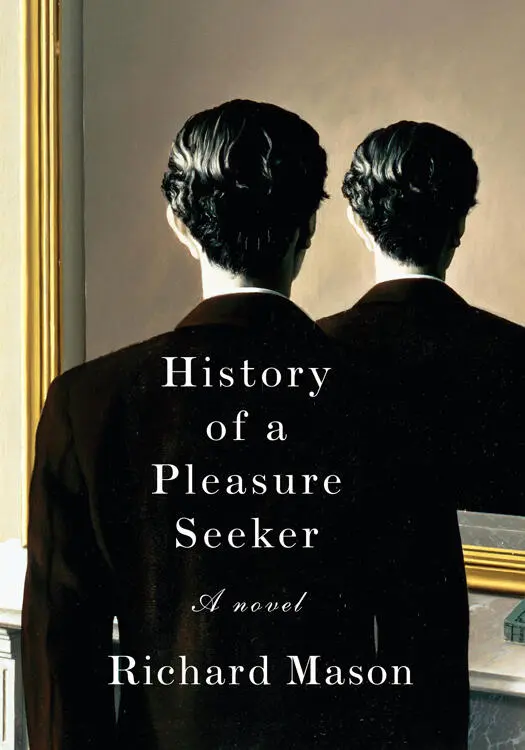
- Название:History of a Pleasure Seeker
- Автор:
- Издательство:Knopf
- Жанр:
- Год:2012
- ISBN:нет данных
- Рейтинг книги:4 / 5. Голосов: 1
-
Избранное:Добавить в избранное
- Отзывы:
-
Ваша оценка:
History of a Pleasure Seeker: краткое содержание, описание и аннотация
Предлагаем к чтению аннотацию, описание, краткое содержание или предисловие (зависит от того, что написал сам автор книги «History of a Pleasure Seeker»). Если вы не нашли необходимую информацию о книге — напишите в комментариях, мы постараемся отыскать её.
The novel opens in Amsterdam at the turn of the last century. It moves to New York at the time of the 1907 financial crisis and proceeds onboard a luxury liner headed for Cape Town.
It is about a young man — Piet Barol — with an instinctive appreciation for pleasure and a gift for finding it. Piet’s father is an austere administrator at Holland’s oldest university. His mother, a singing teacher, has died — but not before giving him a thorough grounding in the arts of charm.
Piet applies for a job as tutor to the troubled son of Europe’s leading hotelier: a child who refuses to leave his family’s mansion on Amsterdam’s grandest canal. As the young man enters this glittering world, he learns its secrets — and soon, quietly, steadily, finds his life transformed as he in turn transforms the lives of those around him.
History of a Pleasure Seeker is a brilliantly written portrait of the senses, a novel about pleasure and those who are in search of it; those who embrace it, luxuriate in it, need it; and those who deprive themselves of it as they do those they love. It is a book that will beguile and transport you — to another world, another time, another state of being.
History of a Pleasure Seeker — читать онлайн бесплатно полную книгу (весь текст) целиком
Ниже представлен текст книги, разбитый по страницам. Система сохранения места последней прочитанной страницы, позволяет с удобством читать онлайн бесплатно книгу «History of a Pleasure Seeker», без необходимости каждый раз заново искать на чём Вы остановились. Поставьте закладку, и сможете в любой момент перейти на страницу, на которой закончили чтение.
Интервал:
Закладка:
Mr. Blok now appeared at the door in a dark tailcoat: a waxy man in his late fifties with a scrupulously shaven chin. Something in his glance suggested an awareness of Piet’s charms — which Piet thought problematic, since he felt no answering inclination. On the rare occasions Piet Barol went with men, he preferred them athletic and close to his own age. The butler was neither. “This way, Mr. Barol,” he said.
Mr. Blok left the room and went up a narrow staircase. Piet did not wish to appear provincial, and his face gave no sign of the impression the entrance hall made. Panels with quotations from the Romantic painters surmounted a wainscot of marble shot with pink and gray. On a half-moon table was a silver bowl filled with visiting cards. Mr. Blok turned right beneath a gilt lantern and led Piet towards an open door at the head of the passage, through which tall French windows were visible.
As he passed the dining room Piet glimpsed olive-green-and-gold wallpaper and a table set for five — a family dinner, which meant that Constance and Louisa would be dining in. He knew from the newspapers that they did so rarely and read this, quite correctly, as a sign of their interest in their brother’s new tutor.
He longed to meet them and be their friend.
The staircase to the upper floors was carpeted in soft red wool and surveyed by a trio of statues beneath a glass dome. Mr. Blok led Piet past it and ushered him into the room with the French windows, which was nothing but a tiny octagon, constructed of glass and stone and furnished with two sofas of extreme rigidity. It told him plainly that the splendors of the drawing room were reserved for men better and grander than he; and because Piet Barol had a strong sense of his innate value, he took exception to this judgment and resolved to conquer the person in whose gift the freedom of the house lay.
The butler retreated. Piet placed the envelope containing his references on a table so slender it barely bore this burden and settled to wait. Above him, a chandelier of five gilt griffins observed him disdainfully, as if each of its winged lions could see into his soul and disapproved of what they found there. Mrs. Vermeulen-Sickerts’ first name conjured images of hairy patriarchs and he hoped she wouldn’t be too ugly. It was harder to flirt with an ugly woman.
He was pleasantly surprised when a light step sounded on the tiles and Jacobina appeared. Although approaching forty-six, the legacy of an athletic youth was evident in her neat waist and quick, fashionable movements. She was wearing a day dress of apple-green wool with a high lace collar and a small train: an impractical garment in many respects, but Jacobina Vermeulen-Sickerts had no pressing need to be practical. “Good afternoon, Mr. Barol.” She extended a hand and shook his firmly. “Please don’t get up.” But Piet was already standing, and he smiled shyly as Jacobina sank onto one of the sofas and said: “Do excuse the uncomfortable furniture. My husband is very fond of Louis Quinze and the fabric is too delicate to have the seats resprung. Would you drink some tea with me?”
“Gladly.”
Jacobina ordered refreshments on an extravagantly ornamental telephone. “And now, may I see your references?”
It was as well to get these out of the way at the beginning. As Piet handed them to her, his eye caught Jacobina’s and he understood that he had made a favorable first impression. Indeed, Piet’s smell, which was the smell of a gentleman, and his clothes, which were a gentleman’s clothes, reassured Jacobina in ways of which she was not at all conscious. She glanced at the pages in her hand, saw that Piet had the university degree the position required, and said: “Tell me about your family. Your father is a clerk in the university at Leiden, I believe?”
“He is, ma’am.” Herman Barol had a respectable position in the administration of Holland’s oldest university. Piet conveyed this without mentioning that such posts are generally held by petty autocrats unable to achieve influence elsewhere.
“And your mother?”
“She died when I was seventeen. She was a singing teacher.”
“I’m so sorry. Do you sing?”
“I do, ma’am.”
“Excellent. So does my husband.”
It was, in fact, thanks to his mother the singing teacher that Piet was able to read in Jacobina Vermeulen-Sickerts the subtle traces of an interest that was not wholly professional, long before she became aware of it herself. Since her son could walk, Nina Barol had spoken to Piet as though he were a cultivated and delightful intimate of her own age. She had discussed the personal situations of her students with a candor that would have horrified them, and later, as a boy accompanist, Piet had had ample opportunity to look for evidence of what his mother told him. He was now unusually sensitive to indications of private emotion. As he answered Jacobina’s questions, he absorbed a wealth of detail about the woman who might be persuaded to change his life. She had a strong sense of propriety, that was clear. But it did not seem to be stronger in her than in other respectable women Piet knew, who had happily abandoned it for him. “And what of Master Egbert?” he said.
Tea was brought in and Jacobina poured. “My son is extremely intelligent, but sometimes intelligence of that sort can be a burden. He has always had a vivid imagination. Indeed, I have encouraged it. But perhaps I have been overly lenient with him. My husband believes he needs sterner treatment, though I am looking for a tutor who can combine authority with gentleness.”
Jacobina had made this speech to each of the sixteen people she had so far interviewed; but as she spoke the word gentleness to Piet Barol her eyes flicked to his hands, as if they were the perfect expression of what she sought. “Egbert completes his schoolwork very well. He speaks English and German and French and dedicates himself to the practice of his music with commendable discipline. He has long outgrown any music teacher I have been able to find. But—”
“He is shy, perhaps?”
“Not unusually so, Mr. Barol. If you met him you would not think anything much out of the ordinary. The problem is — he will not leave the house.”
“Will not?”
“Perhaps cannot. We have had to obtain a special permit to educate him at home. He last went into the garden a year and a half ago but has refused absolutely to go into the street since he was eight years old. We tried to coax him at first and then to force him; but I am afraid the tantrums were so affecting I put a stop to my husband’s efforts. Perhaps that was wrong, but it is very hard for a mother to see her child afraid and do nothing.”
“Of course.”
“So there you have it. We need a tutor who is capable of — of finding Egbert, wherever he has lost himself, and bringing him back to us.”
It was the fourth time that day, and the twelfth that week, that Jacobina had been obliged to debase herself before a stranger with this frank rendition of her maternal failings. It was not an experience she enjoyed. But Piet’s expression was one of such thoughtful concern, and contrasted so well with the embarrassment of the other candidates, that she was inspired to further revelation. “I cosseted him too much when he was little, Mr. Barol. I should have made him be braver, but I did not and now he lacks the courage even to venture onto the steps outside. Have you experience of difficult children?”
Piet had no experience of any children whatsoever. “Life in a university town acquaints one with many brilliant eccentrics,” he said judiciously.
Jacobina smiled to disguise the fact that she might also have burst into tears. She loved each of her children fiercely, but Egbert most fiercely of all because he had greatest need of her. She took a sip of tea. “It is also essential that any tutor is able to communicate with him musically. He is devoted to music.”
Читать дальшеИнтервал:
Закладка:
Похожие книги на «History of a Pleasure Seeker»
Представляем Вашему вниманию похожие книги на «History of a Pleasure Seeker» списком для выбора. Мы отобрали схожую по названию и смыслу литературу в надежде предоставить читателям больше вариантов отыскать новые, интересные, ещё непрочитанные произведения.











Обсуждение, отзывы о книге «History of a Pleasure Seeker» и просто собственные мнения читателей. Оставьте ваши комментарии, напишите, что Вы думаете о произведении, его смысле или главных героях. Укажите что конкретно понравилось, а что нет, и почему Вы так считаете.