T. Johnson - Welcome to Braggsville
Здесь есть возможность читать онлайн «T. Johnson - Welcome to Braggsville» — ознакомительный отрывок электронной книги совершенно бесплатно, а после прочтения отрывка купить полную версию. В некоторых случаях можно слушать аудио, скачать через торрент в формате fb2 и присутствует краткое содержание. Год выпуска: 2015, Издательство: William Morrow, Жанр: Современная проза, на английском языке. Описание произведения, (предисловие) а так же отзывы посетителей доступны на портале библиотеки ЛибКат.
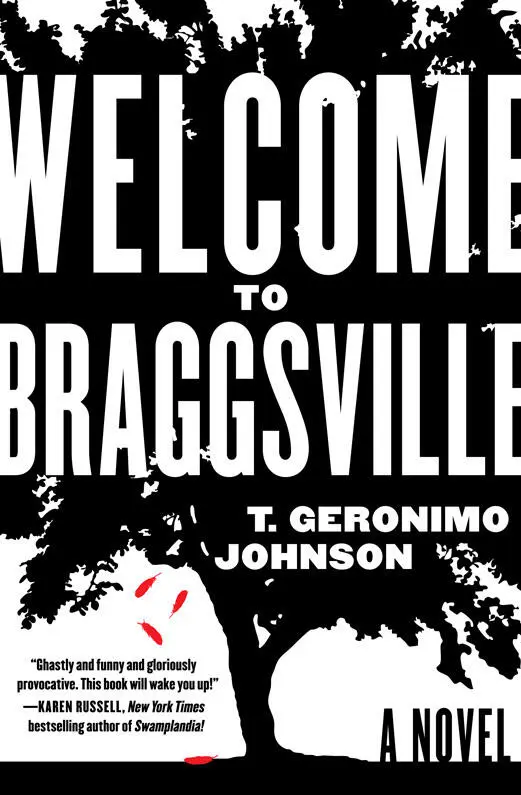
- Название:Welcome to Braggsville
- Автор:
- Издательство:William Morrow
- Жанр:
- Год:2015
- ISBN:нет данных
- Рейтинг книги:3 / 5. Голосов: 1
-
Избранное:Добавить в избранное
- Отзывы:
-
Ваша оценка:
Welcome to Braggsville: краткое содержание, описание и аннотация
Предлагаем к чтению аннотацию, описание, краткое содержание или предисловие (зависит от того, что написал сам автор книги «Welcome to Braggsville»). Если вы не нашли необходимую информацию о книге — напишите в комментариях, мы постараемся отыскать её.
comes a dark and socially provocative Southern-fried comedy about four UC Berkeley students who stage a dramatic protest during a Civil War reenactment — a fierce, funny, tragic work from a bold new writer
Welcome to Braggsville. The City That Love Built in the Heart of Georgia. Population 712. Born and raised in the heart of old Dixie, D'aron Davenport finds himself in unfamiliar territory his freshman year at UC Berkeley. Two thousand miles and a world away from his childhood, he is a small-town fish floundering in the depths of a large hyperliberal pond. Caught between the prosaic values of his rural hometown and the intellectualized multicultural cosmopolitanism of "Berzerkeley," the nineteen-year-old white kid is uncertain about his place, until one disastrous party brings him three idiosyncratic best friends: Louis, a "kung fu comedian" from California; Candice, an earnest do-gooder from Iowa claiming Native roots; and Charlie, an introspective inner-city black teen from Chicago. They dub themselves the "4 Little Indians."
But everything changes in the group's alternative history class, when D'aron lets slip that his hometown hosts an annual Civil War reenactment, recently rebranded "Patriot Days." His announcement is met with righteous indignation and inspires Candice to suggest a "performative intervention" to protest the reenactment. Armed with youthful self-importance, makeshift slave costumes, righteous zeal, and their own misguided ideas about the South, the 4 Little Indians descend on Braggsville. Their journey through backwoods churches, backroom politics, Waffle Houses, and drunken family barbecues is uproarious at first but has devastating consequences.
With the keen wit of
and the deft argot of
, T. Geronimo Johnson has written an astonishing, razor-sharp satire. Using a panoply of styles and tones, from tragicomic to Southern Gothic, he skewers issues of class, race, intellectual and political chauvinism, Obamaism, social media, and much more.
A literary coming-of-age novel for a new generation, written with tremendous social insight and a unique, generous heart,
reminds us of the promise and perils of youthful exuberance, while painting an indelible portrait of contemporary America.
Welcome to Braggsville — читать онлайн ознакомительный отрывок
Ниже представлен текст книги, разбитый по страницам. Система сохранения места последней прочитанной страницы, позволяет с удобством читать онлайн бесплатно книгу «Welcome to Braggsville», без необходимости каждый раз заново искать на чём Вы остановились. Поставьте закладку, и сможете в любой момент перейти на страницу, на которой закончили чтение.
Интервал:
Закладка:
Like the sign at Lou’s, Daron had noticed — hadn’t he? — but never thought about why things were as they were. Never pondered, deliberated, considered, ruminated, cogitated. There was truth to the saying you look with your eyes but see with your brain. Look-see-think. Think-see-look. If he had done that, he would have known the answer all along. Or would he? Read the signs, the cook at the Awful Waffle had said. Read the signs. What signs?
What about the rabbit’s feet, and the horseshoes over every entry door? What about hoppin’ john, greens, cornbread, and a man first across the threshold on New Year’s? Why is the odd-point stag’s head burned? He had laughed at Candice’s harvest dolls, Louis with his crazy feng shui — zee, Charlie’s old-time religion. But watching his parents, Daron found himself facing an indecipherable hieroglyphic of rituals.
And there were more. Why do so many around Braggsville leave and enter the house by the same door, even after wheeling the trash bin from the back stoop to the front curb? Why do they sit with the dead for twenty-four hours before releasing kin to the authorities? Why do they stop the clocks and wave a candle over the body three times when a child passes? Why is it forbidden to sweep before breakfast? Why are doves’ eggs bad luck, but partridges’ eggs fortuitous? Why touch your nose when passing a slaughtered animal? Why spit on a restless grave to appease thirsty spirits? Why was it bad luck to eat in the Gully after dark? Why did his mother sprinkle rock salt on the porch after every visit by the Great Agent Denver, as she called him?
Hmmph! Ain’t working anyway, he keeps coming right back, she complained. They were sitting in the kitchen, Daron peeling potatoes, she chopping them. The sun had turned in, and his father slept the last few hours he could before heading to the mill.
Where’s that come from?
She shrugged. Methuselah knows.
For the first time, though, Daron did not understand whether she meant that everybody knew or only Methuselah knew. He didn’t even know, he admitted to himself with a snort, who Methuselah was.
Don’t look at me funny, I know your friends have superstitions, especially the Chinese one, God bless him.
He didn’t bother correcting her. Both parents made that mistake occasionally. For weeks he reminded them that Louis was Malaysian, not Chinese, from an island, not a continent. She would only remind him that when Daron first called about his new roommate, he himself said Louis was Chinese, and when Louis did his backyard stand-up routine, even Louis said he was Chinese. Touché.
When you were little — she made a fist — you used to snatch at the air in front of my mouth whenever I sang. Her speech again blossomed into sermon. It’s like you thought you could grab the song right out of the sky. She smiled sweetly, as though that explained it all. He now saw that it might could account for everything.
Chapter Thirty-3
Only twice-cut trees stay down. Birds don’t sky before dusk. Where wolves walk upright, their curled tails question marks. Wily wind slips silent through soft Georgia pine, upsetting without a sound. Low moon’s cloudy; high moon hangs behind the ridge. Spring babes won’t taste winter stew. Moss grows on the wrong side, and if tracked into the house, mutts stop eating and soon die. Cats soon die, but not before eating their young. It’s where preachers hold court at branching streams divining with serpents. Feudal clans retain witches and consult wizened sages said to have seen Bragg himself consort with night itself to console his interminable grief. Beavers build dams with the bones of fallen men. Had Abel been laid here, Cain ’a nev’ been found out. According to his nana.
To the Holler’s edge she took eight-year-old D’aron, to see her last chance, he who read life in the spine. Preacher swathed in rags, chained to anchor, length taut, swaying on unseen waves, like a swimming dog straining at the lead. Anchor and chain scraping up the steps, clumping, clanging on each one, tearing wood and stone, grinding, as if they were eating their way in, as if all the earth’s anger was set to devour the church. D’aron dreamed of it for years, hearing it in every scraping midnight step on the front porch, darting awake, breathless, like Nana’s final days.
Nana’s remission everyone knew would be a black lunch, short-lived. Face gray as a catfish, she’d arranged a premature release. Hearing Nana coo and mutter (she could salt the air ’til it burned your eyes), her cracked lips intoning long-forgotten chants, the nurse — who knew a curse when she heard one — blanched to match her uniform and wheeled that patient right out the alley exit. When the ward caught fire a year later, that nurse was the only survivor. Glick was her name. Glick. She was from ’round the Holler.
In flashes, the memory of the church returned to Daron. Others said the blacks were just superstitious, but being amid those Gulls cauterized by faith was the closest he’d come to a true religious experience. The floor shaking and vibrating like the porch had collapsed. The smell of bodies pressed together. Kerosene. Wood varnish fumes rising from the pews, as if heated by anxious rubbing, turning every time again the floorboards shake, the doors bow as if the Devil himself is ramming, nostrils aflame, hooves driving down, searing the dirt. Murmuring as they slyly glance at their watches, women fan themselves and slap the wrists of fidgety children while the men nod, the oldest tapping chin to chest before jerking upright and glancing about rheumy-eyed. D’aron sighs loudly, wincing when Nana pinches his ear tight as a tick. He is tempted to peer over his shoulder, to see if anyone saw, before remembering there are few whites here, mostly elderly women and a few of their grandkids. So what does it matter? He looks around anyway, and sure enough, Giselle Goman is giggling. He would have died of embarrassment but for the doors swinging open at that moment, flung apart with enough force to rattle their frame and shake the floor. Deacon Woodbridge stands on the sill, sweating in force and fury, in his usual three-piece suit and holding before him, between his legs, a thick, silver chain draped in his hands like a spent penis. The men nearest him rise to their feet, but the deacon waves them away.
No man, he says, can carry another man’s cross. You may think you can, but you only delay their journey. If God has deemed that you must walk three days and three nights to reach your destination, but you try to hitchhike, the car will break down. Try he pronounces as trah. Will he pronounces as wheel. You’ll find your goal is farther than you thought.
Listen to the deacon. You all hear him now? croons the reverend. Let him do his piece.
The deacon turns his back to the crowd, wraps the chain around his wrist, and begins heaving like a longshoreman, breathing in, leaning on the right foot as he pulls, exhaling on the left as he bends forward and feeds more chain through his palms. The womenfolk tap their menfolk big and little. The deacon waves them back each time, stopping only when a four-year-old boy pulls on his jacket.
Son, I know your momma raised you right, and she might not have even been the one to send you out here. You maybe came on your own, but for once and all — he scanned the room, giving each an eyeful — leave me to my work. Mrs. Patterson, I don’t come downtown and make your pies, good thing, I know. Brother Hal, I don’t till your field. He looked back at the kid, And, Ricky Foldercap, young man, I don’t draw in your coloring book. Okay?
You can, says Ricky, and everyone laughs.
You’ll know when it’s time. Lord, bless this boy. The deacon scans the room. He already has, has he not? He is merciful, is he not?
Читать дальшеИнтервал:
Закладка:
Похожие книги на «Welcome to Braggsville»
Представляем Вашему вниманию похожие книги на «Welcome to Braggsville» списком для выбора. Мы отобрали схожую по названию и смыслу литературу в надежде предоставить читателям больше вариантов отыскать новые, интересные, ещё непрочитанные произведения.






Обсуждение, отзывы о книге «Welcome to Braggsville» и просто собственные мнения читателей. Оставьте ваши комментарии, напишите, что Вы думаете о произведении, его смысле или главных героях. Укажите что конкретно понравилось, а что нет, и почему Вы так считаете.