T. Johnson - Welcome to Braggsville
Здесь есть возможность читать онлайн «T. Johnson - Welcome to Braggsville» — ознакомительный отрывок электронной книги совершенно бесплатно, а после прочтения отрывка купить полную версию. В некоторых случаях можно слушать аудио, скачать через торрент в формате fb2 и присутствует краткое содержание. Год выпуска: 2015, Издательство: William Morrow, Жанр: Современная проза, на английском языке. Описание произведения, (предисловие) а так же отзывы посетителей доступны на портале библиотеки ЛибКат.
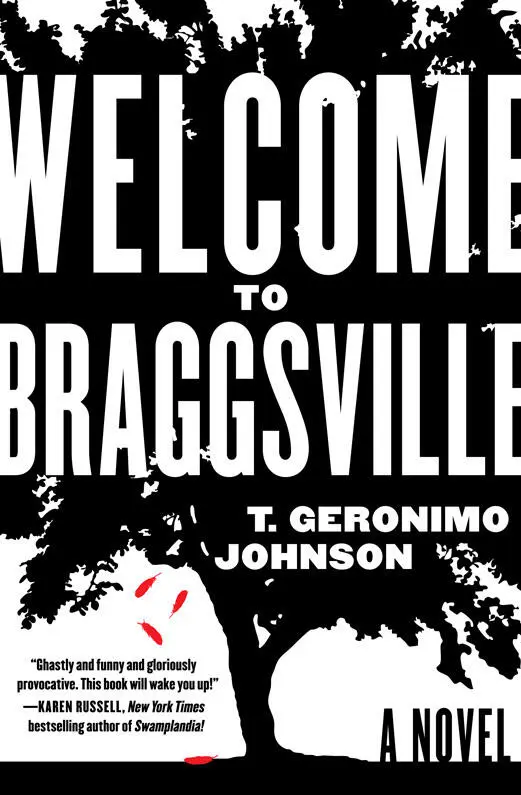
- Название:Welcome to Braggsville
- Автор:
- Издательство:William Morrow
- Жанр:
- Год:2015
- ISBN:нет данных
- Рейтинг книги:3 / 5. Голосов: 1
-
Избранное:Добавить в избранное
- Отзывы:
-
Ваша оценка:
Welcome to Braggsville: краткое содержание, описание и аннотация
Предлагаем к чтению аннотацию, описание, краткое содержание или предисловие (зависит от того, что написал сам автор книги «Welcome to Braggsville»). Если вы не нашли необходимую информацию о книге — напишите в комментариях, мы постараемся отыскать её.
comes a dark and socially provocative Southern-fried comedy about four UC Berkeley students who stage a dramatic protest during a Civil War reenactment — a fierce, funny, tragic work from a bold new writer
Welcome to Braggsville. The City That Love Built in the Heart of Georgia. Population 712. Born and raised in the heart of old Dixie, D'aron Davenport finds himself in unfamiliar territory his freshman year at UC Berkeley. Two thousand miles and a world away from his childhood, he is a small-town fish floundering in the depths of a large hyperliberal pond. Caught between the prosaic values of his rural hometown and the intellectualized multicultural cosmopolitanism of "Berzerkeley," the nineteen-year-old white kid is uncertain about his place, until one disastrous party brings him three idiosyncratic best friends: Louis, a "kung fu comedian" from California; Candice, an earnest do-gooder from Iowa claiming Native roots; and Charlie, an introspective inner-city black teen from Chicago. They dub themselves the "4 Little Indians."
But everything changes in the group's alternative history class, when D'aron lets slip that his hometown hosts an annual Civil War reenactment, recently rebranded "Patriot Days." His announcement is met with righteous indignation and inspires Candice to suggest a "performative intervention" to protest the reenactment. Armed with youthful self-importance, makeshift slave costumes, righteous zeal, and their own misguided ideas about the South, the 4 Little Indians descend on Braggsville. Their journey through backwoods churches, backroom politics, Waffle Houses, and drunken family barbecues is uproarious at first but has devastating consequences.
With the keen wit of
and the deft argot of
, T. Geronimo Johnson has written an astonishing, razor-sharp satire. Using a panoply of styles and tones, from tragicomic to Southern Gothic, he skewers issues of class, race, intellectual and political chauvinism, Obamaism, social media, and much more.
A literary coming-of-age novel for a new generation, written with tremendous social insight and a unique, generous heart,
reminds us of the promise and perils of youthful exuberance, while painting an indelible portrait of contemporary America.
Welcome to Braggsville — читать онлайн ознакомительный отрывок
Ниже представлен текст книги, разбитый по страницам. Система сохранения места последней прочитанной страницы, позволяет с удобством читать онлайн бесплатно книгу «Welcome to Braggsville», без необходимости каждый раз заново искать на чём Вы остановились. Поставьте закладку, и сможете в любой момент перейти на страницу, на которой закончили чтение.
Интервал:
Закладка:
He didn’t. Not only did he not remember, he didn’t believe it had happened. Just like he hadn’t remembered half the things his mother made him write in his college admissions letters. He was of late suspicious of the longstanding wild divergences in the family’s accounts of history, of the entire town’s, really, of wrongheaded answers to unasked questions, of the subjectivity of it all. Subjectivity. An angel poking a hole in the plastic bag pulled tight as air over your head. A finger in the sky pointing not to some promised land, some high school fantasy, but to your heart, affirming that what you feel is true. A message from God. As real as a strawberry, and just as magical. Christ! Of course Nietzsche grew a burl. Daron felt his own knar growing, grubbing, fingering his being like a pimp, saw that this subjectivity had not been the dance it felt that morning in class — him being set free — but more like him being let go, or worse yet, him letting go without realizing it. So that as his mother spoke — this woman who he had always thought did not understand him — he feared, as he listened, that he in fact did not understand her, and the latter was more frightening. So that now, as she spoke, arms at her side, blond hair kinked and corkscrewed (when had that begun?), shoulders down, confessional in all ways, he worried that he had never understood a thing. So that as she spoke, he listened anew.
Remember what you said? Why learn to do a job? Why commit your brain to making someone else rich? Remember? Her speech blossomed into sermon. You were out back with me, it was the year we planted the pears, it was the first summer you could have worked in their little apprentice program at the hotbox. It was the last summer you worked in the yard with me. You were thirteen. You won the debate championship. You refused to hunt. I was so proud. I didn’t think I could be any prouder of you until the moment you spoke up about that job. That’s why your father went back to school. Of course he’ll never admit that. Don’t you remember? She wasn’t asking. She was insisting. Remember?
Except for being called Buttercup after some kids from school saw him gardening, he didn’t remember, but he uncrossed his own arms, willing to believe, damned desperate to remember it, desperate as a man stranded at sea struggling to get his bearings when he’s only energy enough to swim to a shore unseen. Then he noticed the lock.
He tells her… that when he was in the garage talking to his mom this morning, the loft door was mysteriously padlocked, a security measure typically instituted only during that secretive season between Black Friday and Christmas, a month during which he scaled the support beams daily, ticktacking between two columns as if climbing in a chimney, inching his way along a four-foot crossbeam while hanging by his hands only, and hoisting himself at last over the loft knee wall with a grunt of pride and a soft, singing ache in the arms. He’d had imagination enough to make the climb at eight, limbs long enough at ten, hands strong enough at twelve. In addition to the pride that accompanied the exertion, the climb was one secret he didn’t think his parents had ever sussed out. That was reason enough to continue the tradition.
He tells her… that tonight he announced his early retirement at the dinner table, soliciting both a welcome smile and a lingering look of concern — neither from whom he’d expected them — and retreated to his room, where he sat in the closet until he heard his parents leave, first the hum of the garage door retracting, followed by the Bronco easing out and dipping its toes in the dirt, patient as a sated retiree on a postmeal constitutional. He waited ten minutes after the whine of the tires was muzzled by safe distance to make his way to the garage. If his parents had not returned by then, as his mother always joked, Anything left behind has missed the ark.
He tells her… not… about why he had the house to himself for a couple of hours of essential isolation. Mother was going to make groceries, as of late always at night, always one town over because, Queuing ain’t cool; Produce is restocked second shift; Sun’s so much milder after sunset. (Throat clearing? Sun after sunset? Cough-cough? She means humidity.) On her way to the big cold box, she would drop his father off, To go factoring, as he used to say. He hadn’t said that for over a decade, not since eight-year-old D’aron, aka Mr. Hanky, bka Faggot, begged his father to visit his social studies class on Parents’ Day. His father pinched his left nostril to clear the right, said no one wanted to hear about factoring, yanked his waxy brogan laces tight as a tourniquet. Back then, when D’aron was in third grade, both parents worked nights, which he understood to mean that they worked in a graveyard. He had prided himself on this fact, on his parents’ valor and wisdom, their necessary intimacy with night rangers and the Holler’s other bedizened denizens, their familiarity with the many charms and amulets certainly required to hold at bay the mad ether, just as guns, germs, and steel held at uneasy remove societal collapse. He imagined them as characters in Nana’s favorite cartoon, one where a Saint Bernard and a coyote spent the day tormenting each other with pranks and insults only to clock out at dinner time and clap hands like rival ballers after a game, and then walk home shoulder to shoulder, their steps and smiles as steady, and their laughter as companionable, as those of brothers-in-arms. And those nights when his father sat on the back porch playing Tool and staring into the Holler, the Holler stared back with an equal measure of affinity. Everybody knew their place, and felt not shackled but swaddled. In those days the narrow garage storage loft was a kingdom of treasures.
Tonight, though, tonight in the garage, after he scaled the support beams to the loft, Daron found a peculiar trove, he found, in a manner of speaking, Jo-Jo, and all else he had hidden, or asked his parents to hide, as well as dozens of small items he had not thought to ask them to tuck away, which explained Old Hitch’s General Lee flyswatter, the Confederate place mats, the picture of Bugs Bunny from Southern Fried Rabbit . Of these, neither his mother’s undercover education nor
the garage menagerie, he tells her… not. And of the conclusion drawn
standing in the loft — breath spooked by shock and not exertion,
arms singing a soft ache, of the conclusion
he draws he thinks not to tell her
…
Chapter Thirty-2
… The night before a big test, he slept with his head away from the door so that when morning came he could rise on the right side of the bed; he never sharpened more than three pencils at a time; and he always used the same door to enter the testing hall, the middle one, not the ones on the ends. Charlie had his lucky pencil, Candice her knit Rastafarian hat, Louis his entire family. The uncles would rather lose than play the four card in Uno. Mrs. Chang collected pineapples the way Daron’s mom collected pigs, but Daron’s mom didn’t believe that pigs were good luck.
Maybe it was only OCD.
His father turning the dead bolt back and forth twice before locking it. His mother shaking the coffee can before throwing it away, and if she saw it atop the garbage later, shaking it again. Both of them always lining up the spout opposite the seam on their coffee cups. Considering how many times his father had scratched his car on The Charlies, it would make sense to back into the driveway. Then in the mornings dark and groggy the headlights would usher his exit. But his father only pulls into the garage and backs out of it, even stepping half backward across the doorsill when exiting it. Over the last few days, Daron noticed that they did this often, backed out of rooms as if to ensure they were not being followed. Maybe he hadn’t thought about it because they only did it while closing doors. Subtle to be sure. They could pass it off as checking the locks. It wasn’t like they moonwalked from the kitchen to the hall. But it was strange nonetheless.
Читать дальшеИнтервал:
Закладка:
Похожие книги на «Welcome to Braggsville»
Представляем Вашему вниманию похожие книги на «Welcome to Braggsville» списком для выбора. Мы отобрали схожую по названию и смыслу литературу в надежде предоставить читателям больше вариантов отыскать новые, интересные, ещё непрочитанные произведения.



Обсуждение, отзывы о книге «Welcome to Braggsville» и просто собственные мнения читателей. Оставьте ваши комментарии, напишите, что Вы думаете о произведении, его смысле или главных героях. Укажите что конкретно понравилось, а что нет, и почему Вы так считаете.