Robert Stone - A Flag for Sunrise
Здесь есть возможность читать онлайн «Robert Stone - A Flag for Sunrise» весь текст электронной книги совершенно бесплатно (целиком полную версию без сокращений). В некоторых случаях можно слушать аудио, скачать через торрент в формате fb2 и присутствует краткое содержание. Год выпуска: 2012, Издательство: Vintage, Жанр: Современная проза, на английском языке. Описание произведения, (предисловие) а так же отзывы посетителей доступны на портале библиотеки ЛибКат.
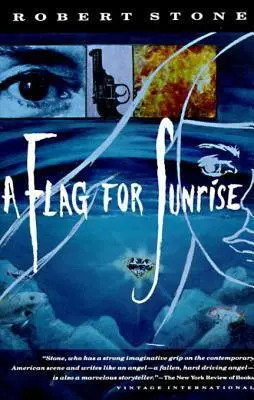
- Название:A Flag for Sunrise
- Автор:
- Издательство:Vintage
- Жанр:
- Год:2012
- ISBN:нет данных
- Рейтинг книги:4 / 5. Голосов: 1
-
Избранное:Добавить в избранное
- Отзывы:
-
Ваша оценка:
A Flag for Sunrise: краткое содержание, описание и аннотация
Предлагаем к чтению аннотацию, описание, краткое содержание или предисловие (зависит от того, что написал сам автор книги «A Flag for Sunrise»). Если вы не нашли необходимую информацию о книге — напишите в комментариях, мы постараемся отыскать её.
A Flag for Sunrise — читать онлайн бесплатно полную книгу (весь текст) целиком
Ниже представлен текст книги, разбитый по страницам. Система сохранения места последней прочитанной страницы, позволяет с удобством читать онлайн бесплатно книгу «A Flag for Sunrise», без необходимости каждый раз заново искать на чём Вы остановились. Поставьте закладку, и сможете в любой момент перейти на страницу, на которой закончили чтение.
Интервал:
Закладка:
“Courage and conviction are always to some degree admirable,” Ortega said with a shrug.
“And you, Emilio, say ‘so what?’ And I agree. But let me tell you that I think that Godoy is a bit like those men. I think he fights for the peasants and the Indians because whether he knows it or not, he deeply desires the just rule of the Lord. Probably, he will never realize this — certainly we must hope not, for his sake. I’m sure he sees himself as a humanist and a student of Marxism. But I think unconsciously it is the kingdom of God he fights for. Emilio, the best revolutionaries, the first Communists may come from among such men!”
“This must be what I don’t like about him,” Ortega said, smiling. “I admit only that he’s good at his job and for now that’s good enough for me.”
“Ah, yes,” Aguirre said archly. “UCLA. He fights for Christ and you for John Dewey.”
“Tell me, Sebastián,” Ortega said, pouring out a brandy for himself, “what shall we do about our late comrade, Morelos? In fact,” he told the old man, “I’ve already decided. But I should like your opinion all the same.”
Aguirre was taken aback and impressed. He felt justly chastened. Ortega had terminated the anecdotes and the levity with talk of treason and its consequences. It was calculated, brutal and to the point; it reminded Aguirre of the Old Man. The Old Man might have done it the same way. How right he himself had been, Aguirre thought, in deciding that Ortega must lead.
“Do you think me sentimental?” Aguirre asked his young leader. “Do you imagine I would plead for him?” Only once in his career had Aguirre opposed an execution for reasons of friendship and his advocacy had nearly cost him his own life at the hands of André Marty and the NKVD clique. Only Stalin’s intervention had saved him. Never again had he undertaken to defend one condemned and though he had suffered in his conscience as a result, further reflection had always convinced him that the policy of unyielding severity was ultimately correct. In the case of Morelos it was not in question. There could be no mitigating circumstances to regret here.
“Perhaps I’m sentimental,” Ortega said, “because my first instinct was somehow to spare him. For his long service and his gray hairs. I thought we might dispatch him abroad with his ten favorite classics in the presidential airplane. Or wrap him in ribbons for the Yanqui embassy.”
“But now you think otherwise?”
“Tomorrow, when our people here are underground and you and I are in the mountains with First Brigade — Senor Morelos will be arrested by the Guardia as a proven Communist. Then you may be sure he’ll howl for the gringos and he’ll learn whether they retain any interest in him after he’s no use to them.”
Aguirre finished his brandy.
“This,” he said, “is only simple justice.” He would not himself have handled it with such studied harshness. But he was not made to be a leader.
“Now let me tell you something, Don Sebastián — pardon me for addressing you so — we are fighting for a new Tecan with a new leadership. The leader will not be John Dewey and he will certainly not be Jesus Christ. Not Bolívar, or Jefferson or the ghost of Pope John. Not, as we say, the People. Nor even the Party, because all of these entities are either dead or not yet truly formed.”
“Who then?”
“With permission,” Ortega said, “and with your invaluable assistance — me!”
“Am I to take this for cynicism, Emilio?”
Ortega looked away from him and out through the curtained window.
“Cynicism? That I — a plain man, a mediocre artist, perhaps even a mediocre fighter — take it upon myself to bring justice to our accursed suffering country? To bring health to her children, dignity to her desperate poor? To replace her absurdity in the eyes of the world with pride — to make housing, hospitals, schools for her masses of ignorant? To leave sound philosophy and engage life which we both know to be so vulgar? To dispense life to some and death to others in the name of a form of humanity which for all we know may never exist?”
The old man listening to Ortega rose from his chair. Ortega turned his back on him.
“ Hombre, ” Ortega said, “there is no Jesus Christ. There is no philosophy in a shack or in the gutter. There is not yet even such a thing as the People. There are only poor creatures like you and me, my comrade — and we propose to bring these things about. We propose unto death.”
Ortega turned toward Aguirre again. “Cynicism? I would have to be mad, would I not, to cherish all this cynically — in the name of my own glory? Perhaps I am mad to propose these things at all. Yet, as an act of faith, I do propose them.”
Aguirre fixed his eyes on Ortega and took a step toward him. The old man spoke truly of himself when he said that he was not sentimental. He had heard such words from the cynical and the mad. He had seen much of war and executions, death and cruelty. He raised his palsied hand in a fist.
“I don’t know,” he said to Ortega, “whether one may thank History. She’s a cold bitch. But I thank her now. I thank her with love that I’ve lived to see you and this day. I beg her to allow me to see the days that are coming. You are my son, Ortega …” The old man laughed with pleasure and to cover his emotion. He could say no more and advanced no further. It was a time to refrain from embracing. Perhaps, later.
Ortega returned his salute with a smile. He was embarrassed at having run on. He supposed that the suggestion of his cynicism had provoked him; moreover he was an artist, a man of temperament.
“And you, my father,” he told Aguirre. “Without you — nothing. I thank you.”
If the gringos could see us here, he thought, it would amuse them. “So,” old Aguirre said. “Death in one eye and dishonor in the other, eh. We shall have a drama.”
They raised nearly empty glasses to each other.
“Victory,” Ortega said. “ Patria o muerte. ”
The dark came down quickly after sunset. The lights of the coastal fishing boats grew dimmer and more distant abaft; eastward the evening star was rising, the wind steady. The Cloud plowed into its faint resistance making seven or eight knots. From the galley came the smell of frying steak.
Pablo sat beside the after hatch, watching the wake in starlight. Freddy Negus came out on deck and called him forward for chow.
Mrs. Callahan was leaning over the galley stove, a rum and tonic secured on a rack beside her. Strips of sirloin were warming on the pan, there was a huge pot of boiled greens.
“She’s a good feeder,” Pablo said. He was cheerful.
“Oh, you bet,” Mrs. Callahan said. “Get yourself a drink and go sit down.”
Pablo helped himself to a moderate measure of light rum and took it down to the fancy paneled compartment. The crew’s lounge. Tino came down behind him, smelling of diesel fuel, and ducked into the head to wash.
At opposite quarters of the mahogany table, drinks set before them, were Negus and Mr. Callahan. Pablo picked himself a chair and sat down. After a moment Tino came out of the head, ducked up to the galley to draw a Coke from the freezer and joined them.
Pablo looked around at the men in the compartment; all of them were watching him. Callahan looked boozy and affable. Freddy Negus, scratching his ear, looked unhappy; Tino, sleepy-eyed now, expressionless.
“What do you think, Pablo?” Mr. Callahan asked.
Pablo smiled. “What do I think about what, Mr. Callahan? You got a nice boat here. She’s a good feeder. I ain’t even done any work yet.”
Mrs. Callahan, in the galley, was humming “Amazing Grace.”
“You will, though” Callahan said. “For example, can you handle an M-16?”
Читать дальшеИнтервал:
Закладка:
Похожие книги на «A Flag for Sunrise»
Представляем Вашему вниманию похожие книги на «A Flag for Sunrise» списком для выбора. Мы отобрали схожую по названию и смыслу литературу в надежде предоставить читателям больше вариантов отыскать новые, интересные, ещё непрочитанные произведения.




Обсуждение, отзывы о книге «A Flag for Sunrise» и просто собственные мнения читателей. Оставьте ваши комментарии, напишите, что Вы думаете о произведении, его смысле или главных героях. Укажите что конкретно понравилось, а что нет, и почему Вы так считаете.