Robert Stone - A Flag for Sunrise
Здесь есть возможность читать онлайн «Robert Stone - A Flag for Sunrise» весь текст электронной книги совершенно бесплатно (целиком полную версию без сокращений). В некоторых случаях можно слушать аудио, скачать через торрент в формате fb2 и присутствует краткое содержание. Год выпуска: 2012, Издательство: Vintage, Жанр: Современная проза, на английском языке. Описание произведения, (предисловие) а так же отзывы посетителей доступны на портале библиотеки ЛибКат.
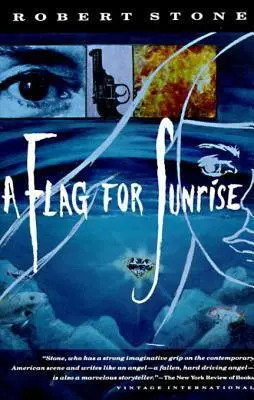
- Название:A Flag for Sunrise
- Автор:
- Издательство:Vintage
- Жанр:
- Год:2012
- ISBN:нет данных
- Рейтинг книги:4 / 5. Голосов: 1
-
Избранное:Добавить в избранное
- Отзывы:
-
Ваша оценка:
A Flag for Sunrise: краткое содержание, описание и аннотация
Предлагаем к чтению аннотацию, описание, краткое содержание или предисловие (зависит от того, что написал сам автор книги «A Flag for Sunrise»). Если вы не нашли необходимую информацию о книге — напишите в комментариях, мы постараемся отыскать её.
A Flag for Sunrise — читать онлайн бесплатно полную книгу (весь текст) целиком
Ниже представлен текст книги, разбитый по страницам. Система сохранения места последней прочитанной страницы, позволяет с удобством читать онлайн бесплатно книгу «A Flag for Sunrise», без необходимости каждый раз заново искать на чём Вы остановились. Поставьте закладку, и сможете в любой момент перейти на страницу, на которой закончили чтение.
Интервал:
Закладка:
He was the man, Aguirre thought, reassured, watching him nod encouragement to the rambling monsignor. They thought well of him abroad. The Americans thought they knew him, liked him, had no reason to fear him. He looked as vital, as capable as ever. He was the man who would lead — during the revolution and afterwards. Among those in the room, only Aguirre and the young man himself realized this. The realization had taken Aguirre a long time to arrive at; the young man himself seemed always to have known it.
From his suit pocket, Aguirre drew a forbidden cigarette — Benson & Hedges — and waited, smoking, for the mock council to draw to its conclusion. The scarred young man was his only true collaborator among the lot of them and there were things now that required urgent consultation.
The pro forma strategy session was not ended easily. All participants required a stroke for their self-esteem, the spy required reassurance. Roles had to be assigned and abrazos exchanged with the venerable and distinguished visitor. It seemed a long time before they had all gone and Aguirre was left alone with the scarred man, whose name was Emilio Ortega Curtis.
When they were across the table from each other in the abandoned conference room, Aguirre lit another cigarette and offered Ortega the pack. Ortega smiled and shook his head.
“How was Prague?”
“Beautiful as ever. A bit subdued, as you may imagine.”
“Well,” Emilio Ortega said, “too bad. But that’s their problem, of course. How did you find our friends abroad?”
“How?” Aguirre weighed his words. “Cautious. Patronizing. Faux naïve. ”
“Then nothing’s changed.”
“Nothing essential. Tell me about Tecan.”
“As they say in the Koran, Don Sebastián, no one has promised us tomorrow. But I think, my friend, you’ve lived to see the revolution.”
Aguirre’s frail heart began to beat in his throat.
“And have I just seen the provisional government — more or less?”
“Some of it. The same sort of people. Except, of course, for Morelos. Whom we know is a Yanqui spy.”
Aguirre nodded. “Sad, no? I can’t know how you feel, Emil, but — myself — I’ll miss him.”
“I miss him,” Ortega said. “I’ve already mourned for him.”
They sat without speaking, observing something like a moment of silence for the man’s treachery.
“If one must have a moral,” Ortega said, “I propose: Look too long into yourself and you won’t know whom you’re seeing.”
“He was always,” Aguirre said, “an exquisite ironist.”
“Well,” Ortega said. “Small suffering countries don’t require ironists. When we require ironists we’ll produce our own. Without help from the United States.”
“But not too many, one hopes.”
“The representatives of our provisional government — what did you think of them? The ‘usual suspects’?”
“Yes, I suppose. I have hopes for Golz, as priests go.”
“I do too,” Ortega said. “His organization within the church was built very discreetly and subtly. He’s lined up some solid ones for this stage.”
“Godoy, I think, is his man, no?”
“Godoy is among his chiefs. Like him, but not a man to my taste.”
“You’re not Spanish enough to appreciate Godoy.”
Ortega shrugged. He was indifferent to the legend of Spain and the self-obsession of Spaniards. Even Tecanecan criollos like Aguirre, with their peninsular pieties, offended his indigenismo.
“I’m a man of UCLA,” he said. “In spite of what they say, we weren’t all mystics in Los Angeles.”
“Clearly not,” Aguirre agreed, then changed the subject. “You’re aware, I hope, that the gringos have filled up the country with spies. Their activity is more than routine. We have this from primary sources abroad.”
“We’re aware. They’re here for the show, so we’re making it hot for them. In fact, a la Torre shot one in the mountains last week.”
“You’re joking! A U.S. citizen?”
Ortega was unable to repress a smile; in a moment his expression sobered.
“Not merely a U.S. citizen but an imported gringo.”
Dr. Aguirre whistled between his teeth.
“A man named Cole showed himself in Extremadura. He claimed to be a journalist and full of sympathy and he expressed great interest in visiting our military formations. He had just come from Oscar Ocampo. A la Torre took him up to First Brigade. He talked a great deal and he demonstrated familiarity with every sort of weapon. He had been in Vietnam — he told us this himself. We held back awhile — we wanted to be fair and avoid a provocation. The third day there he was court-martialed and executed.”
“I approve,” Aguirre said. “Let them stop taking us for fools. Let them find out that Yanquis die as easily as peasants. And perhaps,” Aguirre said, “the regrettable time has come to do something about Oscar. He seems to enjoy making difficulties.”
“The time has come. But we have to clear it abroad — or so we’re told.”
“I grant you dispensation,” Aguirre said. “Let the Compostelan comrades have him.” He stood up from his hard-backed chair and began pacing the room. Then tiring, he took a different chair. “Thank God for the Atapas,” he said, his eyes closed. “The Fascists truly screwed themselves when they went mad over those mineral rights. They tore the last spines out of the social structure.”
Ortega smiled in agreement.
“For forty years,” Sebastían Aguirre said, “we worked to bring the Atapas to our side and like pious donkeys they ignored us. It would have taken us forty more without the mineral grab.”
“We have them now,” Ortega said. “Moreover, the government has taken to drafting more and more Atapas into the Guardia to find reliable troops — and also of course to demoralize them. When these Indians get out they’re changed men. And right now half of the Guardia is Atapa.”
“My God,” Aguirre said, “it’s going to happen! I don’t know if I ever believed it.”
“There were times, my friend, when you were the only man in the country who did.”
“Morelos and I,” Aguirre said.
There was a tray in the center of the table that held a pitcher of cold coffee and some cups. Ortega poured them both a quarter cup and they drank.
“I want to talk strategy now,” Aguirre said. “Is there a chance that Señor Morelos or these good brothers have placed some electronic instruments here? A bug?”
“We have had help from abroad to determine that. Not here.”
“You must realize,” Aguirre told him, “that I have instructions for you. More help from abroad. Most of it is so much shit. So now I’ll ask you what you propose to do.”
“With pleasure. Sunday — a demonstration here in the capital. A dangerous one, a bad one — but as you’ll see a necessary one for our purposes. They’ll bring in more Guardia from the mountains. A day passes and we hit the Libertad Guardia barracks on the edge of town in small force with automatic weapons. The Guardia troops there are slightly less than half of them Atapas — we don’t expect to take it but anything can happen and we’ll see. Should we take it, we won’t try to hold it but we may gain some arms and recruits. While this is happening the main force will move. The five Atapa brigades will take command of the cordillera and liberate the fincas. In a single offensive they can close the Pan-American Highway north of the capital, close the Pacific highway and the river. The Guardia will never dislodge them, even with aircraft. This is the important thing, and you may depend on its not being in the newspapers. We’ve had tons of automatic weapons and surface-to-air missiles flown in and we haven’t lost a single shipment. Guardia troops going into the mountains will meet Atapas more numerous and better armed than themselves. They will have no support whatever from the population. The Guardia air arm has no experience against surface-to-air missiles and the bastards don’t know how to fly anyway — at least not in a combat situation. The gringos trained them in close air support and if they try doing what they’ve been taught they’ll cease to exist in those mountains within an hour. The ground-to-air missiles are miraculous; they’re easy to hide and two half-trained men can use them. They’ll be the only ordnance from the socialist bloc we’re using and they’re untraceable.”
Читать дальшеИнтервал:
Закладка:
Похожие книги на «A Flag for Sunrise»
Представляем Вашему вниманию похожие книги на «A Flag for Sunrise» списком для выбора. Мы отобрали схожую по названию и смыслу литературу в надежде предоставить читателям больше вариантов отыскать новые, интересные, ещё непрочитанные произведения.





Обсуждение, отзывы о книге «A Flag for Sunrise» и просто собственные мнения читателей. Оставьте ваши комментарии, напишите, что Вы думаете о произведении, его смысле или главных героях. Укажите что конкретно понравилось, а что нет, и почему Вы так считаете.