Robert Stone - A Flag for Sunrise
Здесь есть возможность читать онлайн «Robert Stone - A Flag for Sunrise» весь текст электронной книги совершенно бесплатно (целиком полную версию без сокращений). В некоторых случаях можно слушать аудио, скачать через торрент в формате fb2 и присутствует краткое содержание. Год выпуска: 2012, Издательство: Vintage, Жанр: Современная проза, на английском языке. Описание произведения, (предисловие) а так же отзывы посетителей доступны на портале библиотеки ЛибКат.
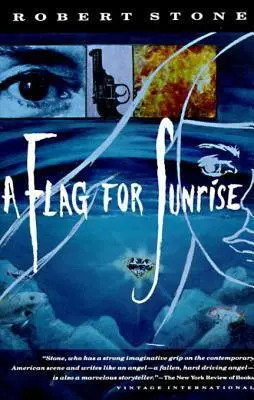
- Название:A Flag for Sunrise
- Автор:
- Издательство:Vintage
- Жанр:
- Год:2012
- ISBN:нет данных
- Рейтинг книги:4 / 5. Голосов: 1
-
Избранное:Добавить в избранное
- Отзывы:
-
Ваша оценка:
A Flag for Sunrise: краткое содержание, описание и аннотация
Предлагаем к чтению аннотацию, описание, краткое содержание или предисловие (зависит от того, что написал сам автор книги «A Flag for Sunrise»). Если вы не нашли необходимую информацию о книге — напишите в комментариях, мы постараемся отыскать её.
A Flag for Sunrise — читать онлайн бесплатно полную книгу (весь текст) целиком
Ниже представлен текст книги, разбитый по страницам. Система сохранения места последней прочитанной страницы, позволяет с удобством читать онлайн бесплатно книгу «A Flag for Sunrise», без необходимости каждый раз заново искать на чём Вы остановились. Поставьте закладку, и сможете в любой момент перейти на страницу, на которой закончили чтение.
Интервал:
Закладка:
Of course, Holliwell thought. Bien sûr. Our worlds have touched before and we both know it, don’t we?
In any case the small opportunity he had offered himself for second thoughts on the spot seemed just about removed. Now he would be obliging Ocampo. He was there; he was being seen , as Oscar had put it, to be there. He glanced about the broken streets and wondered by whom.
Taking his bag once around the square, he paused on a guano-spotted bench to have his shoes shined yet again by a gaunt nine-year-old. It was a grim little plaza; the people lounging in it were as poor as any that Holliwell had ever seen. The interior of the cathedral, though it contained some good carved santos , was mainly a Babylonian horror with mindless rococo gilding and a curious encoffined Christ. When he had finished inspecting it, he carried his bag down a street of notaries and public letter writers to the clapboard riverfront.
The jeep was parked in the declining shade of the customs shed, its driver stretched out in the front seat with the brim of a Ralston Purina cap pulled down over his face. The ships at the adjoining wharf were loading sacks of coffee beans and the longshoremen working them wore sweatbands across their foreheads and machetes at their belts which gave them a piratical look.
The sleeping Paradise driver awoke to the whistle of a diesel launch from the interior which was pulling for its berth. He raised his hat and looked at Holliwell sympathetically.
“We goin’ to Paradise, you and me?”
“I guess we are. How much to go there?”
“Ten dollars,” the man said. “And I didn’t say pesos, did I? I said ten dollars U.S.”
Holliwell shrugged.
“The tourists always sayin’ I told ’em ten pesos,” the driver said as they turned to watch the arriving boat. “Never told anyone dat. Ten dollars. One with Mr. Hamilton on it.”
“I got you,” Holliwell said.
There were three gringos on the steamer, all going to the Paradise. A short rounded man with a deep tan, a gray goatee lengthening his thick jowls. His wife or girlfriend, gray-blond with a leathery brown face like a boot about to crack. A thin, florid man wearing a Yucatecan Panama.
The driver took their bags and everyone exchanged small nods. Holliwell sat in the back, beside the slight man with the Panama.
“Ralph Heath,” the man beside Holliwell said, as they drove over a straight dirt road through the mangrove swamp. The man held his Panama in his lap.
“Frank Holliwell.”
“Been here before?” He was an Englishman of about fifty, with a mean-featured hard little face. A drinker — the pouches under his eyes were the only slack part of him and distended veins ran down the sides of his nose.
“Never.”
“Alvarado’s a hole. But it’s a nice coast if that’s what you’re after. Coming place.”
“Are you down here often?” Holliwell asked him.
“Once or twice a year. Sometimes on business, sometimes just for the beer.”
“From England?”
“I live in Miami now,” Heath told him. “I have ever since our fruit company merged with yours. You’re American?”
“Yes,” Holliwell said. And after a moment, he shouted to Heath over the engine noise. “How do you like Miami?”
“Never looked back,” Heath said.
They drove under the mangrove wilderness opened to sandy beaches and palm groves; the road was only a packed sand track near the water’s edge. The cheerlessness of Puerto Alvarado fell away in the sunlight.
The drive took hours. They sped past clapboard fishing villages in the palm groves where nets were drying on poles along the beach and brightly painted boats with cabined wheelhouses were hauled up, buccaneer fashion, on raked plank dry docks beyond the tide line. Almost every house had in front of it a small garden of plantains and an overturned double-ended skiff. Farther from the ocean were the miles of fruit company houses, numbered and painted yellow. A good half of them appeared to be unoccupied.
On the beach road they were constantly passing women carrying baskets or pots on their heads. From time to time, Holliwell would see a basket that looked to have the ghost of an African design or a pot inlaid with a highland Indian pattern. But for the most part they were factory-made, bought in Alvarado or from a passing Syrian. Between the villages or on the edge of them were some compounds of vaguely ecclesiastical design that looked as though they might be missions. Holliwell said something to Heath about its being a fine place to be a missionary in.
“Too damn many of them,” Heath shouted to him. “That was your company’s policy in the old days — the more of the bastards, the merrier. They’re regretting it now.”
“Why’s that?”
“Why? Because they’re a pack of reds. Why shouldn’t they be? They don’t work for a living like you and me. I’m assuming you work for a living.”
“I teach,” Holliwell said.
“Ah,” said Mr. Heath, and he fell silent for a while.
“It isn’t religion they need down here,” Heath declared after five minutes. “They’ve had plenty of that. It’s the Pill. If this coast had half the population it has it would be in damn fine shape.”
Heath was speaking at the top of his voice, conceding their driver only the virtue of some necessity. The couple in the front seat stirred and half turned round in embarrassment.
“Then who would pick the fruit?”
“Hardly any fruit to pick these days. Less than half the crop there was ten years ago. We package coffee and bananas now — we’ve lost most of the bananas to blight. The next thing we need to package is tourism and we don’t need all these imported Jamaicans for that. The other way round — we need less of them.”
The couple in the front seat cringed visibly. The driver, one arm resting on the back of his seat, looked with an amiable countenance at the track before him.
“In the old days,” Heath said, “when the bananas had a few bad years the pickers moved on. No more. The sensible thing for us to do is to airlift the lot to the Pacific coast where we’re bloody crying out for pickers. It’s the sensible thing, so naturally these psalm singers are determined to stop us doing it. They turn the people against us and against the government. They’re masters of propaganda.”
“Really?” Holliwell asked.
“God, yes. Down here they’re meek and mild. Lambs. Then they go abroad and thunder for blood and revolution. They’ve got powerful friends, you know, and they use them to the hilt. Dignity of man,” Heath said sourly. “Where I stand a man’s got dignity or he hasn’t, rich or poor the same. You can’t bestow it on him. You can’t send it to him in a CARE package.”
“I don’t really know the situation,” Holliwell shouted back. “So I can’t say.”
“Fair enough,” Heath told him. “You’re one among many.”
The hotel called Paradise was neither as transcendent nor as banal as its name. It consisted of a number of simple wooden bungalows around a well-tended garden. At some distance from the bungalows was what appeared to be a disused airplane hangar but which revealed itself on closer inspection to be a terraced dining room, open to the beach. Where the tool shops might have been there was a kitchen and a crescent-shaped bar; an old nineteen-forties jukebox stood at the edge of the large cement floor between the bar and the decks of tables, blasting Freddy Fender’s rendition of “El Rancho Grande” into every square foot of covered space. At the water’s edge was a dock with a couple of numbered boats tied up to it and a shack with a diver’s flag painted on the roof.
Not paradise but nice enough. In the office bungalow a hefty Spanish woman registered the guests and dispensed keys to the bungalows.
Читать дальшеИнтервал:
Закладка:
Похожие книги на «A Flag for Sunrise»
Представляем Вашему вниманию похожие книги на «A Flag for Sunrise» списком для выбора. Мы отобрали схожую по названию и смыслу литературу в надежде предоставить читателям больше вариантов отыскать новые, интересные, ещё непрочитанные произведения.






Обсуждение, отзывы о книге «A Flag for Sunrise» и просто собственные мнения читателей. Оставьте ваши комментарии, напишите, что Вы думаете о произведении, его смысле или главных героях. Укажите что конкретно понравилось, а что нет, и почему Вы так считаете.