Leslie Silko - Gardens in the Dunes
Здесь есть возможность читать онлайн «Leslie Silko - Gardens in the Dunes» весь текст электронной книги совершенно бесплатно (целиком полную версию без сокращений). В некоторых случаях можно слушать аудио, скачать через торрент в формате fb2 и присутствует краткое содержание. Год выпуска: 2013, Издательство: Simon & Schuster, Жанр: Современная проза, на английском языке. Описание произведения, (предисловие) а так же отзывы посетителей доступны на портале библиотеки ЛибКат.
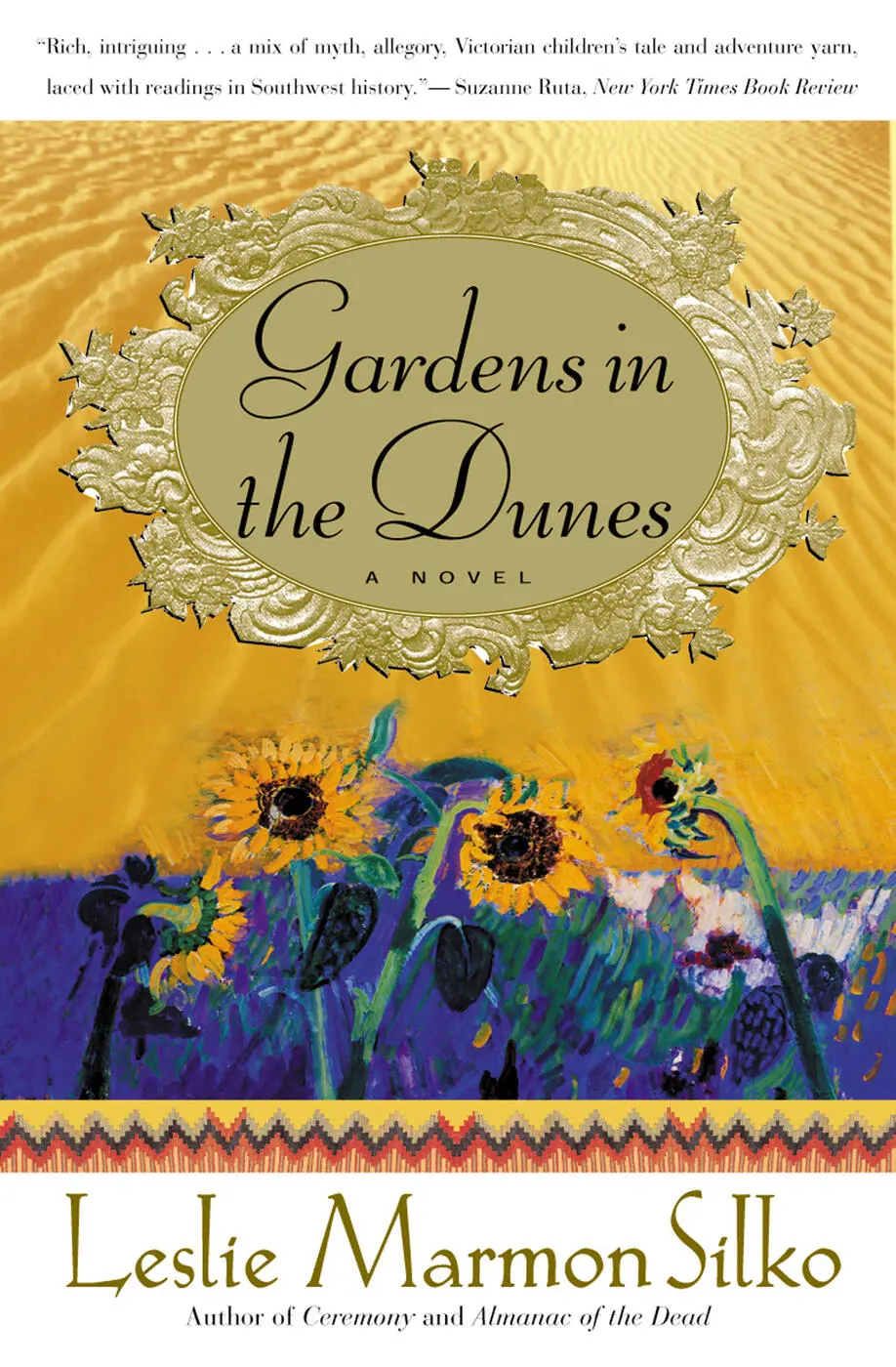
- Название:Gardens in the Dunes
- Автор:
- Издательство:Simon & Schuster
- Жанр:
- Год:2013
- ISBN:нет данных
- Рейтинг книги:5 / 5. Голосов: 1
-
Избранное:Добавить в избранное
- Отзывы:
-
Ваша оценка:
Gardens in the Dunes: краткое содержание, описание и аннотация
Предлагаем к чтению аннотацию, описание, краткое содержание или предисловие (зависит от того, что написал сам автор книги «Gardens in the Dunes»). Если вы не нашли необходимую информацию о книге — напишите в комментариях, мы постараемся отыскать её.
is the powerful story of one woman's quest to reconcile two worlds that are diametrically opposed.At the center of this struggle is Indigo, who is ripped from her tribe, the Sand Lizard people, by white soldiers who destroy her home and family. Placed in a government school to learn the ways of a white child, Indigo is rescued by the kind-hearted Hattie and her worldly husband, Edward, who undertake to transform this complex, spirited girl into a "proper" young lady. Bit by bit, and through a wondrous journey that spans the European continent, traipses through the jungles of Brazil, and returns to the rich desert of Southwest America, Indigo bridges the gap between the two forces in her life and teaches her adoptive parents as much as, if not more than, she learns from them.
Gardens in the Dunes — читать онлайн бесплатно полную книгу (весь текст) целиком
Ниже представлен текст книги, разбитый по страницам. Система сохранения места последней прочитанной страницы, позволяет с удобством читать онлайн бесплатно книгу «Gardens in the Dunes», без необходимости каждый раз заново искать на чём Вы остановились. Поставьте закладку, и сможете в любой момент перейти на страницу, на которой закончили чтение.
Интервал:
Закладка:
♦ ♦ ♦
“Come on, Hattie, let’s take a walk down the road,” her father said as he came indoors from his pigs and goats in his dust coat and rubber boots.
“We are likely to find the child on our stroll. She’s probably found something more interesting than a house full of elderly Yankees!”
How Hattie loved her father when he made her laugh at her troubles! He was proud of her choice of the female principle in the early church as a thesis topic, despite the furor it caused. Hattie reminded him of Aunt Bronwyn, his mother’s sister, who abruptly left the church after her husband died and moved to Bath to live in seclusion and study the prehistoric archaeology of the British Isles and old Europe.
“When you ran away from Lucille, you always ran to the sea,” he said, and she laughed and linked her arm in his as they walked the rocky shoreline.
Hattie knew he wanted to know if she and Edward were happy together, but he did not want to pry, bless his heart!
She told him what he wanted to know: she and Edward got along quite well in the marriage. They both had their own interests; although Edward’s interests called him to distant places, she rather enjoyed the solitude of the Riverside house and its dilapidated but elegant gardens. Almost as an afterthought she added he and her mother should not expect grandchildren; she felt strangely breathless and regretted her last remark. Her father’s expression of disappointment was gone in an instant, replaced by a look of puzzlement and concern. For reasons of health, Hattie said, and offered no explanation. Her remarks left her strangely breathless and light-headed. They were about to walk onto the stone jetty when voices called, “Mr. Abbott! Mr. Abbott! The farmers caught the little Indian!” Here came Ceena and Grace running down from the road.
Indigo had followed the rocky beach for a good distance, examining the bits of shells and kelp and driftwood she found among the gray rocks. The ocean was fascinating and Indigo was sorry when she got too hungry to keep walking along the shore. She left the beach and crossed the road to reach the overgrown meadows on the hillside where she had seen the purple blossoms of wild peas scattered among the sunflowers, goldenrod, and milkweed. She picked green pea pods and when there were no more, she hungrily pushed purple blossoms into her mouth as she continued to walk toward the west, through the old fields not planted for a long time. Where did white people get their food if they didn’t plant these fields? She could not see what lay past the sharp curve of the bay, so she kept walking, alert for wild pea pods and berries or anything that might be good to eat. She wished she could locate some drinking water. Where did the stream flowing through Hattie’s yard come down the hill? She stopped to empty the sand out of her shoes and to urinate. Up ahead, she was thrilled to see a low stone wall with field of tall corn beyond it.
She easily scaled the wall and went for a nice plump ear of green corn. The white kernels were different — smaller and sweeter — than Sand Lizard corn, but still this was Mother Corn, who feeds her children generously. The baby kernels were tiny, but oh so juicy and sweet! She had eaten her fill and was just about to climb back over the wall to head back home when someone grabbed her from behind and lifted her off her feet.
Instinctively she sank to the ground as deadweight to tear free from the grip. When the hand reached down to lift her she buried her teeth into the sweaty, hairy forearm. For an instant he flinched and lost his hold; she managed to break free. She ran as fast as she could through the rows of corn, back in the direction she had come. She was about to climb over the rock wall when the two farmers cornered her. This time they knew better than to grab hold of her. She watched them and they watched her; they spoke to each other but they didn’t speak to her. They thought she was lost. They thought she belonged to someone named Matinnecock.
The bitten man went for the wagon while the other man watched her; she could easily have escaped him, but she was tired. They refused to believe her when she pointed in the direction of the Abbotts’ house; its gray slate roof was partially visible through the tall trees on the hilltop.
Lloyd brought the buggy and off they went to the farm down the road. Yes, the farmers had found an Indian girl that morning. She had pointed in the direction of the Abbott house but they thought she must be mistaken. Only minutes earlier his brother left to take her to the Indian settlement on Manhasset Bay near Glen Cove. Hattie barely contained her agitation; she took deep breaths and reminded herself to remain calm; the child was in no danger.
Indigo was skeptical when the white man said he would take her home, but she thought he might know something she didn’t know. Not long after they turned west, they passed through a small settlement and then a village similar to Oyster Bay. She was happy to be going west, but she knew there was a great distance south she must travel as well to get back to Arizona.
The farmland gave way to salt marshes that ran to the edge of the ocean. Then the wagon turned off the road onto a narrow sandy trail that led to a cluster of old wooden buildings and beyond them. Two dogs came barking to greet them and Indigo saw heads peek out of doors and windows; the wagon stopped and a small group of women and men gathered around. Their clothes and shoes and the hats they wore fooled her for an instant, but Indigo saw their faces and realized these were Indians, though their features were very distinct from the people at home. They all looked at her and shook theirs heads slowly when the farmer asked if she was their child.
“No sir, this girl’s not from around here.”
The farmer looked at Indigo. He had not believed her when she told him that she came from the big house on the hill.
“She looks like one of those desert Indians, don’t you think?” one of the women said to the others. “Look how round her head is!”
“Look what nice shoes those were before she ruined them in the sand!”
“She’s really dark,” said another.
“If she isn’t one of yours,” the farmer said with a look of concern on his face, “I wonder what I should do.” No one spoke. Now that it was clear the lost child did not belong to the small settlement of Matinnecock Indians near Manhasset Bay, the farmer began to reconsider. The big house the child had indicated was the Abbott house; old man Abbott went from one crazy philanthropic scheme to another; maybe this Indian child was part of a new scheme. The farmer paused a moment to decide what to do next.
Indigo looked at the children who gathered around the wagon with the older folks; she saw no one her mother’s age. They all looked at her with wide eyes; then from behind the houses a big woman, tall as a man, with big strong legs and arms, approached Indigo’s side of the wagon.
“Where did you come from, little one?”
Indigo pointed to the southwest horizon.
“But how did you get here?”
“On the train.”
“Where is your mama?”
Indigo again pointed to the southwest. The big Indian woman chuckled and shook her head as she went back to the farmer’s side of the wagon.
“She’s probably been sent from an Indian school for the summer to work in one of the big houses here,” the woman told the farmer. She smiled at Indigo.
“You stay with me. I’ll take care of you until someone comes for you.” Indigo nodded shyly.
“We’ll look after her,” the big woman announced. The farmer was hesitant; he was not sure what he would do with the Indian child otherwise, so he agreed. Indigo stepped down from the wagon seat into the big woman’s open arms; she squirmed because only babies were carried and the woman set her down. The beach sand was deep and warm through her kid slippers; she looked past the other children, who were watching her. Tall grass and scrubby little bushes covered the dunes that went on and on until they met the blue-gray sea.
Читать дальшеИнтервал:
Закладка:
Похожие книги на «Gardens in the Dunes»
Представляем Вашему вниманию похожие книги на «Gardens in the Dunes» списком для выбора. Мы отобрали схожую по названию и смыслу литературу в надежде предоставить читателям больше вариантов отыскать новые, интересные, ещё непрочитанные произведения.







Обсуждение, отзывы о книге «Gardens in the Dunes» и просто собственные мнения читателей. Оставьте ваши комментарии, напишите, что Вы думаете о произведении, его смысле или главных героях. Укажите что конкретно понравилось, а что нет, и почему Вы так считаете.