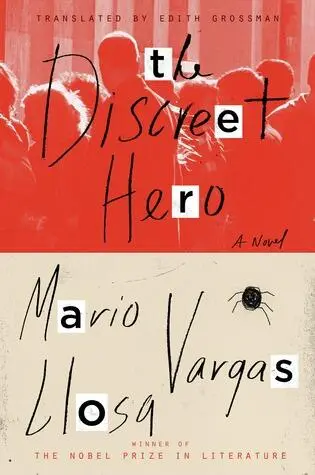
Mario Vargas Llosa - The Discreet Hero
Здесь есть возможность читать онлайн «Mario Vargas Llosa - The Discreet Hero» весь текст электронной книги совершенно бесплатно (целиком полную версию без сокращений). В некоторых случаях можно слушать аудио, скачать через торрент в формате fb2 и присутствует краткое содержание. Год выпуска: 2015, Издательство: Farrar, Straus and Giroux, Жанр: Современная проза, на английском языке. Описание произведения, (предисловие) а так же отзывы посетителей доступны на портале библиотеки ЛибКат.
- Название:The Discreet Hero
- Автор:
- Издательство:Farrar, Straus and Giroux
- Жанр:
- Год:2015
- ISBN:нет данных
- Рейтинг книги:3 / 5. Голосов: 1
-
Избранное:Добавить в избранное
- Отзывы:
-
Ваша оценка:
The Discreet Hero: краткое содержание, описание и аннотация
Предлагаем к чтению аннотацию, описание, краткое содержание или предисловие (зависит от того, что написал сам автор книги «The Discreet Hero»). Если вы не нашли необходимую информацию о книге — напишите в комментариях, мы постараемся отыскать её.
Nobel laureate Mario Vargas Llosa’s newest novel, The Discreet Hero, follows two fascinating characters whose lives are destined to intersect: neat, endearing Felícito Yanaqué, a small businessman in Piura, Peru, who finds himself the victim of blackmail; and Ismael Carrera, a successful owner of an insurance company in Lima, who cooks up a plan to avenge himself against the two lazy sons who want him dead.
Felícito and Ismael are, each in his own way, quiet, discreet rebels: honorable men trying to seize control of their destinies in a social and political climate where all can seem set in stone, predetermined. They are hardly vigilantes, but each is determined to live according to his own personal ideals and desires — which means forcibly rising above the pettiness of their surroundings. The Discreet Hero is also a chance to revisit some of our favorite players from previous Vargas Llosa novels: Sergeant Lituma, Don Rigoberto, Doña Lucrecia, and Fonchito are all here in a prosperous Peru. Vargas Llosa sketches Piura and Lima vividly — and the cities become not merely physical spaces but realms of the imagination populated by his vivid characters.
A novel whose humor and pathos shine through in Edith Grossman’s masterly translation, The Discreet Hero is another remarkable achievement from the finest Latin American novelist at work today.
The Discreet Hero — читать онлайн бесплатно полную книгу (весь текст) целиком
Ниже представлен текст книги, разбитый по страницам. Система сохранения места последней прочитанной страницы, позволяет с удобством читать онлайн бесплатно книгу «The Discreet Hero», без необходимости каждый раз заново искать на чём Вы остановились. Поставьте закладку, и сможете в любой момент перейти на страницу, на которой закончили чтение.
Интервал:
Закладка:
“Neither one, but the cook,” replied Lucrecia. “Her name’s Navidad and she’s from Arequipa, of course.”
“When was the last time you saw this gentleman?” asked the priest, who’d lost the confident, secure air he’d had until now and seemed somewhat nervous. He asked the question with great diffidence.
“Yesterday, crossing the Puente de los Suspiros, in Barranco, Father,” Fonchito answered immediately. “I was walking across the bridge and there were maybe three other people. And suddenly there he was, sitting on the railing.”
“Crying, as usual?” asked Father O’Donovan.
“I don’t know, I saw him for just a moment as I walked past. I didn’t stop, I kept walking, walking faster,” the boy explained, and now he seemed frightened. “I don’t know if he was crying. But his face looked really sad. I don’t know how to say it, Father. I swear to you I’ve never seen anyone as sad as Señor Torres. It’s contagious, I’m upset for a long time afterward, full of sorrow, and I don’t know what to do. I’d like to know why he’s crying. I’d like to know what he wants me to do. Sometimes I tell myself he’s crying for all the people who suffer. For the sick, the blind, for those who beg in the streets. Well, I don’t know, lots of things go through my head when I see him. But I don’t know how to explain them, Father.”
“You explain them very well, Fonchito,” Father O’Donovan said. “Don’t worry about that.”
“But then, what should we do?” asked Lucrecia.
“Advise us, Pepín,” Rigoberto added. “I’m completely paralyzed. If it’s as you say, then the boy has a kind of gift, a hypersensibility, and sees what no one else sees. It’s that, isn’t it? Should I talk to him about it? Should I say nothing? It worries me, it frightens me. I don’t know what to do.”
“Love him and leave him in peace,” said Father O’Donovan. “What’s certain is that this individual, whether or not he exists, is no pervert and doesn’t wish to hurt your son in the slightest. Whether or not he exists, he has more to do with Fonchito’s soul, well, with his spirit, if you prefer, than with his body.”
“Something mystical?” Lucrecia interjected. “Could that be it? But Fonchito was never very religious. Just the opposite, I’d say.”
“I’d like to be more precise, but I can’t,” Father O’Donovan confessed again; he looked defeated. “Something’s happening to the boy that has no rational explanation. We don’t know everything that’s in us, Ears. Human beings, each of us, are chasms filled with shadows. Some men, some women, are more intensely sensitive than others, they feel and perceive things that the rest of us don’t. Could this be purely a product of his imagination? Yes, perhaps. But it could also be something else I don’t dare give a name to, Rigoberto. Your son is experiencing this so powerfully, so authentically, that I resist thinking it’s purely imaginary. And I don’t want to and won’t say more than that.”
He fell silent and sat looking at the plate of corvina and rice with a kind of hybrid feeling that was both stupefaction and tenderness. Lucrecia and Rigoberto had not tasted a mouthful.
“I’m sorry I haven’t been much help to you,” the priest added sadly. “Instead of helping you out of this tangled situation, I’ve become entangled in it too.”
He was silent for a long time and looked at them both with concern.
“I’m not exaggerating if I tell you that this is the first time in my life I’ve confronted something I wasn’t prepared for,” he murmured very seriously. “Something that, for me, has no rational explanation. I already told you I don’t discount the possibility that the boy is exceptionally good at deception and has made me swallow a huge fabrication. It’s not impossible. I’ve thought about that a great deal. But no, I don’t believe it. I think he’s very sincere.”
“You’re not going to leave us very reassured knowing my son has daily communication with the beyond,” said Rigoberto with a shrug, “and that Fonchito is a bit like the little shepherdess of Lourdes. She was a shepherdess, wasn’t she?”
“You’re going to laugh, the two of you are going to laugh,” said Father O’Donovan, toying with his fork and not touching the corvina. “But I haven’t stopped thinking about the boy for a moment. Of all the people I’ve known in my life, and there are many, I believe that Fonchito is closest to what we believers call a pure being. And not only because of how beautiful he is.”
“Now the priest is showing, Pepín.” Rigoberto was indignant. “Are you suggesting my son might be an angel?”
“An angel without wings in any case,” Lucrecia said with a laugh, openly happy now, her eyes burning with mischief.
“I’ll say it and repeat it even though it makes you both laugh,” declared Father O’Donovan, laughing as well. “Yes, Ears, yes, Lucrecia, I mean it literally. And even though it amuses you. A little angel, why not?”
XI
When they reached the house in Castilla where Mabel lived, on the other side of the river, Sergeant Lituma and Captain Silva were dripping with sweat. The sun beat down mercilessly from a cloudless sky where turkey buzzards were circling, and there wasn’t the slightest breeze to alleviate the heat. During the trip from the station, Lituma had been asking himself questions. In what condition would they find the cute brunette? Had those bastards mistreated Felícito Yanaqué’s mistress? Had they beaten her? Raped her? Very possibly. Given how good-looking she was, why wouldn’t they take advantage of having her at their mercy day and night.
Felícito himself opened the door of Mabel’s house. He was euphoric, relieved, happy. The grim face that Lituma had always seen had changed, his recent tragicomic expression had disappeared. Now he grinned from ear to ear and his eyes gleamed with happiness. He looked rejuvenated. He wasn’t wearing a jacket, and his vest was unbuttoned. He was so skinny, his chest and back almost touched, and he was really a runt, he almost looked like a midget to Lituma. As soon as he saw the two policemen he did something unheard-of for a man so little given to emotional displays: He opened his arms and embraced Captain Silva.
“It happened just as you said, Captain,” he said effusively, patting him on the back. “They let her go, they let her go. You were right, Chief. I don’t have the words to thank you. I’m alive again, thanks to you. And to you too, Sergeant. Many thanks, many thanks to you both.”
His eyes were wet with emotion. Mabel was showering, she’d be with them right away. He had them sit in the living room, beneath the image of the Sacred Heart of Jesus, facing the small table that held a papier-mâché llama and a Peruvian flag. The electric fan twanged rhythmically and the current of air made the plastic flowers sway. The trucker, effusive and happy, nodded to all of the officers’ questions: Yes, yes, she was fine, it had been terrifying, of course, but luckily they hadn’t hit or abused her, thank God. All that time they’d kept her blindfolded, with her hands tied, what heartless, cruel people. Mabel would give them all the details herself as soon as she came out. And from time to time, Felícito would lift his hands to heaven: “If anything had happened to her, I would never have forgiven myself. Poor thing! All this via crucis on my account. I’ve never been very devout, but I promised God that from now on I’d go to Mass every Sunday without fail.”
“He’s head over heels in love with her,” thought Lituma. You could be sure he’d have a great fuck. This reminded him of his own solitude, how long it had been since he’d had a woman. He envied Don Felícito and was furious with himself.
Читать дальшеИнтервал:
Закладка:
Похожие книги на «The Discreet Hero»
Представляем Вашему вниманию похожие книги на «The Discreet Hero» списком для выбора. Мы отобрали схожую по названию и смыслу литературу в надежде предоставить читателям больше вариантов отыскать новые, интересные, ещё непрочитанные произведения.
![Гарри Гаррисон - Bill, the Galactic Hero [= The Starsloggers]](/books/87536/garri-garrison-bill-the-galactic-hero-the-star-thumb.webp)









Обсуждение, отзывы о книге «The Discreet Hero» и просто собственные мнения читателей. Оставьте ваши комментарии, напишите, что Вы думаете о произведении, его смысле или главных героях. Укажите что конкретно понравилось, а что нет, и почему Вы так считаете.