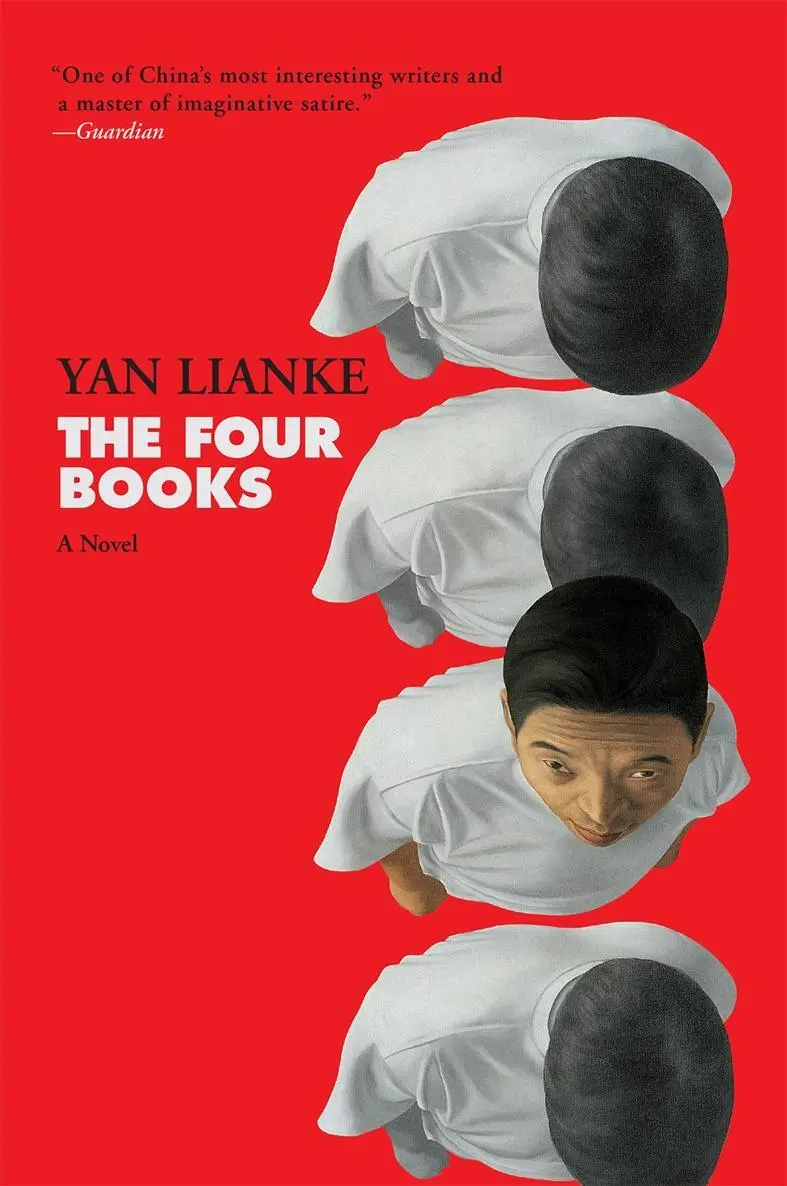
Yan Lianke - The Four Books
Здесь есть возможность читать онлайн «Yan Lianke - The Four Books» весь текст электронной книги совершенно бесплатно (целиком полную версию без сокращений). В некоторых случаях можно слушать аудио, скачать через торрент в формате fb2 и присутствует краткое содержание. Год выпуска: 2015, Издательство: Grove Press, Жанр: Современная проза, на английском языке. Описание произведения, (предисловие) а так же отзывы посетителей доступны на портале библиотеки ЛибКат.
- Название:The Four Books
- Автор:
- Издательство:Grove Press
- Жанр:
- Год:2015
- ISBN:нет данных
- Рейтинг книги:3 / 5. Голосов: 1
-
Избранное:Добавить в избранное
- Отзывы:
-
Ваша оценка:
The Four Books: краткое содержание, описание и аннотация
Предлагаем к чтению аннотацию, описание, краткое содержание или предисловие (зависит от того, что написал сам автор книги «The Four Books»). Если вы не нашли необходимую информацию о книге — напишите в комментариях, мы постараемся отыскать её.
is a powerful, daring novel of the dog-eat-dog psychology inside a labor camp for intellectuals during Mao’s Great Leap Forward. A renowned author in China, and among its most censored, Yan’s mythical, sometimes surreal tale cuts to the bone in its portrayal of the struggle between authoritarian power and man’s will to prevail against the darkest odds through camaraderie, love, and faith.
In the ninety-ninth district of a sprawling reeducation compound, freethinking artists and academics are detained to strengthen their loyalty to Communist ideologies. Here, the Musician and her lover, the Scholar — along with the Author and the Theologian — are forced to carry out grueling physical work and are encouraged to inform on each other for dissident behavior. The prize: winning the chance at freedom. They're overseen by preadolescent supervisor, the Child, who delights in reward systems and excessive punishments. When agricultural and industrial production quotas are raised to an unattainable level, the ninety-ninth district dissolves into lawlessness. And then, as inclement weather and famine set in, they are abandoned by the regime and left alone to survive.
The Four Books — читать онлайн бесплатно полную книгу (весь текст) целиком
Ниже представлен текст книги, разбитый по страницам. Система сохранения места последней прочитанной страницы, позволяет с удобством читать онлайн бесплатно книгу «The Four Books», без необходимости каждый раз заново искать на чём Вы остановились. Поставьте закладку, и сможете в любой момент перейти на страницу, на которой закончили чтение.
Интервал:
Закладка:
Then he went to yet another bed, asking, “Are you still alive?. You definitely need to live, so that the higher-ups can see the result of sending us here for Re-Ed.”
As if he were one of the higher-ups of the ninety-ninth, the Scholar called upon his comrades to persevere. He was neither the most educated person there nor the one with the highest position, and he was certainly not the oldest. No one had appointed him to perform this task of serving as a higher-up like the Child, but he nevertheless proceeded on his own accord from one bed to another, and from one room to another. Everyone knew that the Scholar had once helped the nation’s highest higher-ups prepare philosophy lectures, create translations, and revise critically important volumes, and therefore they listened to him just as they did the Child.
They gazed up at him and asked skeptically,
“Will the higher-ups forget about us?”
He shook his head, “They definitely won’t. Within half a month they’ll definitely send someone to come check on us.”
He then went to one of the women’s rooms and asked, “Are you still alive?” When he saw the woman turn over in bed to look at him, he pulled a packet out of his pocket and said, “Here are some grass seeds, which you can mix with flour and boil.” He gave each woman a packet of grass seed, and when he got to the Musician he placed the packet on her pillow. He then caressed her face and squeezed her hand, and whispered into her ear, “Get up and go eat. I’ve brought you some flour and grass seeds.” Then he turned, leaning against the wall, and announced loudly, “Everyone must live. The higher-ups will not forget us. As soon as the snow melts and the roads open, the higher-ups will send someone to bring us grain. Because, at the end of the day, the country still needs scholars!”
Everyone believed him, and each day they would mix into their black flour some wild grass, tree leaves, and even mud from the salt flats, and they would bake it all into a mud pancake. When they were hungry they would eat a bite, washing it down with water. After eating too many of these mud pancakes, everyone became very constipated. The Scholar then organized them into pairs and had them take turns using chopsticks to help each other defecate. It was very cold outside, and the Scholar was afraid that people would die of exposure and hunger if they tried to go to the courtyard to use the outhouse, so he instructed everyone to relieve themselves in their rooms. He told them they could urinate in their doorway, or if they had extra bowls or bottles, they could simply urinate into them and dump the waste outside. Everyone did as the Scholar recommended, and consequently everyone’s room started to smell like an outhouse.
They continued in this way for another ten days, whereupon the snow finally began to melt and the roads began to dry up. At this point some higher-ups did in fact arrive. Everyone was standing in their doorways, warming themselves in the sunlight and searching their bodies for lice. Some women were mending their men’s clothes. By noontime, the sun was so warm that everyone could take off their jackets without feeling cold. Some people pointed to the empty road and exclaimed, “Quick, come look!” Everyone looked, and saw a jeep driving through the empty wasteland, like a small boat cutting through the surf. When the jeep arrived at the ninety-ninth, several people got out. The first person was wearing a gray uniform and had gray hair that was parted on the side. He was tall and thin, with a chiseled face and white but slightly protruding teeth. He walked ahead of the others to the Child’s door and went inside.
It had already been a week since anyone had seen the Child, and they all assumed that he had gone into town for a meeting, to be wined and dined. No one had expected that he had actually been in his room this entire time. After spending half an hour in his room, the higher-ups reemerged and slowly proceeded toward the people sunning themselves in the doorways of their buildings. The Child followed them like a lamb following a flock of sheep. When they arrived in a sunlit area in front of the first row of buildings, the slender, uniform-wearing higher-up looked excited. He gazed at the crowd, all of whom had swollen faces and legs, and immediately turned pale. He didn’t say a word, and just turned to look at the people accompanying him, who lowered their heads and muttered something, whereupon the slender higher-up’s eyes turned red.
He told the Child to have everyone come stand in the sun in front of the first row of buildings. The Child then ran around, shouting, “Everyone assemble!. The higher-ups have come to see you!” Everyone slowly emerged from their rooms, leaning on walls or on each other for support, and then proceeded to the open area in front of the first row of houses. The bright yellow sunlight flowed over the ground like an iridescent liquid. More than a hundred gleaming, swollen faces were reflected in the sunlight like an array of water bottles. Although it was winter, given that there was no wind, the courtyard overflowed with the midday warmth. In the wasteland beyond the courtyard the snow had not fully melted, and under the sunlight it was blindingly bright. Everyone was faint with hunger and didn’t dare look into the distance, and instead they just stared down at the moist sandy ground at their feet.
Among the group of higher-ups, they saw that the highest higher-up was wearing cloth shoes with pointed toes, with black tops and hand-sewn soles that were as white as snow, but with red stains on the soles that resembled blood from crushed fleas. He was wearing gray woolen pants that were as straight as a ruler. Everyone stood silently in front of him. He gazed at the crowd, and they gazed back at him. The Scholar, the Musician, and I all stood in front. We knew that he was one of the highest higher-ups, but we didn’t know whether he was from the district or from the province. Everything was very still, and we could hear the hunger-induced pounding in our eyes. We could also hear the sound of the sunlight splattering over the sandy ground, together with that of the people and the higher-ups gazing at each other. It was in the midst of these unusually quiet sounds that everyone stood waiting for the highest higher-up to say something. But suddenly he broke into tears and knelt down in front of everyone, repeating the same phrase that the Scholar had previously uttered: “The country needs you, and if you starve to death, the nation will starve as well. No matter what, you must find a way to survive!” Once he was finished, he kowtowed three times to the crowd and added, “The country has let you down!” He stood up and wiped away his tears, cast one final glance at the swollen faces sparkling in the sunlight like water bottles, then turned around and walked away.
The people who accompanied him also turned around and walked away.
They went back to the entranceway, where they unloaded two sacks of flour from the jeep. The slender man patted the Child on the shoulder, let the Child take the flour back to his own room, and said a few more words to him. Then they all got back into the car to go to another Re-Ed district. By this point the snow had already melted, and the jeep drove through countless puddles of muddy water.
Everyone’s faces were red with excitement as they gazed eagerly after the two sacks of flour in the Child’s room. They gathered around, forming a crowd in front of the Child. As they were waiting for the Child to distribute the flour, the Scholar appeared to remember something. He jostled his way into the crowd and exclaimed, “Do you know who those people were?. I just realized who they were — they were people who came from Beijing to see us!”
Everyone turned around to look at the Scholar, and waited to see what else he would say.
Читать дальшеИнтервал:
Закладка:
Похожие книги на «The Four Books»
Представляем Вашему вниманию похожие книги на «The Four Books» списком для выбора. Мы отобрали схожую по названию и смыслу литературу в надежде предоставить читателям больше вариантов отыскать новые, интересные, ещё непрочитанные произведения.









Обсуждение, отзывы о книге «The Four Books» и просто собственные мнения читателей. Оставьте ваши комментарии, напишите, что Вы думаете о произведении, его смысле или главных героях. Укажите что конкретно понравилось, а что нет, и почему Вы так считаете.