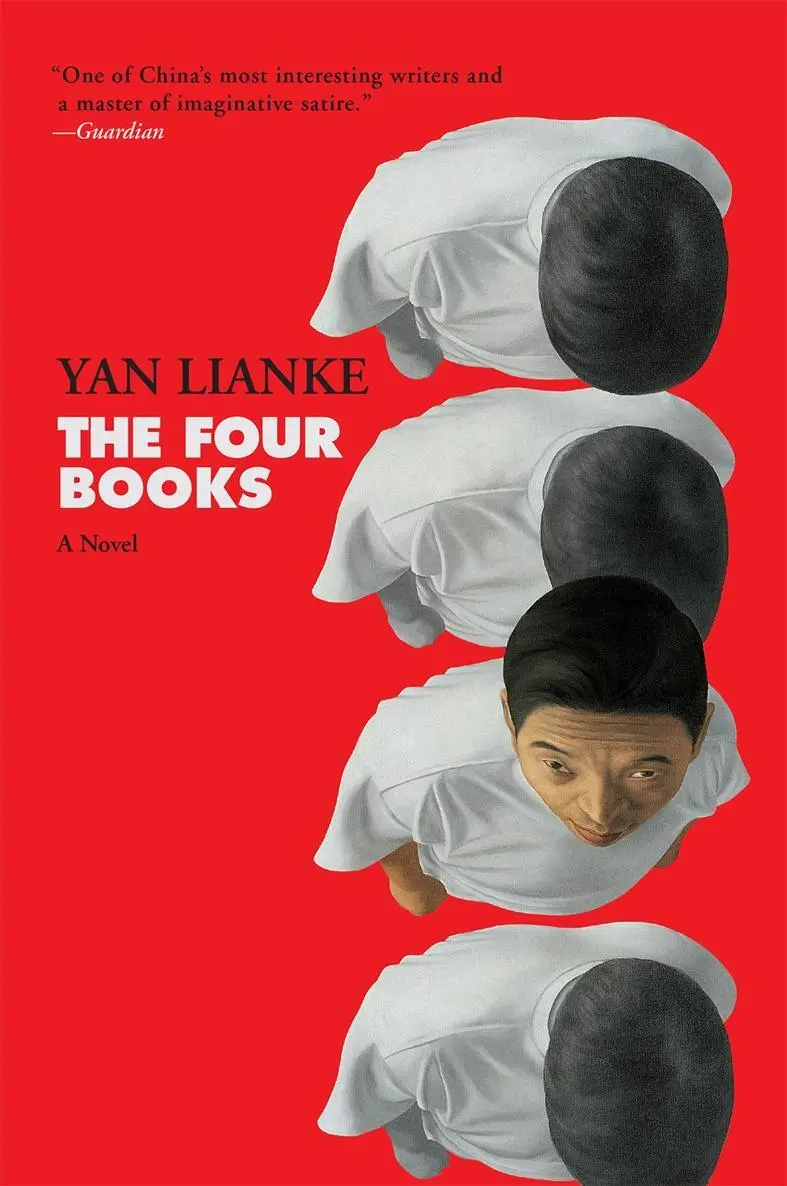
Yan Lianke - The Four Books
Здесь есть возможность читать онлайн «Yan Lianke - The Four Books» весь текст электронной книги совершенно бесплатно (целиком полную версию без сокращений). В некоторых случаях можно слушать аудио, скачать через торрент в формате fb2 и присутствует краткое содержание. Год выпуска: 2015, Издательство: Grove Press, Жанр: Современная проза, на английском языке. Описание произведения, (предисловие) а так же отзывы посетителей доступны на портале библиотеки ЛибКат.
- Название:The Four Books
- Автор:
- Издательство:Grove Press
- Жанр:
- Год:2015
- ISBN:нет данных
- Рейтинг книги:3 / 5. Голосов: 1
-
Избранное:Добавить в избранное
- Отзывы:
-
Ваша оценка:
The Four Books: краткое содержание, описание и аннотация
Предлагаем к чтению аннотацию, описание, краткое содержание или предисловие (зависит от того, что написал сам автор книги «The Four Books»). Если вы не нашли необходимую информацию о книге — напишите в комментариях, мы постараемся отыскать её.
is a powerful, daring novel of the dog-eat-dog psychology inside a labor camp for intellectuals during Mao’s Great Leap Forward. A renowned author in China, and among its most censored, Yan’s mythical, sometimes surreal tale cuts to the bone in its portrayal of the struggle between authoritarian power and man’s will to prevail against the darkest odds through camaraderie, love, and faith.
In the ninety-ninth district of a sprawling reeducation compound, freethinking artists and academics are detained to strengthen their loyalty to Communist ideologies. Here, the Musician and her lover, the Scholar — along with the Author and the Theologian — are forced to carry out grueling physical work and are encouraged to inform on each other for dissident behavior. The prize: winning the chance at freedom. They're overseen by preadolescent supervisor, the Child, who delights in reward systems and excessive punishments. When agricultural and industrial production quotas are raised to an unattainable level, the ninety-ninth district dissolves into lawlessness. And then, as inclement weather and famine set in, they are abandoned by the regime and left alone to survive.
The Four Books — читать онлайн бесплатно полную книгу (весь текст) целиком
Ниже представлен текст книги, разбитый по страницам. Система сохранения места последней прочитанной страницы, позволяет с удобством читать онлайн бесплатно книгу «The Four Books», без необходимости каждый раз заново искать на чём Вы остановились. Поставьте закладку, и сможете в любой момент перейти на страницу, на которой закончили чтение.
Интервал:
Закладка:
One day passed.
Another day passed.
By the third or fourth day, someone became so hungry that he came out of his room with something in his hands, then headed to the district entrance, where he knocked on the Child’s door. Inside, the Child had a fire burning in his room, and there was the fragrant smell of flour paste. The visitor immediately kneeled down and began kowtowing to the Child, saying “If I give you a book, could you exchange it for a liang of black flour?” He brought out the book from where he was carrying it in his coat. It had a thread-sewn binding, and the pages were yellow and brittle. “This is a volume of great Yongle Encyclopedia , and it has been in my family for five hundred and fifty years. I take it with me wherever I go.”
As he was saying this, he handed over the book. The volume consisted entirely of small black characters written with a fine brush. The paper was soft and light. The Child didn’t know what the Yongle Encyclopedia was, but he recognized that this was something very valuable. He accepted the volume, and gave the book’s owner half a cup — which is to say about three liang —of sweet potato flour. The visitor was about sixty years old, and originally worked at the national history research institute. He was a historian, and accepted the flour as though he were accepting history itself. He cradled it carefully, kowtowed to the Child in gratitude, then closed his coat and left.
That evening several other visitors arrived. The moon shone coldly in the sky, and a dry wind was blowing. The Child used kindling to start a fire. Five or six people were kneeling in his room, and they saw him tear something in half and throw it in the fire. It was a copy of the Book of Psalms, and he tossed the remainder of the page on the table. They had brought the book to him, confessing that they had not handed it over earlier because this book was actually not counterrevolutionary, though it was included in the higher-ups’ list of blacklisted titles. One volume on that list was a copy of Aristotle’s Physics that foreigners had brought to China fifty years earlier, and another was a copy of Aristotle’s On the Heavens , which had been brought from Britain even earlier. There were also other books that belonged to our ancestors, including several thread-bound copies of Records of the Historian and Three Kingdoms . The people had brought the Child all of these books and said that these volumes were out-of-print editions, and that these were among the final copies in the entire country. The Child didn’t know how valuable those volumes actually were. He simply accepted them, and gave each person one or two liang of sweet potato flour.
Many more people approached the Child to hand over their books. Initially he would give each of them a liang or two of flour in return, but by the end he gave them only a handful of flour, or even half a handful. After a couple of weeks, people stopped coming to hand over their books. This was because no one had any books left — except, of course, the Child, who now had many, all of which he stored inside the room where no one had previously been allowed to enter. One day the Theologian walked in just as the Child was lighting a book on fire. The Theologian had come out when everyone else was huddled in their blankets in their rooms. He didn’t bring anything with him, and neither did he kneel down when he entered. Instead he stood in the middle of the Child’s room, which was full of a red light. The Child was reading a comic book while holding a black pancake. The pancake was as thin and brittle as a sheet of paper, and it crackled as he ate it. Even though it was made from black flour, the scent of wheat nevertheless filled the room.
Staring at that black pancake, the Theologian swallowed hard. It was snowing outside, and was dark and gray. The Child put down the comic book he was reading and placed a piece of pancake on one of the ripped out pages. He looked at the Theologian’s face, which was lit up like a pool of water. The Theologian lifted his pants to show the Child, who saw that his ankle was as thick and bright as a column of water.
The Child exclaimed, “My God!”
“I’m on the verge of starving to death,” the Theologian explained. “For four days I haven’t consumed anything other than water, and I had to lean against the walls simply to get here.”
“I’ll give you a liang of flour,” the Child said. “But you mustn’t tell anyone that I gave you flour for no reason.” The Child went into his room and wrapped the flour in a page from one of his books. The Theologian immediately opened the makeshift packet and swallowed some of the raw flour right then and there. As he started to choke, the Child handed him a glass of water. After eating the flour, the Theologian had a bit more strength, and therefore proceeded to wrap up the remainder of the flour and placed it on the corner of the table, then licked his lips. He stretched out his neck and said, “It’s not the case that I’m getting something for nothing.” He took a portrait of Mother Mary from his pocket, like the one he had handed over before, and laid it out on the ground, stomping on the figure’s head. He deliberately ground his foot on the portrait’s eye, leaving it a black hole. He knelt down and kowtowed to the Child, then took the packet of flour on the table and, still leaning against walls, left the room.
It was at this point that the Child finally realized what had just happened. He looked down at the black eye of the portrait of Mary that the Theologian had trampled and left lying on the ground and, startled, turned to the Theologian. The Theologian stepped out of the Child’s room. It was snowing lightly outside, and as the Theologian was about to close the door, he noticed the Author kneeling in the doorway. The Author saw that the Theologian was carrying a paper packet, and his eyes began to gleam. But just as he was getting up to go into the Child’s room, he almost lost consciousness and squatted down again. He half crawled into the Child’s room, then looked up and said in a soft voice,
“If you let me live, I’ll write that Criminal Records for you. This winter I’ll record what everyone says and does, and next spring I’ll go back to that sand dune and grow wheat with ears that are even larger than ears of corn. I confirmed that beneath that sand dune there is in fact an ancient imperial tomb. I planted the wheat on top of the emperor’s body, and irrigated it with blood from my own veins. I guarantee that the ears of wheat will be bigger than ears of corn, and the grains will be larger than peanuts. You’ll be able to take the wheat into the capital and stay in Zhongnanhai. I don’t want those five stars. Instead I’ll stay here with you for the rest of my life, doing whatever you want. But you must help me survive this winter.”
The Child was very moved, and gave the Author one of the black pancakes on the table. As the Author was eating it, the Child went back into the room to fetch a cup of flour. The Author offered a shallow smile, his future now bright. “The further things proceed,” the Child said, “the more the higher-ups insist that we must know what everyone is thinking, saying, and doing. I won’t let you starve, but you must keep a record of everything everyone says and does, and next year you definitely must grow me an ear of wheat that is even larger than an ear of corn.”
The Author nodded, and that same day began working again on his Criminal Records .
CHAPTER 14. The Great Famine (II)
1. Old Course , pp. 425–31
The billowing snow stopped, and both banks of the Yellow River were an endless expanse of white. When it snowed the previous winter, everyone continued smelting steel in the snow, working so hard they each wished they had four legs and eight arms. During this year’s winter snow, everyone in the ninety-ninth stayed buried under their covers, neither moving nor talking — afraid of using up valuable energy and exacerbating their hunger. The one person who remained active was the Scholar, who continued going back and forth between one room and another, while supporting himself by leaning against the walls. He approached one bed, pulled back the covers, and asked, “Are you still alive?” Upon seeing the person move or simply stare straight ahead, he would add, “You must live. The higher-ups can’t let us starve to death. If all of the country’s scholars were to starve, the country itself would starve.” Not caring whether or not the person in the bed was listening to him, or was even interested in listening to him, the Scholar moved on to the next bed, pulled back the dirty sheets, and saw that the person had his eyes closed. The Scholar placed his fingers under the person’s nose to see whether he was still breathing, then pushed his shoulders and said, “Wake up, wake up! Are you still alive? You definitely need to wake up.”
Читать дальшеИнтервал:
Закладка:
Похожие книги на «The Four Books»
Представляем Вашему вниманию похожие книги на «The Four Books» списком для выбора. Мы отобрали схожую по названию и смыслу литературу в надежде предоставить читателям больше вариантов отыскать новые, интересные, ещё непрочитанные произведения.

Обсуждение, отзывы о книге «The Four Books» и просто собственные мнения читателей. Оставьте ваши комментарии, напишите, что Вы думаете о произведении, его смысле или главных героях. Укажите что конкретно понравилось, а что нет, и почему Вы так считаете.