T. Boyle - T. C. Boyle Stories
Здесь есть возможность читать онлайн «T. Boyle - T. C. Boyle Stories» весь текст электронной книги совершенно бесплатно (целиком полную версию без сокращений). В некоторых случаях можно слушать аудио, скачать через торрент в формате fb2 и присутствует краткое содержание. Год выпуска: 1999, Издательство: Penguin (Non-Classics), Жанр: Современная проза, на английском языке. Описание произведения, (предисловие) а так же отзывы посетителей доступны на портале библиотеки ЛибКат.
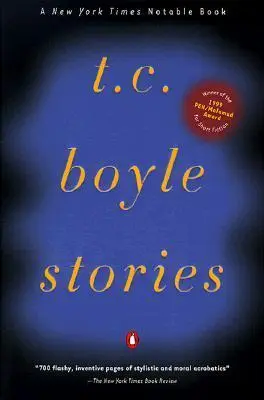
- Название:T. C. Boyle Stories
- Автор:
- Издательство:Penguin (Non-Classics)
- Жанр:
- Год:1999
- ISBN:нет данных
- Рейтинг книги:5 / 5. Голосов: 1
-
Избранное:Добавить в избранное
- Отзывы:
-
Ваша оценка:
T. C. Boyle Stories: краткое содержание, описание и аннотация
Предлагаем к чтению аннотацию, описание, краткое содержание или предисловие (зависит от того, что написал сам автор книги «T. C. Boyle Stories»). Если вы не нашли необходимую информацию о книге — напишите в комментариях, мы постараемся отыскать её.
T. C. Boyle Stories — читать онлайн бесплатно полную книгу (весь текст) целиком
Ниже представлен текст книги, разбитый по страницам. Система сохранения места последней прочитанной страницы, позволяет с удобством читать онлайн бесплатно книгу «T. C. Boyle Stories», без необходимости каждый раз заново искать на чём Вы остановились. Поставьте закладку, и сможете в любой момент перейти на страницу, на которой закончили чтение.
Интервал:
Закладка:
Calvin is sitting glumly over a bowl of tepid corn chowder in the Country Griddle, toying with his spoon and sucking his teeth like a two-year-old. Across the bright Formica table, his daughter breaks off her monologue just long enough to take a sip of coffee and a quick ladylike nip at her tuna on rye. She’s wearing an off-white dress, stockings, false eyelashes, and an expression about midway between harried and exasperated.
“He was innocent,” Calvin says.
His daughter gives him an impatient look. “Innocent or not, Dad, the man is in jail — in prison — for armed robbery. And I want to know who’s paying the bills and taking care of the place — I want to know who’s looking after you.”
“Armed robbery? The man had a screwdriver in his hand, for Christ’s sake—”
“Sharpened.”
“What?”
“I said it was a sharpened screwdriver.”
For a moment, Calvin says nothing. He fiddles with the salt shaker and watches his daughter get the Dad-you-know-you’re-not-supposed-to look on her face, and then, when he’s got her off guard, he says, “Jewel.”
“Jewel? Jewel what?”
“Takes care of the place. Pays the bills. Feeds me.” And she does a hell of a job of it too, he’s about to add, when a vast and crushing weariness suddenly descends on him. Why bother? His daughter’s up here on her day off to see about his arm and snoop around till she finds something rotten. And she’ll find it, all right, because she’s nothing but a sack of complaints and suspicions. Her ex-husband is second only to Adolf Hitler for pure maliciousness, her youngest is going to a psychiatrist three times a week, and her oldest is flunking out of college, she’s holding down two jobs to pay for the station wagon, figure-skating coaches, and orthopedic shoes, and her feet hurt. How could she even begin to understand what he feels for these people?
“Yes, and she drinks too. And that yard — it looks like something out of ‘Li’l Abner.’ “She’s waving her sandwich now, gesturing in a way that reminds him of her mother, and it makes him angry, it makes him want to throw her across his knee and paddle her. “Dad,” she’s saying, “listen. I’ve heard of this place up near me — a woman I know whose mother is bedridden recommended it and she—”
“A nursing home.”
“It’s called a ‘gerontological care facility’ and it’ll cost us seventy-five dollars more a month, but for my peace of mind — I mean, I just don’t feel right about you being with these people anymore.”
He bends low over his chowder, making a racket with the spoon. So what if Jewel drinks? (And she does, he won’t deny it — red wine mainly, out of the gallon jug — and she’s not afraid to share it, either.) Calvin drinks too. So does the president. And so does the bossy, tired-looking woman sitting across the table from him. It doesn’t mean a damn thing. Even with Lee in jail, even with her two big out-of-work nephews sitting down at the table and eating like loggers or linebackers or something, Jewel manages. And with no scrimping, either. Eggs for breakfast, bologna and American cheese on white for lunch with sweet butter pickles, and meat — real meat — for supper. Damn Mexicans never gave him meat, that’s for shit sure.
“Dad? Did you hear what I said? I think it’s time we made a change.”
“I’m going nowhere,” he says, and he means it, but already the subject has lost interest for him. Thinking of Jewel has got him thinking of her ham hocks and beans, and thinking of ham hocks and beans has got him thinking of Charlottesville, Virginia, and a time before he lost his leg when he and Bobbie Bartro were drunk on a bottle of stolen bourbon and racing up the street to his mother’s Sunday-afternoon sit-down dinner, where they slid into their seats and passed the mashed potatoes as if there were nothing more natural in the world. Off on the periphery of his consciousness he can hear his daughter trumpeting away, stringing together arguments, threatening and cajoling, but it makes no difference. His mind is made up. “Dad? Are you listening?”
Suddenly the lights are blinding him, the jukebox is scalding his ears, and the weariness pressing down on him like a truckload of cement. “Take me home, Berta,” he says.
He wakes to darkness, momentarily disoriented. The dreams have come at him like dark swooping birds, lifting him, taking him back, dropping him in scene after scene of disorder, threat, and sorrow. All of a sudden he’s sunk into the narrow hospital bed in San Bernardino, fifty years back, his head pounding with the ache of concussion, his left leg gone at the knee. What kind of motorcycle was it? the doctor asks. And then he’s in Bud’s Grocery and General Store in Charlottesville, thirteen years old, and he’s got a salami in one hand and a sixty-pound-pull hunting bow in the other and no money, and he’s out the door and running before Bud can even get out from behind the counter. And then finally, in the moment of waking, there’s Ruth, his wife, down on the kitchen floor in a spasm, hurt bad somewhere down in the deep of her. But wait: somehow all of a sudden she’s grown fat, rearranged her features and the color of her hair — somehow she’s transformed herself into the Patio-soda woman. Big, big, big. Thighs like buttermilk. You people , she says.
There’s a persistent thumping in the floorboards, like the beat of a colossal heart, and the occasional snatch of laughter. He hears Ormand’s voice, Jewel’s. Then another he doesn’t recognize. Ormand. Lee Junior. Laughter. Pushing himself up to a sitting position, he swings his legs around and drops heavily into the wheelchair. Then he fumbles for his glasses—1:30, reads the dimly glowing face of the clock — and knocks over the cup with his partial plate in it. He’s wearing his striped pajamas. No need to bother about a bathrobe.
“Hey, Calvin — what’s happening!” Ormand shouts as the old man wheels himself into the living room. Lee Junior and Jewel are sitting side by side on the couch; the Mexican kid — Calvin can never remember his name — is sprawled on the floor smoking a big yellow cigarette, and Ormand is hunched over a bottle of tequila in the easy chair. All three color TVs are on and the hi-fi is scaring up some hellacious caterwauling nonsense that sets his teeth on edge. “Come on in and join the party,” Jewel says, holding up a bottle of Spañada.
For a moment he just sits there blinking at them, his eyes adjusting to the light. The numbers are in his head again — batting averages, disaster tolls, the dimensions of the Grand Coulee Dam — and he doesn’t know what to say. “C’mon, Calvin,” Ormand says, “loosen up.”
He feels ridiculous, humbled by age. Bony as a corpse in the striped pajamas, hair fluffed out like cotton balls pasted to his head, glasses glinting in the lamplight. “Okay,” he murmurs, and Jewel is up off the couch and handing him a paper cup of the sweetened red wine.
“You hear about Rod Chefalo?” the Mexican says.
“No,” says Lee Junior.
“Ormand, you want to put on a movie or something I can watch?” Jewel says. One TV set, the biggest one, shows an auto race, little cars plastered with motor-oil stickers whizzing round a track as if in a children’s game; the other two feature brilliantined young men with guitars.
“Drove that beat Camaro of his up a tree out in the wash.”
“No shit? He wind up in the hospital or what?”
“What do you want to watch, Aunt Jewel? You just name it. I don’t give a shit about any of this.”
After a while, Calvin finds himself drifting. The wine smells like honeydew melons and oranges and tastes like Kool-Aid, but it gives him a nice little burn in the stomach. His daughter’s crazy, he’s thinking as the wine settles into him. These are good people. Nice to sit here with them in the middle of the night instead of being afraid to leave his room, like when he was with those Mexicans, or having some starched-up bitch in the nursing home dousing the lights at eight.
Читать дальшеИнтервал:
Закладка:
Похожие книги на «T. C. Boyle Stories»
Представляем Вашему вниманию похожие книги на «T. C. Boyle Stories» списком для выбора. Мы отобрали схожую по названию и смыслу литературу в надежде предоставить читателям больше вариантов отыскать новые, интересные, ещё непрочитанные произведения.








Обсуждение, отзывы о книге «T. C. Boyle Stories» и просто собственные мнения читателей. Оставьте ваши комментарии, напишите, что Вы думаете о произведении, его смысле или главных героях. Укажите что конкретно понравилось, а что нет, и почему Вы так считаете.