Hannah Kent - Burial Rites
Здесь есть возможность читать онлайн «Hannah Kent - Burial Rites» весь текст электронной книги совершенно бесплатно (целиком полную версию без сокращений). В некоторых случаях можно слушать аудио, скачать через торрент в формате fb2 и присутствует краткое содержание. Год выпуска: 2014, Издательство: Back Bay Books, Жанр: Современная проза, на английском языке. Описание произведения, (предисловие) а так же отзывы посетителей доступны на портале библиотеки ЛибКат.
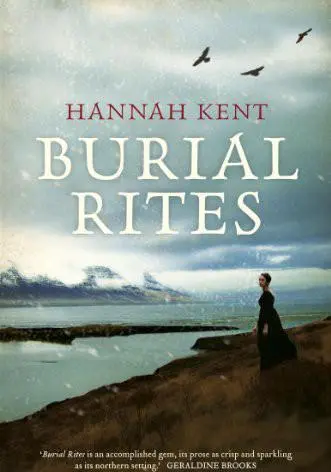
- Название:Burial Rites
- Автор:
- Издательство:Back Bay Books
- Жанр:
- Год:2014
- ISBN:нет данных
- Рейтинг книги:3 / 5. Голосов: 1
-
Избранное:Добавить в избранное
- Отзывы:
-
Ваша оценка:
Burial Rites: краткое содержание, описание и аннотация
Предлагаем к чтению аннотацию, описание, краткое содержание или предисловие (зависит от того, что написал сам автор книги «Burial Rites»). Если вы не нашли необходимую информацию о книге — напишите в комментариях, мы постараемся отыскать её.
Horrified at the prospect of housing a convicted murderer, the family at first avoids Agnes. Only Tóti, a priest Agnes has mysteriously chosen to be her spiritual guardian, seeks to understand her. But as Agnes's death looms, the farmer's wife and their daughters learn there is another side to the sensational story they've heard.
Riveting and rich with lyricism, BURIAL RITES evokes a dramatic existence in a distant time and place, and asks the question, how can one woman hope to endure when her life depends upon the stories told by others?
Burial Rites — читать онлайн бесплатно полную книгу (весь текст) целиком
Ниже представлен текст книги, разбитый по страницам. Система сохранения места последней прочитанной страницы, позволяет с удобством читать онлайн бесплатно книгу «Burial Rites», без необходимости каждый раз заново искать на чём Вы остановились. Поставьте закладку, и сможете в любой момент перейти на страницу, на которой закончили чтение.
Интервал:
Закладка:

IT WON’T BE ANY GOOD for the Reverend to read ministerial books, or any book for that matter — what will he learn of me there? Only the things other men think important about me.
When the Reverend saw my name and birth in the church book, did he see only the writing and understand only the date? Or did he see the fog of that day, and hear the ravens cawing at the smell of blood? Did he imagine it as I have imagined it? My mother, weeping, holding me against the clammy warmth of her skin. Avoiding the looks of the Flaga women she worked for, knowing already that she’d have to leave and try to find work elsewhere. Knowing no farmer would hire a servant woman with a newborn.
If he wants to learn of my family he’ll have a hard time of it. Two fathers and a mother who seem as blurry to me as strangers departing through a snowstorm. I have few clear memories of her. One is the day she left me. Another is when I was young, watching her in the lamplight of a winter night. It’s a silent memory, and one, like the others, I can’t quite trust. Memories shift like loose snow in a wind, or are a chorale of ghosts all talking over one another. There is only ever a sense that what is real to me is not real to others, and to share a memory with someone is to risk sullying my belief in what has truly happened. Is the Reverend the person of my memory, or is he another altogether? Did I do that, or was it another? Magnús or Jón? It’s the glaze of ice over the water, too fragile to trust.
Did my mother look down at her baby daughter and think: ‘One day I will leave you’? Did she look at my scrunched face, hoping I would die, or did she silently urge me to stick to life like a burr? Perhaps she looked out to the valley, into the mist and stillness, and wondered what she could give me. A lie for a father. A head of dark hair. A hayrack to sleep in. A kiss. A stone, so that I might learn to understand the birds and never be lonely.
CHAPTER FIVE
~ ~ ~
Poet-Rósa’s poem to Agnes Magnúsdóttir,
June 1828
Undrast þarftu ei, baugabrú
þó beiskrar kennir þínu:
Hefir burtu hrífsað þú
helft af lífi mínu.
Don’t be surprised by the sorrow in my eyes
nor at the bitter pangs of pain that I feel:
For you have stolen with your scheming
he who gave my life meaning,
and thrown your life to the Devil to deal.
~ ~ ~
Agnes Magnúsdóttir’s reply to Rósa,
June 1828
Er mín klára ósk til þín ,
angurs tárum bundin:
Ýfðu ei sárin sollin mín ,
solar báru hrundin.
Sorg ei minnar sálar herð!
Seka Drottin náðar ,
af því Jésus eitt fyrir verð
okkur keypti báðar.
This is my only wish to you,
bound in anger and grief:
Do not scratch my bleeding wounds,
I’m full of disbelief.
My soul is filled with sorrow!
I seek grace from the Lord.
Remember, Jesus bought us both
and for the same accord.
~ ~ ~
‘HOW IS IT TO HAVE her here, in this same room as you? I should find it difficult to sleep,’ said Ingibjörg Pétursdóttir.
Margrét looked over to where the Kornsá mowers were cutting the grass closest to the river. ‘Oh, I don’t think she’d dare set a foot wrong.’
The two women were resting on the pile of stacked wood outside the Kornsá croft. Ingibjörg, a small, plain-looking woman from a nearby farm, had paid Margrét a visit, having heard that her friend’s cough was preventing her from participating in the haymaking. While Ingibjörg had none of Margrét’s acidity, or her forthrightness, the two women were fast friends, and often visited one other when the river that divided their farms was low enough to be forded.
‘Róslín seems to think you’ll all be strangled in your sleep.’
Margrét gave a brusque laugh. ‘I can’t help but think that’s exactly what Róslín wants.’
‘What do you mean?’
‘It would give that well-oiled mouth something else to wag about.’
‘Margrét…’ Ingibjörg warned.
‘Oh, Inga. We both know having all those children has turned her head.’
‘The littlest has croup.’
Margrét raised her eyebrows. ‘Won’t be long before they all have it, then. We’ll hear them wailing at all hours of the night.’
‘She’s getting big, too.’
Margrét hesitated. ‘Do you plan on helping with the birth? She’s had that many you’d think she could do it herself.’
Ingibjörg sighed. ‘I don’t know. I have a bad feeling.’
Margrét studied her friend’s grave expression. ‘Did you have a dream?’ she asked.
Ingibjörg opened her mouth as if to say something, and then shook herself, changing her mind. ‘I’m sure it’s nothing. Anyway, let’s not be gloomy. Tell me about the murderess!’
Margrét laughed in spite of herself. ‘There! You’re as bad as Róslín.’
Ingibjörg smiled. ‘How is she really, though? In character. Are you frightened of her?’
Margrét thought for a moment. ‘She’s nothing like how I imagined a murderess,’ she said at last. ‘She sleeps, she works, she eats. All in silence, though. Her lips might as well be sewn over for all she says to me. That young man, the Reverend Thorvardur, he’s begun to visit her again over these last few weeks, and I know she talks to him, but he doesn’t tell me what passes between them. Perhaps nothing.’ Margrét glanced over to the field. ‘I often wonder what she’s thinking.’
Ingibjörg followed Margrét’s gaze, and the two women looked together at the bent figure of Agnes amidst the hay, hacking at the grass with her scythe. The blade flashed brightly as she swung it.
‘Who knows?’ Ingibjörg murmured. ‘I shudder to think of what goes on inside that dark head of hers.’
‘The Reverend says her mother was Ingveldur Rafnsdóttir.’
Ingibjörg paused. ‘Ingveldur Rafnsdóttir. I knew an Ingveldur once. A loose woman.’
‘No doves come from ravens’ eggs,’ Margrét agreed. ‘It’s strange to think of Agnes being a daughter. I can’t imagine my girls even thinking about something so wretched and sinful as murder.’
Ingibjörg nodded. ‘And how are your girls?’
Margrét stood and dusted the dirt from her skirt. ‘Oh, you know.’ She started coughing again and Ingibjörg began to rub her back.
‘Easy, now.’
‘I’m fine,’ Margrét croaked. ‘You know, Steina thinks she knows her.’
Ingibjörg gave her friend a curious look.
‘She thinks we met her on the way to Gudrúnarstadir, way back when.’
‘Is Steina making up stories again?’
Margrét winced. ‘Only the good Lord knows. I don’t remember. Actually, I’m a bit worried about her. She smiles at Agnes.’
Ingibjörg laughed. ‘Oh, Margrét! When did a smile ever get anyone into trouble?’
‘Many a time, I should think!’ Margrét snapped. ‘Just look at Róslín. Anyway, it’s other things, too. I’ve caught Steina asking questions of Agnes, and I’ve noticed she rushes to fetch her for errands and the like. Look — she’s following her now, even while she’s raking.’ She pointed to Steina turning the hay near Agnes. ‘I don’t know, I just think of that poor girl Sigga, and I worry the same thing will happen to her.’
‘Sigga? The other maid at Illugastadir?’
Читать дальшеИнтервал:
Закладка:
Похожие книги на «Burial Rites»
Представляем Вашему вниманию похожие книги на «Burial Rites» списком для выбора. Мы отобрали схожую по названию и смыслу литературу в надежде предоставить читателям больше вариантов отыскать новые, интересные, ещё непрочитанные произведения.








Обсуждение, отзывы о книге «Burial Rites» и просто собственные мнения читателей. Оставьте ваши комментарии, напишите, что Вы думаете о произведении, его смысле или главных героях. Укажите что конкретно понравилось, а что нет, и почему Вы так считаете.