Evan Hunter - Streets of Gold
Здесь есть возможность читать онлайн «Evan Hunter - Streets of Gold» весь текст электронной книги совершенно бесплатно (целиком полную версию без сокращений). В некоторых случаях можно слушать аудио, скачать через торрент в формате fb2 и присутствует краткое содержание. Город: New York, Год выпуска: 1975, ISBN: 1975, Издательство: Ballantine Books, Жанр: Современная проза, на английском языке. Описание произведения, (предисловие) а так же отзывы посетителей доступны на портале библиотеки ЛибКат.
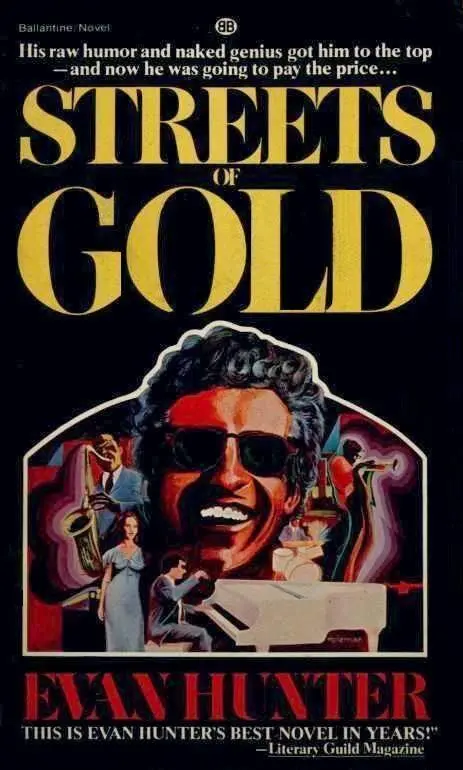
- Название:Streets of Gold
- Автор:
- Издательство:Ballantine Books
- Жанр:
- Год:1975
- Город:New York
- ISBN:978-0-345-24631-8
- Рейтинг книги:4 / 5. Голосов: 1
-
Избранное:Добавить в избранное
- Отзывы:
-
Ваша оценка:
Streets of Gold: краткое содержание, описание и аннотация
Предлагаем к чтению аннотацию, описание, краткое содержание или предисловие (зависит от того, что написал сам автор книги «Streets of Gold»). Если вы не нашли необходимую информацию о книге — напишите в комментариях, мы постараемся отыскать её.
Streets of Gold — читать онлайн бесплатно полную книгу (весь текст) целиком
Ниже представлен текст книги, разбитый по страницам. Система сохранения места последней прочитанной страницы, позволяет с удобством читать онлайн бесплатно книгу «Streets of Gold», без необходимости каждый раз заново искать на чём Вы остановились. Поставьте закладку, и сможете в любой момент перейти на страницу, на которой закончили чтение.
Интервал:
Закладка:
She had a dream, Stella. When she was fifteen, she dreamed that everyone would one day be American — like her. No greenhorns anywhere in the streets of her golden city. Everybody talking English like mad (when they weren’t talking French), everybody going to the movies every Saturday, and riding in Ford cars, and dressing like the people in Vogue, and making wisecracks all the time, and roasting mickies. America the beautiful.
I had a dream for America, too.
It was similar to my mother’s except for one vital difference.
But neither of us ever realized our separate dreams.
In April of 1917, when President Wilson and the Congress declared war against those Huns who were doing all sorts of atrocious things that simply incensed a devout American like Stella, she cheered her brains out and marched up the middle of 116th Street with four hundred other young American teenagers like herself, chanting dire warnings and predictions to Kaiser Bill, who probably didn’t hear her. She was fifteen, going on sixteen. The next few years of her life passed in a near delirium of excitement. Where the war had earlier been a remote fantasy translated from newspaper reports, it now became immediate. Everywhere around her, there was the activity of a nation gearing up to save the world for democracy.
The people running the war didn’t have to try very hard to sell it; anti-German feelings were running high long before the formal declaration of hostilities, and patriotic fervor was almost hysterical. But nonetheless, they did have a product on their hands which was, by definition, lethal. And they decided they had better do something to make the product seem a trifle more palatable. The reasoning must have gone something like this: We are sending a lot of our boys over there to die on foreign soil because we want to make the world safe for democracy, which is an inspiring cause, to be sure, but mightn’t someone (most likely a woman) ask a possibly embarrassing question such as “If my son goes over there to France and gets killed in a trench over there filled with poison gas and German bayonets, why then he will no longer be in this world, and how will it matter that he made it safe for democracy?” Now the way to avoid this question is to develop some sort of sales talk, some sort of pitch, native-born and inspired in concept, which we can shpiel at anyone out there who is likely to ask any questions about what this war is all about.
What we’ll do is we’ll organize bond rallies, so people will concentrate on buying bonds instead of on dying sons, put out these little Liberty Books, you know, where they can stick twenty-five-cent stamps in them, “Lick a Stamp and Lick the Kaiser,” get some of our movie folk out there to push the bonds, maybe Doug Fairbanks wearing boxing gloves lettered with “Victory” on one glove and “Liberty Bonds” on the other, and have him knock out some Kaiser we can get from Central Casting, get them away from the prime question, you see, which is “ Why are you sending our sons to be killed?” And we’ll get old Herbert Hoover here, who’s our Food Administrator, to ask for voluntary sacrifices on the part of all the people, ask them to hold off eating bread or other wheat products on Mondays and Wednesdays, and pork on Thursdays and Saturdays, and any other kind of meat on Tuesdays — did we leave a day out? Idea is to get them thinking about their own sacrifices, you see, maybe even grumbling about them a bit, so they won’t be able to think of their sons getting legs blown off or being sliced up the middle by some German bayonet. Get them involved here , you see, do you get the overall idea?
Stella had no trouble getting the overall idea because, in her case, it had something going for it that did not apply to the vast majority of Americans. Since most of the men immediately surrounding her — her father, her brothers, her uncles, cousins, and goombahs — were either too young or too old or not even American citizens, they were not required to go to Europe to have their brains blown out. They were safe. So what better way to enjoy a war? Not only did Stella have all those socks and sweaters to knit, not only did she have the thrill of seeing her favorite movie stars right there in New York City pushing the sale of war bonds, not only did she herself proudly collect eight hundred and thirty-seven peach pits which she weighed on the grocer’s scale downstairs (having been informed that it took seven pounds of pits to make a filter for one gas mask), she also was secure in the knowledge that nobody near and dear to her was going to be killed. War was fun.
The only person near and dear to her (though he wasn’t near, and, certainly not dear to her in the years between 1917 and 1919) who might have been killed was a stranger named Jimmy Di Palermo, my father-to-be. While Stella was collecting her peach pits for a filter, my father was throwing away his mask because the fucking thing didn’t work, anyway — not against mustard gas.
Giacomo Roberto Di Palermo was born on East 103rd Street in the year 1898. When America entered the war, he was nineteen years old. In June of 1917, he walked over to P.S. 121 and registered for the draft. By August of the following year, he was getting shot at in France.
My father rarely talked about the war. Even when I was a kid, and he took my brother and me to pictures like Dawn Patrol and What Price Glory? , even then, walking home to our apartment on 120th Street, he refused to answer any of our questions about the war. “What was it really like, Daddy?” we would ask. And he would say, “Oh, it was okay.”
Maybe it was okay. Maybe he’d lived through worse things than World War I.
In 1965, when one of my last record albums was being prepared for release, I was asked by the man compiling the liner notes to write something about the background of my parents, the idea being to show how they had influenced the music I make. (I think he had heard someplace that my father used to play drums.) I asked my father to jot down a few details, which I planned to edit before sending them on. This is what he wrote, on lined paper:
Dear Ike:
Here’s my autobiography in part.
I came from Harlem in a prominent Italian section. My parents were Italian born. I was born on the East Side around the 100’s. I left school in the 4th grade because my father passed away and I went out to work to help my mother and the rest of our brood, consisting of two sisters and two brothers. I started as an errand boy of a delicatessen. From there I worked on the New York City Transit (trolley lines) in the repair shop. From there I worked in a laundry running all the machines. Then I worked in a florist, and really learned this trade. While here I suddenly was plummeted in the machine-and-beading line. My mother went into a partnership with a man who graduated Cooper Union in Art. He was the designer. My services and my younger brother’s were free because my mother went into this business without a penny. So our pay was put into the business until the amount was made up. I learned designing from this man and did very well.
Later my mother split up the business and we went on our own. I took care of the designing and drummed up the business. My mother took care of the girls inside of the store, also the home workers. While working here, I was compelled to take over a set of drums from one of our buddies on our block, so I may finish the payments. That’s how I became a musician. I formed a five-piece orchestra known as “Jimmy Palmer and the Phantom Five.” We did very well and got lots of work. Weddings, socials, baptisms, block parties, at most of the ballrooms in and around New York. I was still in the business of embroidery and crochet beading. At one of these functions, I met my wife Stella (it was at her sister’s engagement party). After a short engagement, we were married in 1923. A year later, our first son, Anthony, was born. I took a summer engagement in Keansburg, N.J., at the palais de dance. That’s where I formed a Dixieland band known as the “Original Louisiana Five.”
Читать дальшеИнтервал:
Закладка:
Похожие книги на «Streets of Gold»
Представляем Вашему вниманию похожие книги на «Streets of Gold» списком для выбора. Мы отобрали схожую по названию и смыслу литературу в надежде предоставить читателям больше вариантов отыскать новые, интересные, ещё непрочитанные произведения.
Обсуждение, отзывы о книге «Streets of Gold» и просто собственные мнения читателей. Оставьте ваши комментарии, напишите, что Вы думаете о произведении, его смысле или главных героях. Укажите что конкретно понравилось, а что нет, и почему Вы так считаете.