Evan Hunter - Streets of Gold
Здесь есть возможность читать онлайн «Evan Hunter - Streets of Gold» весь текст электронной книги совершенно бесплатно (целиком полную версию без сокращений). В некоторых случаях можно слушать аудио, скачать через торрент в формате fb2 и присутствует краткое содержание. Город: New York, Год выпуска: 1975, ISBN: 1975, Издательство: Ballantine Books, Жанр: Современная проза, на английском языке. Описание произведения, (предисловие) а так же отзывы посетителей доступны на портале библиотеки ЛибКат.
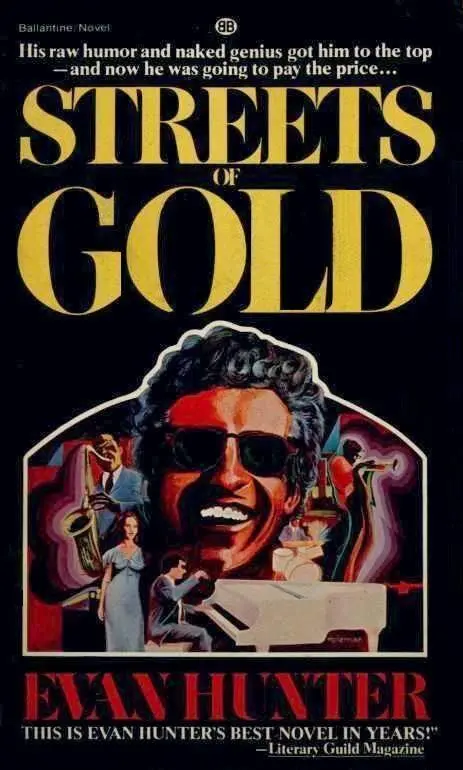
- Название:Streets of Gold
- Автор:
- Издательство:Ballantine Books
- Жанр:
- Год:1975
- Город:New York
- ISBN:978-0-345-24631-8
- Рейтинг книги:4 / 5. Голосов: 1
-
Избранное:Добавить в избранное
- Отзывы:
-
Ваша оценка:
Streets of Gold: краткое содержание, описание и аннотация
Предлагаем к чтению аннотацию, описание, краткое содержание или предисловие (зависит от того, что написал сам автор книги «Streets of Gold»). Если вы не нашли необходимую информацию о книге — напишите в комментариях, мы постараемся отыскать её.
Streets of Gold — читать онлайн бесплатно полную книгу (весь текст) целиком
Ниже представлен текст книги, разбитый по страницам. Система сохранения места последней прочитанной страницы, позволяет с удобством читать онлайн бесплатно книгу «Streets of Gold», без необходимости каждый раз заново искать на чём Вы остановились. Поставьте закладку, и сможете в любой момент перейти на страницу, на которой закончили чтение.
Интервал:
Закладка:
“Bull Run Number One, the Confederacy won.
“Bull Run Number Two, the Confederacy won, too.”
She quoted these to me when I was six years old and in the first grade. Nothing much had changed in New York City’s schools — I was being taught music appreciation the same way she’d been taught history. Until then, I had done most of my music appreciating in my grandfather’s house, listening to my uncle bang away at the piano, pecking out one-finger melodies, searching for chords (invariably cacophonous) with his left hand, playing all the popular songs of the day, stuff like “Love Letters in the Sand” and “Out of Nowhere” and “Sweet and Lovely” (his choices now seem significant), all great old tunes which I myself still play. But they weren’t teaching pop shlock when I was in elementary school, oh, no. For us little blind bastards, music appreciation was divided into twice-weekly sessions, one of them vocal, the other auditory, and both concentrating on stuff a little more profound than “Potatoes Are Cheaper.” In the vocal hour, we were separated into Bluebirds and Blackbirds (not an ethnic breakdown since there were no blacks at my school) and we sang things like “The Lord High Executioner” from The Mikado or “By the Bend of the River” in four-part harmony. I was a Blackbird, and I hated the singing sessions. But I did enjoy listening to the records played on the wind-up phonograph in our school auditorium, and I guess I also enjoyed the “lyrics” Miss Alice Goodbody (that was her name; apt or not, I shall never know) wrote for the various compositions in an attempt to drill them into our heads. I’m not sure which philosophy of education was operating; I’m positive it wasn’t John Dewey’s. The following examples won’t make much sense unless you know the melodies. If you don’t know the melodies, then there is something to be said for the way I was taught them (and maybe for the way my mother was taught about the Civil War). Maestro?
Narcissus was
A very good-looking boy.
His image in the brook
Would fi-ill him up with joy.
He looked,
And looked,
And looked,
And looked,
Until he turned
In-to a love-ly
Flower.
Or...
Dawn
Over mountain and
Dawn
Over valley and
Dawn
While the shepherd is play-
ay-ay-ing his flute.
Or...
Morning from “Peer Gynt”
By Grieg the composer—
Oh, morning has come
And it’s time to get up.
Or...
Am-a-ryl-lis,
Written by Ghys,
Used to sell oranges,
Fi-ive cents apiece.
One of my mother’s favorites, which I’m sure she never was taught in school, and which I’m equally sure must have set my grandfather’s teeth on edge each time she recited it, had no musical accompaniment; it was sheer soaring poetry:
Julius Caesar,
The Roman Greaser,
Tripped and fell
On an orange squeezer.
Understand, please, that Stella was simultaneously learning two seemingly contradictory things about America. In school, where all the pupils were the sons and daughters of immigrants (a fact appreciated and exploited by her teachers), she was being taught that America was a nation with a proud history of its own, nonetheless willing to welcome to its shores foreigners from many different lands (witness your own greenhorn parents, little darlings) who would eventually be absorbed into the mainstream, enriching the country and being enriched by it in turn. That’s not a bad concept. That is, in fact, a damn fine concept. At the same time, in the ghetto, Stella was learning that the melting pot had hardly yet begun to boil. Charlie Shoe (who’d hastily moved to San Francisco) was a Chink. So was the man who’d taken over his laundry. They were both Chinks. In school, Stella could be told from dawn till sundown that Charlie was an American, or at least in the process of becoming an American, but you couldn’t convince her that the man who’d reached under her dress was anything but a Chink. Nor did her terminology (and the stereotyped ideas shaped by it) have anything to do with her supposedly traumatic experience. The people who lived west of Lexington Avenue were “niggers” and a mysterious menace, and her feelings about them had nothing to do with the sanctity of her bloomers. (Or maybe so, come to think of it.) The bearded man who came around once a week taking orders for dry goods was “the Jew.” Stella called him this to his face. He would knock on the door, and she would open it and yell, “Mama, it’s the Jew.” I don’t think she ever knew his name. He was simply the Jew. The German family on the fourth floor were i tedeschi, the Germans. Her father (she knew this, she probably taunted him deliberately with the derogatory reference in her epic poem on the noblest Roman) was a wop, a dago, a greaser, a greaseball and a spaghetti bender — but he was not an American.
In Stella’s mind, though (and this is what’s amazing), there was no conflict between what she learned in school and what she learned in the ghetto. For her it was extremely simple. The ideal was for everybody to be American. To be American was to be good, noble, pure, proud, brave, and capable of saying things like “Damn the torpedos, full speed ahead!” To be American meant studying French in junior high school. To be American meant lighting giant bonfires in the street on Election Day or roasting mickies in the empty lot on First Avenue and 121st Street. To be American meant being thrilled on the Fourth of July (tingling even down there ) when you heard the band in Jefferson Park playing John Philip Sousa. To be American meant having a handsome suntanned uncle who was a gambler in Arizona and who spoke English with a drawl, and who did actually take you for a ride in his flivver when he came to visit at Christmastime in the year 1915. Unless you were all these things, and did all these things, and felt all these things, and understood all these things, you weren’t American. What you had to do then was try very hard to get into this magic red-white-and-blue club, presided over by young Stella herself, who decided, unilaterally, on the entrance requirements.
Speaking English was, of course, the first and foremost of the initiation tests. Anybody who did not speak English as purely as Stella was automatically disqualified, maybe for life. (My mother still says “He don’t want any,” and pronounces “boil” as “berl,” but she never says “ain’t,” which simply ain’t American, by her standards.) But young Stella also took into account a person’s appearance, whether or not one dressed according to the fashion dictates of the magazines Tess still slavishly subscribed to, or looked instead like somebody “fresh off the boat.” If English was spoken well enough to please her, if clothes passed muster, she watched for other things — not for nothing was she the high priestess. Did a person, for example, know who had starred in Judith of Bethulia and who had directed the film? Did the aspiring American know the lyrics to “Take Me to the Midnight Cake Walk Ball”? How many Ford jokes were in his repertoire? Did he know all the current comic-strip favorites, was he capable of differentiating between the work of Clare Briggs, for example, and Tad Dorgan? Was Hans the blond one in The Captain and the Kids ? Or was it Fritz? Could the applicant speak French? (Her own French was limited to what she’d learned in one year at junior high school before the program was dropped as premature for children at that level. She learned quite useful sentences like “ Vite, vite, nous manquerons le match de football!” ) Oddly, if someone could speak fluent Italian or German or Yiddish, this didn’t make him an American. Only speaking French as well as she did ( Je suis américaine, n’oubliez pas ) qualified the petitioner for entrance.
Читать дальшеИнтервал:
Закладка:
Похожие книги на «Streets of Gold»
Представляем Вашему вниманию похожие книги на «Streets of Gold» списком для выбора. Мы отобрали схожую по названию и смыслу литературу в надежде предоставить читателям больше вариантов отыскать новые, интересные, ещё непрочитанные произведения.


Обсуждение, отзывы о книге «Streets of Gold» и просто собственные мнения читателей. Оставьте ваши комментарии, напишите, что Вы думаете о произведении, его смысле или главных героях. Укажите что конкретно понравилось, а что нет, и почему Вы так считаете.